

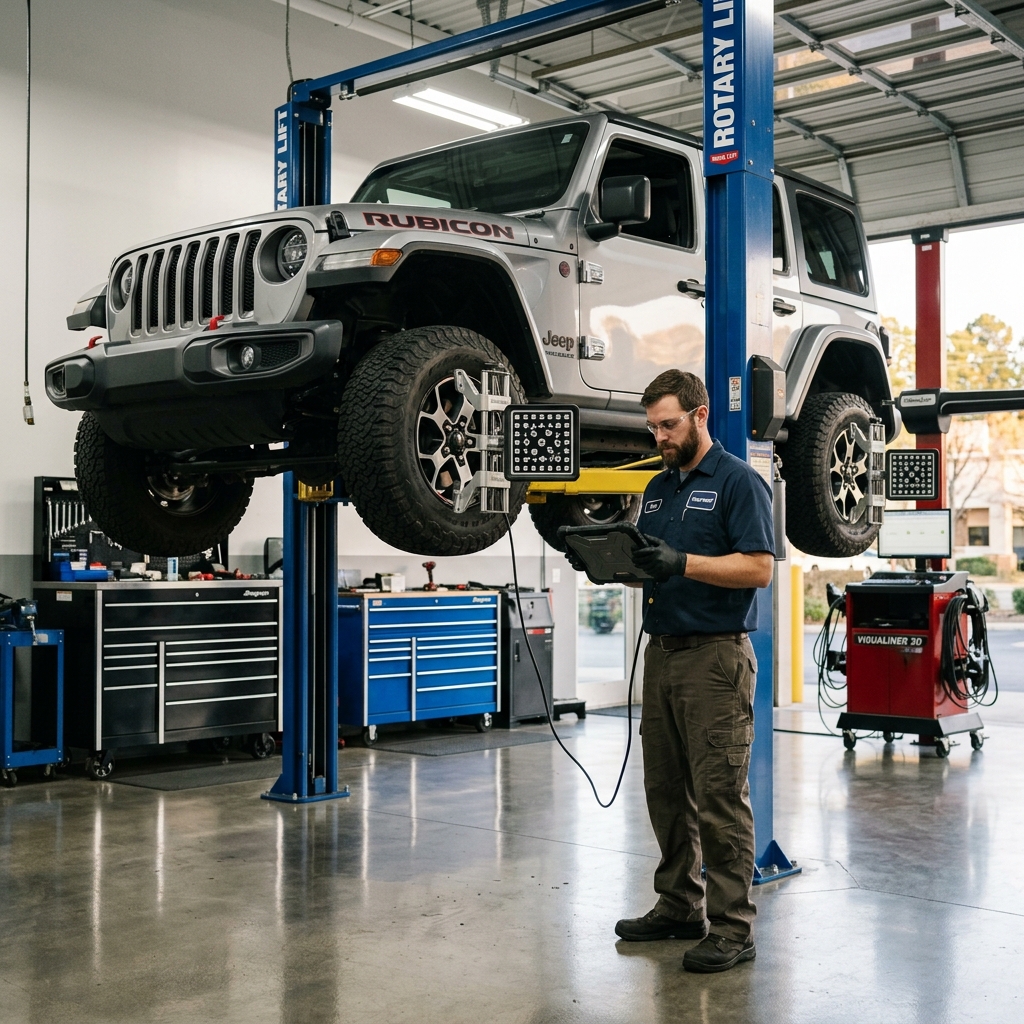
Professional auto repair is better than DIY repair for modern vehicles because certified service departments possess factory diagnostic computers, brand-specific special tools, and technical service bulletins that eliminate diagnostic guesswork. While basic maintenance like replacing wiper blades or cabin air filters is manageable at home, professional technicians complete complex mechanical, electrical, and safety repairs significantly faster and protect vehicle warranties with factory-backed parts.
Modern automobiles integrate dozens of electronic control units, interconnected sensor arrays, and computerized safety systems. Years ago, an experienced owner could tune a carburetor or replace a belt with a basic set of wrenches. Today, even routine component replacements frequently require computer relearn procedures, software calibrations, or precise torque angle measurements. A professional workshop operates with the technical infrastructure required to interface directly with these network systems.
When an unexpected warning light or mechanical symptom occurs, attempting a home fix without dedicated equipment often leads to replacing functional components while the root cause remains unaddressed. Consumer Reports notes that factory-trained dealership technicians specialize in specific vehicle brands, granting them deep platform knowledge and direct access to manufacturer engineering data. This technical backing ensures that repairs meet original factory specifications, preserving vehicle safety systems and long-term resale value.
Drivers navigating the unpaved rural routes around Onsted often encounter suspension wear and alignment drift that basic home garage tools cannot measure accurately. Attempting to realign steering linkages or replace struts without a multi-camera alignment bench can result in rapid tire scrub and compromised electronic stability control calibration. Entrusting your vehicle to trained professionals ensures that complex mechanical assemblies are diagnosed, installed, and calibrated using authorized procedures.
For drivers who value reliable performance and total safety, our team at 1111 W Michigan Ave, Clinton, MI 49236 is ready to assist. You can reach out to our service advisors by giving us a quick call at (517) 456-6555 or finding our location on Michigan Avenue to discuss your vehicle's maintenance needs.
Table of Contents
- How Do Repair Turn-Around Times Compare Between DIY and Professional Shops?
- What Advanced Diagnostic Tools and Equipment Do Professional Mechanics Use That DIYers Lack?
- Which Complex Vehicle Problems and Systems Require Professional Expertise?
- How Can a Bad DIY Repair End Up Costing More Money Over Time?
- What Safety Risks and Equipment Hazards Exist in DIY Vehicle Repair?
- Why Should You Have Your Vehicle Repaired at NewGen?
- Frequently Asked Questions About DIY vs. Professional Vehicle Service
- Schedule Professional Service at NewGen Chrysler Dodge Jeep Ram of Clinton
How Do Repair Turn-Around Times Compare Between DIY and Professional Shops?
Professional repair shops complete major mechanical and electrical services in hours or days due to dedicated lift bays, pneumatic power tools, and direct parts delivery channels, whereas DIY repairs frequently stretch across weeks due to diagnostic delays and component delivery wait times.
A project that takes a professional technician two hours in a fully equipped service bay can easily consume an entire weekend for a home mechanic working on jack stands. Professional facilities feature hydraulic vehicle lifts that raise cars to ergonomic working heights in seconds, providing clear access to underbody components. In contrast, working on your back on a concrete floor with limited clearance slows every movement, increases physical fatigue, and makes removing stubborn fasteners or heavy assemblies like drive shafts and exhaust pipes far more difficult.
Parts availability creates another major discrepancy in turn-around time. Service departments maintain extensive on-site inventories of high-turnover OEM items and enjoy priority delivery from regional distribution hubs. If a technician discovers a worn seal or damaged bracket mid-repair, a replacement part can often be delivered within hours. A DIYer facing the same discovery must pause work, clean up, and wait days for an online delivery or search local parts stores for an equivalent item.
Diagnostic efficiency also directly drives repair speed. A master technician drawing on years of platform experience and guided by brand-specific diagnostic trees can isolate a fault in thirty minutes. A home repairer relying on internet forum advice and trial-and-error component swapping may spend days ordering and installing parts before finding the true issue. You can easily schedule Mopar service online to let certified professionals manage your repair timeline efficiently.
| Efficiency Factor | Home Garage DIY Repair | Professional Dealership Service Bay |
|---|---|---|
| Vehicle Elevation | Manual hydraulic floor jack and static jack stands | Two-post or four-post 12,000-lb hydraulic lifts |
| Tool Access | Basic hand wrenches and consumer socket sets | Pneumatic impact equipment, torque multipliers, and specialized pullers |
| Component Sourcing | Retail auto stores or multi-day online shipping | On-site OEM inventory and local distribution networks |
| Diagnostic Process | Manual trial-and-error or basic OBD-II code reading | Bi-directional factory scan tools and Guided Diagnostics |
| Typical Brake Service Time | 4 to 8 hours across a weekend | 1 to 2 hours including rotor machining and bleed procedures |
What Advanced Diagnostic Tools and Equipment Do Professional Mechanics Use That DIYers Lack?
Professional service facilities utilize bi-directional factory scan tools, multi-channel digital storage oscilloscopes, smoke leak detectors, and high-voltage isolation equipment that far exceed the capabilities of consumer OBD-II code readers.
While a hand-held scanner purchased at an auto store can read basic generic OBD-II powertrain codes, it cannot interact with internal module logic or command component tests. Professional diagnostic platforms costing thousands of dollars allow technicians to execute active bi-directional commands. This means a technician can manually signal a fuel injector to pulse, activate an ABS pump, or cycle an variable valve timing solenoid directly from the scanner to verify operational integrity in real time.
Modern vehicle electrical networks rely on high-speed CAN bus communication networks to transfer data between modules. When a micro-voltage fluctuation or intermittent signal drop occurs, standard code readers show nothing because no permanent fault code has set. Professional technicians attach a multi-channel digital storage oscilloscope to tap directly into wiring harnesses, capturing voltage waveforms over time to pinpoint fraying wires, corroded grounds, or failing sensors before complete component breakdown.
Engine and evaporative emission diagnostics also demand specialized physical equipment. Finding a microscopic vacuum leak or hairline crack in an intake manifold via manual inspection is nearly impossible. Professional shops use chemical smoke machines that pressurize air systems with dense, visible smoke, immediately exposing hidden leaks around gaskets and hoses. Furthermore, computerized four-wheel alignment racks use high-resolution optical cameras to measure suspension angles to hundredths of a degree, ensuring that lane-keep assist systems and adaptive cruise control sensors align perfectly with steering geometry.
Which Complex Vehicle Problems and Systems Require Professional Expertise?
Complex vehicle problems involving multi-module electrical architecture, automatic transmission valve bodies, advanced driver-assist camera calibration, and internal engine timing assemblies require certified professional repair.
Modern driver-assist suites—including automatic emergency braking, blind-spot monitoring, and lane-centering tech—rely on radar units behind front grilles and optical cameras behind windshields. If a bumper is removed for repair or a windshield is replaced, these sensors must undergo a static and dynamic recalibration process using specialized aiming targets and electronic computer alignment. Performing this work at home without specialized calibration targets leaves safety systems blind or misaligned, potentially causing unexpected braking or false collision warnings.
Internal engine and transmission service represents another area where precision tolerances leave zero margin for error. Modern engines feature complex variable valve timing actuators, high-pressure direct fuel injection systems, and tight interference tolerances between valves and pistons. Replacing a timing chain requires holding camshafts and crankshafts in absolute synchronization with specialized locking fixtures. A timing alignment error of a single gear tooth can bend valves, ruin cylinder heads, and destroy an engine upon start-up.
Automatic transmissions and transfer cases contain intricate hydraulic valve bodies, planetary gearsets, and electronic solenoids operating under high hydraulic pressures. Diagnosing internal pressure losses or erratic gear shifts demands factory diagnostic software capable of monitoring fluid pressure sensors and clutch slip ratios simultaneously. When severe mechanical damage makes component overhaul impractical, vehicle owners sometimes decide to custom order a new vehicle directly built to their preferences rather than investing in extensive rebuilding.
How Can a Bad DIY Repair End Up Costing More Money Over Time?
An improper DIY repair increases long-term vehicle ownership costs by damaging adjacent mechanical components, causing repeat part failures due to missed root causes, and voiding warranty coverage through non-compliant procedures.
Misdiagnosis is the primary driver of compounding DIY repair expenses. When a driver assumes a engine misfire code indicates a faulty spark plug and replaces it without testing, they may overlook an underlying fuel injector leak or vacuum leak. Unburned fuel washing down cylinder walls destroys catalytic converters, converting a small sensor or gasket fix into a major exhaust system replacement. A professional diagnostic process verifies system root causes to prevent domino-effect damage.
Fastener torque and installation technique also dictate component longevity. Aluminum engine blocks, plastic intake manifolds, and lightweight suspension arms require exact torque specs measured in inch-pounds or foot-pounds, often followed by specific angle-yield turns. Overtightening a bolt can strip delicate aluminum threads or crack composite housings, leading to fluid leaks that require costly thread inserts or complete housing replacements. Conversely, under-tightening suspension fasteners can cause bolts to back out during highway driving, damaging control arm bushings and subframes.
Fluid selection represents another hidden financial trap for home mechanics. Modern automatic transmissions, transfer cases, and power steering systems require precise fluid chemistry. Installing a generic multi-vehicle fluid instead of specified fluids can degrade internal friction linings, dissolve synthetic seals, and cause total transmission slip within months. Using genuine Mopar parts and fluids engineered specifically for your vehicle ensures fluid compatibility and long-term mechanical protection.
Commuters travelling daily from Michigan Center along agricultural corridors risk severe driveline damage when fluid specifications or differential service intervals are overlooked during DIY attempts. Protecting your vehicle's drivetrain with manufacturer-approved service routines preserves performance across thousands of commuting miles.
What Safety Risks and Equipment Hazards Exist in DIY Vehicle Repair?
Home vehicle repairs carry severe safety hazards, including jack stand collapses, high-pressure fuel or hydraulic fluid injections, hot coolant burns, and high-voltage electrical shocks from hybrid battery systems.
Working beneath a vehicle elevated by an unstable hydraulic jack presents immediate life-threatening risk. Hydraulic jacks are designed solely to lift vehicles, not to support them statically. If a jack seal fails or a jack stand is placed on an unapproved frame point, thousands of pounds of steel can drop instantly. Professional service bays employ heavy-duty lift locks that mechanically engage solid steel pins, securing the vehicle completely before any technician steps underneath.
Pressurized systems within modern vehicles also present severe injury risks. Direct injection fuel systems maintain fuel rail pressures over 2,000 psi, which is powerful enough to drive liquid fuel straight through human skin and cause severe tissue necrosis. Air conditioning systems carry high-pressure refrigerant under continuous pressure, while hot cooling systems retain boiling fluid under 15 psi. Opening a cooling cap or loosening a pressurized fitting without proper pressure-relief procedures can cause severe chemical and thermal burns.
Modern hybrid and electric powertrains introduce dangerous electrical hazards. These vehicles operate on high-voltage direct-current battery packs ranging from 400 volts to 800 volts. Touching a high-voltage orange cable without high-voltage rated protective gloves, an insulated safety hook, and verified de-energization equipment can cause fatal electrical shock. If an older vehicle's electrical or structural safety is compromised beyond sensible repair, drivers can browse our pre-owned vehicle inventory to transition into a safe, reliable replacement vehicle.
Why Should You Have Your Vehicle Repaired at NewGen?
Choosing service at NewGen Chrysler Dodge Jeep Ram of Clinton ensures your Chrysler, Dodge, Jeep, or Ram vehicle receives factory-trained technician care, specialized OEM diagnostics, genuine Mopar parts, and full warranty protection.
Our dealership's technicians undergo rigorous, ongoing brand certification training directly from the manufacturer. They possess specialized knowledge regarding the specific mechanical tolerances, wiring diagrams, and software updates for your vehicle platform. Whether maintaining a high-performance Dodge Charger, servicing a heavy-duty Ram 1500 with impressive towing capacity, or prepping a Jeep Wrangler for off-road trails, our team applies exact factory procedures to every job.
We invest continuously in brand-specific diagnostic computers, specialized pullers, and alignment tools engineered specifically for our lineup. When your vehicle receives service in our facility, we check for open safety recalls, service campaigns, and software updates automatically, completing them seamlessly during your visit. This level of brand-dedicated care preserves your 5-year/60,000-mile powertrain warranty and maintains a centralized, verified digital service history that strengthens your vehicle's future trade-in value.
At NewGen Chrysler Dodge Jeep Ram of Clinton, we value your time and peace of mind. Our certified technicians use genuine parts to keep your vehicle running strong, with transparent pricing and convenient scheduling tailored to your busy life. You can view our new vehicle inventory if you are considering an update, give our team a call at (517) 456-6555, or get simple directions to our showroom to visit our team in person.
Frequently Asked Questions About DIY vs. Professional Vehicle Service
Q: Will servicing my vehicle at home void the manufacturer warranty?
Performing routine maintenance at home does not automatically void your factory warranty under federal law. However, if a failure occurs and the manufacturer determines it was caused by improper installation, incorrect fluid specifications, or skipped service intervals, the specific warranty claim will be denied. Keeping meticulous records, dated receipts, and original parts invoices is required to prove proper maintenance compliance if a dispute arises.
Q: Can a standard auto parts store scan tool identify all diagnostic trouble codes?
Consumer-grade scan tools generally retrieve only basic powertrain codes related to emissions. They cannot access proprietary manufacturer codes stored in body control modules, antilock braking systems, airbag control units, or transmission controllers. Professional diagnostic equipment communicates directly with all internal vehicle networks to read manufacturer-specific fault codes and live sensor data streams.
Q: What routine maintenance tasks are safe to perform in a home garage?
Low-risk maintenance tasks that require minimal specialized tools include replacing engine air filters, changing cabin air filters, installing new windshield wiper blades, and checking tire cold inflation pressure. Tasks involving high fluid pressures, vehicle elevation, safety sensor calibration, or high-voltage electrical components should always be left to certified professional technicians.
Q: How do certified technicians verify that a repair has permanently solved an issue?
Professional technicians verify repairs through multi-step validation processes. After completing a mechanical fix, they use diagnostic scan tools to clear historical fault codes, execute automated system self-tests, and perform targeted test drives while recording live sensor data streams. This ensures the underlying system parameters remain well within factory tolerances under actual driving conditions.
Q: What documentation should I keep if basic maintenance is performed outside the dealer network?
You should maintain a dedicated binder or digital folder containing itemized parts receipts showing exact part numbers, fluid specification sheets, exact vehicle mileage, and the date each service was performed. Having complete, verifiable records protects your warranty rights and provides future buyers with proof of proper maintenance, which helps maintain high resale value.
Schedule Professional Service at NewGen Chrysler Dodge Jeep Ram of Clinton
Protecting your vehicle's safety, performance, and long-term durability requires certified expertise and specialized equipment. Leaving complex repairs, diagnostic troubleshooting, and precision mechanical calibrations to trained technicians saves time, prevents costly compounding mistakes, and maintains your manufacturer warranty coverage intact.
Whether your truck needs routine maintenance or complex diagnostic attention, our team provides trusted, transparent service tailored to your schedule. Reach out to our dedicated service team today to book your next appointment and keep your vehicle operating at peak condition.
© 2026 NewGen Chrysler Dodge Jeep Ram of Clinton. All rights reserved.