
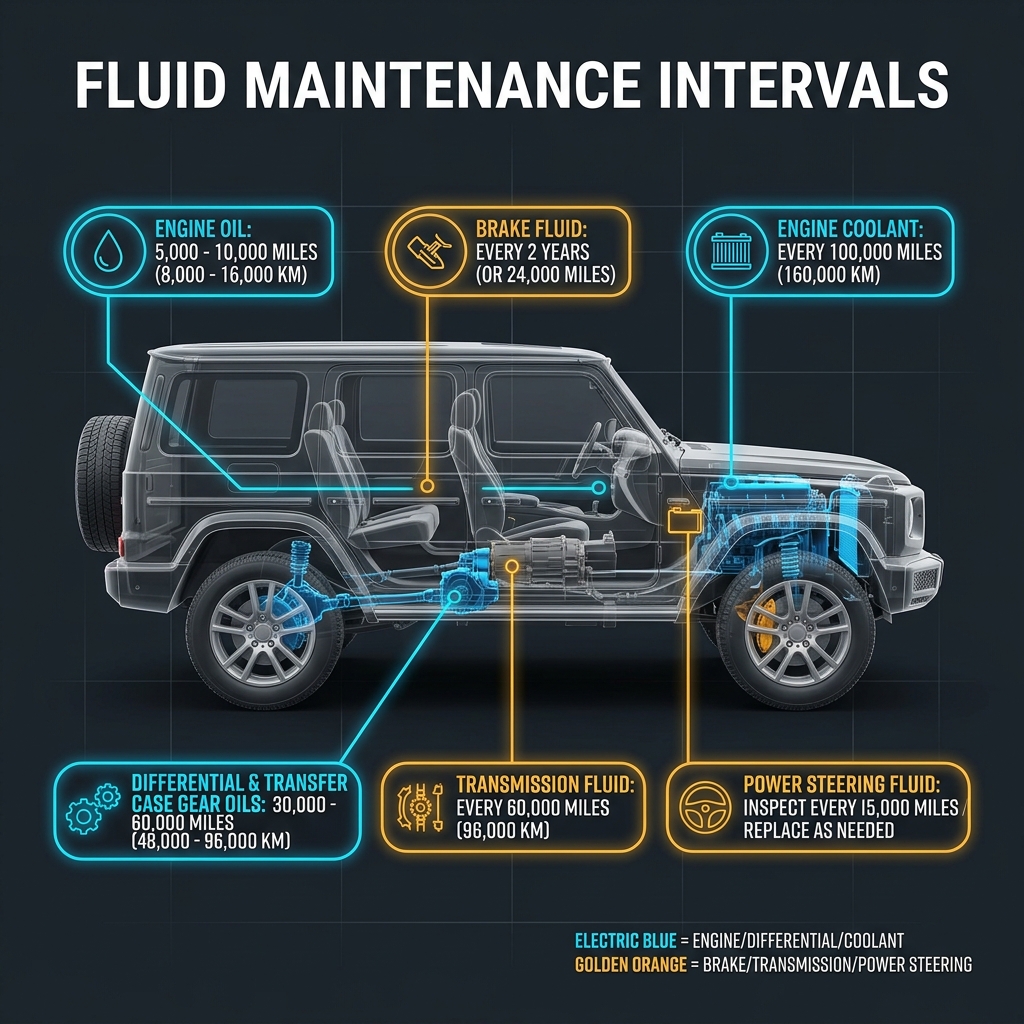
A 2026 Jeep requires engine oil and filter changes every 5,000 to 10,000 miles (never exceeding 12 months), brake fluid flushes every 2 years, differential and transfer case fluid services every 30,000 to 60,000 miles, automatic transmission fluid replacements every 60,000 miles, and long-life coolant changes starting around 100,000 miles or 10 years.
Following this factory-backed calendar ensures vital driveline components remain lubricated and protected against Michigan's harsh seasonal shifts. Modern Jeep models feature intelligent cluster monitors that alert drivers when engine oil deteriorates, but complete fluid upkeep depends on tracking mileage and age across six major systems: engine oil, transmission fluid, transfer case gear oil, front and rear differential fluid, hydraulic brake fluid, and engine coolant.
Driving conditions directly alter these maintenance windows. Severe duty—such as frequent towing, sustained trail riding, deep water crossings, or repeated short winter commutes—accelerates thermal breakdown and fluid contamination. Under heavy workload, driveline intervals shift closer to the 30,000-mile mark to prevent premature component wear.
For personalized maintenance guidance or to inspect your vehicle's current fluid health, stop by our service department at 1111 W Michigan Ave, Clinton, MI 49236 or give our team a quick call to consult with a factory-trained technician.
Table of Contents
- How often should I change the engine oil and filter in a Jeep Wrangler?
- When do I need to change transmission fluid and coolant in my Jeep?
- How frequently should I change differential and axle fluids on a Jeep?
- What fluids need regular service on a Jeep Grand Cherokee?
- Frequently Asked Questions About Jeep Fluid Care
- Schedule Certified Jeep Fluid Service
How often should I change the engine oil and filter in a Jeep Wrangler?
The engine oil and filter in a 2026 Jeep Wrangler should be changed every 5,000 to 7,000 miles for optimal long-term durability, guided by the built-in Oil Change Indicator system, and must never exceed 10,000 miles or 12 months between services.
Jeep equips modern models with an automated Oil Change Indicator that calculates oil degradation based on engine operating temperatures, engine hours, idle time, and load. While the system permits up to 10,000 miles under ideal highway cruising, local driving habits in southern Michigan often merit a tighter schedule. Cold winter starts, short trips where the engine fails to reach full operating temperature, and dusty off-road excursions break down oil viscosity much faster.
Engine architecture determines the specific oil grade required. The 3.6L Pentastar V6 engine requires SAE 0W-20 full synthetic oil, whereas the 2.0L Turbo inline-four engine specifies SAE 5W-30 full synthetic oil meeting FCA Material Standard MS-6395 and API SP / ILSAC GF-6A ratings. Synthetic formulation protects tight internal engine tolerances, reduces carbon buildup on turbocharger bearings, and ensures rapid oil pressure delivery during freezing morning starts. Drivers who bring their Wrangler in for a routine checkup often ask whether synthetic oil is mandatory; we always point to the factory standard, showing them how full synthetic formulation protects turbocharger bearings during severe Michigan winter driving.
When servicing your powertrain, always pair fresh full synthetic oil with an OEM oil filter engineered to handle high bypass pressures. Skipping filter replacements leaves trapped sludge and metal particles in circulation, undermining fresh lubrication. You can easily schedule Mopar maintenance online to keep your engine running smoothly, or order genuine Mopar filters and synthetic oil directly through our parts department.
When do I need to change transmission fluid and coolant in my Jeep?
Automatic transmission fluid in a 2026 Jeep should be replaced every 60,000 miles under normal use—or 30,000 to 50,000 miles during heavy towing or extreme off-roading—while factory Mopar OAT coolant requires its first service at 100,000 miles or 10 years, followed by 50,000-mile intervals.
Modern Jeep 4x4 vehicles rely on smooth-shifting transmissions, such as the TorqueFlite® 8-speed automatic transmission, to deliver precise power to the wheels. Although some factory literature references "filled-for-life" transmission fluid, gear oil undergoes severe thermal stress over time. Heat degrades friction modifiers, causing rough shifting, hesitations, and clutch plate slippage. Servicing transmission fluid and replacing the fluid pan filter at 60,000 miles removes suspended clutch material and protects sensitive valve bodies from premature failure.
Cooling system care is equally critical for thermal regulation. Modern Jeeps utilize specialized Organic Additive Technology ( OAT) coolant, distinguished by its purple hue. Mixing conventional ethylene glycol or Hybrid Organic Additive Technology ( HOAT) antifreeze with OAT coolant causes a chemical reaction that creates gel-like deposits, clogging heat exchangers and radiator cores.
Commuters heading into Jackson from Michigan Center often subject their vehicles to stop-and-go highway traffic and freezing winter slush, accelerating thermal cycling. A cooling system flush restores corrosion inhibitors that protect aluminum engine blocks, cylinder heads, and heater cores from internal pitting and freeze damage.
How frequently should I change differential and axle fluids on a Jeep?
Front and rear differential and transfer case fluids should be replaced every 30,000 to 60,000 miles during normal driving, but require service every 15,000 to 30,000 miles if you frequently tow, haul heavy loads, or engage in off-road trail driving and water crossings.
Jeep 4x4 drivelines utilize heavy-duty front and rear gear axles alongside a transfer case to distribute torque between axles. Hypoid gear sets inside axle differentials operate under extreme pressure, generating high friction that shears down gear lube over time. Fresh gear oil absorbs this mechanical heat while cushioning ring-and-pinion gear teeth.
Off-road enthusiasm and towing duty severely compress maintenance schedules. When pulling trail rigs or launching fishing boats at local spots near Onsted, rear axles operate under continuous heavy load. Furthermore, driving through water deeper than the axle hubs can draw moisture past axle seals and breather tubes into the housing. Contaminated gear oil turns into a milky emulsion that rapidly destroys pinion bearings and ring gears.
Skipping differential fluid changes allows microscopic metallic shavings and oxidized sludge to circulate freely through the housing. Early warning signs of degraded axle fluid include a high-pitched gear whine at highway speeds, clunking during low-speed turns, or burning odors after prolonged driving. Replacing gear lube with fresh synthetic gear lubricant and friction modifier protects limited-slip clutch packs and preserves 4WD traction.
What fluids need regular service on a Jeep Grand Cherokee?
A Jeep Grand Cherokee requires routine maintenance across six core fluids: engine oil every 5,000 to 7,000 miles, brake fluid every 2 years, transfer case and differential fluids every 30,000 to 60,000 miles, automatic transmission fluid at 60,000 miles, and engine coolant at 100,000 miles or 10 years.
The 2026 Jeep Grand Cherokee delivers impressive utility, featuring a standard 2L powertrain producing 324 hp and 332 lb-ft of torque, alongside a robust 6,200 lbs towing capacity. Maintaining this level of capability demands strict adherence to driveline fluid health. Brake fluid is particularly vital yet frequently overlooked; DOT 4 or DOT 3 hydraulic brake fluid is glycol-based and hygroscopic, meaning it actively absorbs atmospheric moisture through rubber brake hoses over time.
Moisture accumulation in brake fluid lowers its boiling point, leading to pedal fade during downhill towing or emergency braking. Even worse, water content causes internal corrosion inside the Anti-lock Braking System ( ABS) hydraulic control unit and brake calipers. Performing a complete brake fluid flush every 2 years purges trapped moisture, restores firm pedal response, and protects critical anti-lock braking actuators.
Whether you maintain a standard Jeep Grand Cherokee, an upgraded Grand Cherokee Limited, or an executive-level Grand Cherokee Summit Reserve, keeping all driveline fluids fresh preserves factory driveability and ensures reliable power delivery across every season.
Frequently Asked Questions About Jeep Fluid Care
Q: How do I know when my Jeep needs its engine oil changed?
Your Jeep features an automatic Oil Change Indicator system on the instrument cluster that calculates remaining oil life based on engine load, temperature, and operating hours. When the notification appears, schedule service as soon as possible. As a standard practice, engine oil and filter changes should be performed every 5,000 to 7,000 miles, and never exceed 10,000 miles or 12 months between services regardless of what the indicator reads.
Q: What happens if I neglect differential fluid service on my Jeep?
Neglecting differential fluid changes causes gear lube to lose viscosity and oxidation resistance, allowing microscopic metal flakes to wear down ring gears and pinion bearings. Over time, friction increases, generating severe heat that damages gear teeth and causes whining noises or vibrations. If left unserviced, total lubrication failure can seize the differential gears, resulting in costly axle replacement and potential driveline lockup while driving.
Q: Can I mix different types or colors of coolant in my Jeep engine?
You should never mix different coolant types or colors in a Jeep engine. Modern Jeep vehicles use specialized Organic Additive Technology (OAT) coolant, which turns purple when fresh. Mixing OAT coolant with older Hybrid Organic Additive Technology (HOAT) or conventional green antifreeze causes a chemical reaction that forms gel-like deposits. These deposits clog the radiator, heater core, and engine passages, leading to severe engine overheating and cylinder head damage.
Q: Why is brake fluid replaced based on time rather than mileage?
Brake fluid is hygroscopic, meaning it constantly absorbs moisture from humidity in the surrounding air, even when the vehicle is driven infrequently. Over two years, trapped moisture lowers the boiling point of the fluid and causes internal rust inside hydraulic brake lines, calipers, and ABS control modules. Flushing brake fluid every 2 years purges contaminated fluid, prevents spongy pedal feel, and protects costly anti-lock braking components from internal corrosion.
Q: How does towing or off-roading affect my Jeep maintenance schedule?
Towing heavy trailers, hauling high payloads, or driving on rough off-road trails puts extra stress on your powertrain, transmission, and differentials. Operating under these severe conditions causes gear oils and transmission fluids to run hotter and break down much faster. Under heavy use, fluid intervals for differentials, transfer cases, and automatic transmissions should be shortened to every 15,000 to 30,000 miles to prevent thermal degradation and hardware wear.
Schedule Certified Jeep Fluid Service
Protecting your Jeep drivetrain requires scheduled fluid maintenance performed by factory-trained technicians at NewGen Chrysler Dodge Jeep Ram of Clinton.
Our factory-certified service center uses genuine Mopar fluids, OEM filters, and specialized diagnostic equipment to keep your vehicle performing at its peak through every season. Whether you require a quick synthetic oil change, a multi-point inspection, or a complete driveline fluid service, our team provides transparent guidance and efficient care. Visit us in person at 1111 W Michigan Ave, Clinton, MI 49236 or call (517) 456-6555 to reserve your upcoming service appointment.