

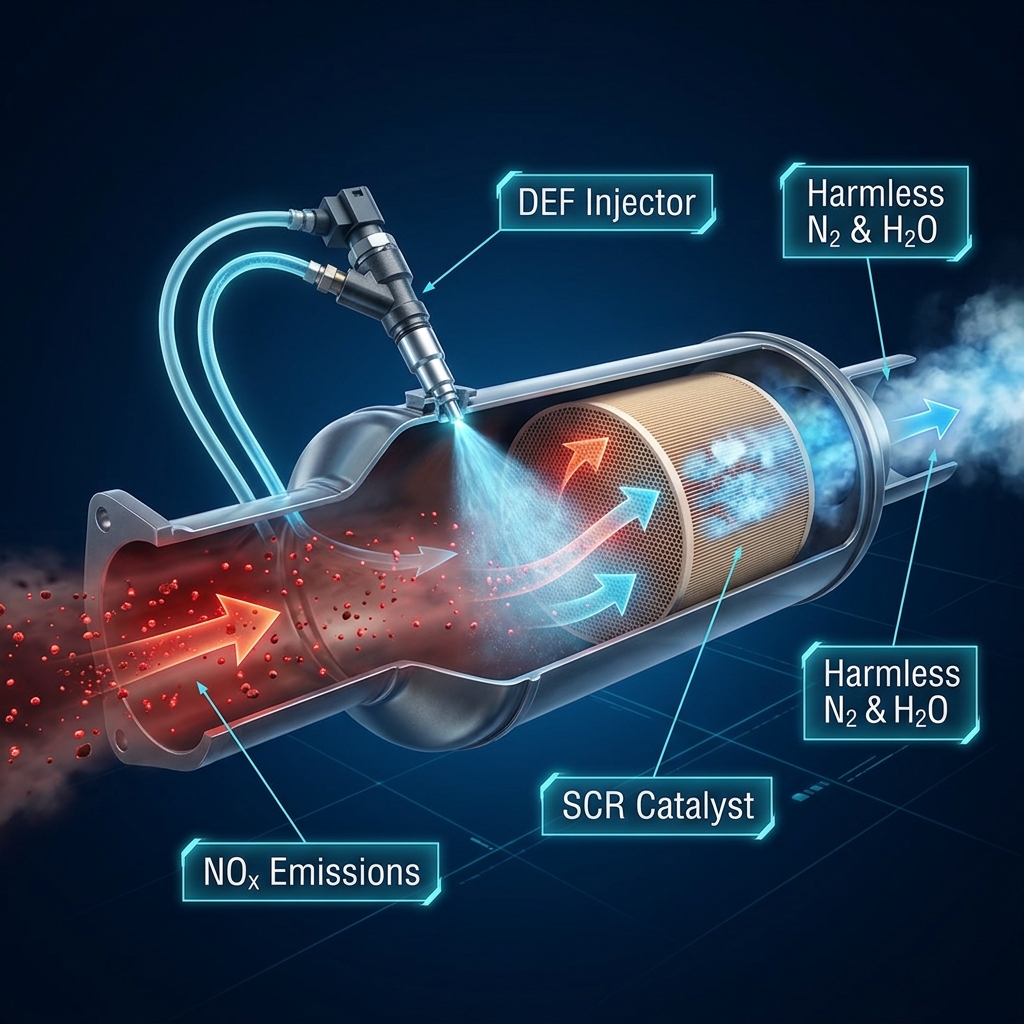
The primary purpose of Diesel Exhaust Fluid (DEF) in diesel engines is to break down toxic nitrogen oxide (NOx) emissions into harmless nitrogen gas and water vapor. Injected directly into the hot exhaust stream of vehicles equipped with Selective Catalytic Reduction (SCR) systems, DEF triggers a chemical reaction that enables modern diesel trucks to satisfy strict federal clean air standards without compromising engine power or fuel efficiency.
Every modern diesel pickup truck and commercial vehicle relies on this non-flammable liquid to manage combustion byproducts. As diesel fuel burns inside high-compression cylinders, intense heat generates high levels of nitrogen oxides. Rather than choking the engine with heavy internal recirculation, engineers direct raw exhaust gas through an external catalyst where fluid dosing occurs. This process converts up to 90% of harmful nitrogen oxides into natural atmospheric elements.
Proper fluid delivery ensures that your diesel truck operates cleanly while preserving maximum towing capacity and heavy-duty performance. Keeping the fluid reservoir filled is a routine aspect of diesel ownership. If you have questions about maintenance schedules or fluid levels, our team at our Clinton service department is ready to inspect your vehicle, or you can give us a quick call at (517) 456-6555 for technical assistance.
Table of Contents
- What Is DEF Made Of and How Does Selective Catalytic Reduction Work?
- What Happens If a Vehicle Is Driven With Very Low or Empty DEF?
- Will a Diesel Engine Shut Off Immediately When DEF Runs Out?
- What Is the ISO 22241 Standard and Is AdBlue the Exact Same Thing as DEF?
- How Much Does DEF Cost and How Long Does It Remain Stable in Storage?
- How Should You Maintain Your Diesel Exhaust Fluid System?
- Common Questions About Diesel Exhaust Fluid Maintenance
- Keeping Your Diesel Engine Running Strong in Clinton
What Is DEF Made Of and How Does Selective Catalytic Reduction Work?
Diesel Exhaust Fluid consists of a high-purity chemical mixture made of 32.5% high-purity urea and 67.5% deionized water. It is not a fuel additive and is never mixed directly with diesel fuel; instead, it is stored in a separate, dedicated fluid tank with a distinct blue filler cap.
The dosing process relies on precision computer control to protect the environment and maintain vehicle performance:
- Exhaust Injection: The engine control module measures exhaust temperature and NOx concentrations, directing a dosing valve to spray a precise mist of fluid into the exhaust pipe upstream of the catalyst.
- Thermal Decomposition: Heat from the exhaust stream vaporizes the deionized water and breaks down the urea into ammonia and carbon dioxide.
- Catalytic Reaction: Inside the SCR catalyst, ammonia reacts with nitrogen oxide molecules across specialized precious metal layers.
- Clean Emission Output: The chemical reaction yields pure nitrogen gas and water vapor, which flow safely out of the tailpipe.
Maintaining exact chemical proportions is essential for the catalyst to function. If the ratio of urea to water drifts outside specification, or if microscopic mineral impurities enter the reservoir, dosing injectors can clog and catalyst surfaces can suffer permanent degradation.
When servicing your heavy-duty truck, routine inspections ensure that dosing lines, heaters, and sensors remain in optimal working condition. Drivers looking to maintain their vehicle maintenance schedules can easily schedule service online with our factory-trained technicians.
What Happens If a Vehicle Is Driven With Very Low or Empty DEF?
Driving a diesel vehicle with very low or empty DEF triggers a series of progressive driver warnings followed by a controlled loss of engine power known as derate mode. Federal emissions regulations require vehicle manufacturers to implement these engine restrictions to prevent vehicles from operating indefinitely while emitting unrefined nitrogen oxides.
When the fluid level drops below established thresholds, the driver display presents clear notifications that advance through specific stages:
- Initial Alert (Roughly 800 to 1,000 Miles Remaining): A dash warning light illuminates accompanied by a text message stating fluid level is low. The vehicle operates normally without performance loss.
- Secondary Alert (Roughly 200 to 300 Miles Remaining): Warning chimes sound repeatedly, and the display indicates the precise distance remaining before engine speed or torque restrictions take effect.
- First Derate Phase (Empty Tank): Engine computer software reduces maximum horsepower and torque, limiting top speeds to roughly 55 mph to encourage immediate refilling.
- Final Derate Phase (Extended Driving on Empty): After a key cycle or extended idling on an empty tank, the system restricts vehicle speed to 5 mph or prevents engine restarts entirely until fluid is added.
Truck drivers hauling heavy agricultural loads or recreational trailers around Onsted frequently put higher stress on their diesel powertrain, which slightly increases fluid consumption during peak work seasons. Allowing the fluid level to drop to complete empty increases the risk of drawing concentrated sediment from the bottom of the reservoir into the dosing pump.
Whether you are keeping up with routine fluid care on a truck secured through a custom factory order, maintaining a vehicle from our new vehicle specials, or servicing a heavy-duty model chosen from our pre-owned vehicle specials, keeping the reservoir topped off protects your engine from unexpected power reductions.
Will a Diesel Engine Shut Off Immediately When DEF Runs Out?
Contrary to some beliefs, diesel engines continue running for a period even after the DEF reservoir is completely empty. Federal safety rules prohibit emissions software from cutting off engine power abruptly at highway speeds, which prevents hazardous loss of power steering and power braking in traffic.
When truck owners bring their heavy-duty Ram diesel into our service bay, they frequently ask if running out of fluid will cause the engine to cut off instantly on the highway. Instead of an immediate engine stall, vehicle electronics allow you to maintain speed until you reach a safe location to stop. Once the engine is turned off or left idling after the fluid reaches zero, safety controls enforce speed caps or a no-restart protocol until a minimum volume of fluid is added.
To clear a no-restart condition or exit speed restriction modes, you must add at least one to two gallons of fresh fluid to the dedicated reservoir. Once the fluid sensor detects sufficient liquid level, the vehicle computer resets the warning sequence and restores normal engine output. Sourcing proper fluid through our genuine Mopar parts department guarantees that you receive clean, factory-approved fluid that meets original manufacturer specs.
What Is the ISO 22241 Standard and Is AdBlue the Exact Same Thing as DEF?
The ISO 22241 standard is the international quality specification that governs the manufacturing, testing, storage, and handling of Diesel Exhaust Fluid. This benchmark dictates chemical composition, requiring a urea content between 31.8% and 33.2% by weight, while establishing strict caps on trace metals, calcium, iron, and organic compounds.
Yes, AdBlue is the exact same chemical product as DEF. AdBlue is simply a registered trademark owned by the German Association of the Automotive Industry (VDA), widely used across European markets and European vehicle owner manuals. Any product labeled as AdBlue or DEF must comply with the identical ISO 22241 specification to ensure safe use in SCR systems.
Using non-certified fluid or low-grade industrial urea solutions causes rapid damage to diesel exhaust components. Unfiltered minerals cause scale build-up inside the exhaust injector, leading to uneven spray patterns and localized catalyst clogging. Verifying that fluid containers carry the official API certification or ISO 22241 label guarantees chemical purity and protects your vehicle warranty.
How Much Does DEF Cost and How Long Does It Remain Stable in Storage?
Diesel Exhaust Fluid costs between $2.50 and $3.50 per gallon when purchased directly from commercial fluid pumps, while retail 2.5-gallon boxed containers generally cost between $3.00 and $4.50 per gallon. Under normal mixed driving conditions, a diesel truck consumes fluid at a rate of roughly 2% to 3% of diesel fuel usage, meaning a full tank lasts between 3,000 to 5,000 miles.
Fluid stability depends almost entirely on storage ambient temperatures:
- Temperatures Under 68°F (20°C): Fluid maintains full chemical integrity for up to two years.
- Temperatures Between 68°F and 86°F: Fluid remains stable for roughly 12 to 18 months.
- Temperatures Exceeding 86°F (30°C): Water content evaporates and urea degrades rapidly, reducing shelf life to six months or less.
- Freezing Conditions Below 12°F (-11°C): Fluid freezes solid but expands by roughly 7%. Once thawed naturally, the chemical ratio remains completely unaffected and ready for use.
Tradespeople commuting daily along local routes in Michigan Center rely on consistent exhaust system performance to prevent unexpected vehicle slowdowns during the workweek. Storing fluid containers in cool, shaded garages out of direct sunlight preserves chemical concentration and prevents premature degradation.
How Should You Maintain Your Diesel Exhaust Fluid System?
Maintaining your fluid system requires simple handling habits focused on cleanliness, temperature control, and correct fill procedures. Because SCR dosing injectors operate with sub-millimeter tolerances, avoiding fluid contamination is the single most critical maintenance practice.
Follow these proven ownership guidelines to ensure system reliability:
- Keep Filler Equipment Clean: Wipe down the blue fill cap and surrounding area before opening to prevent road dust, sand, or salt from dropping into the tank.
- Use Dedicated Containers: Never reuse funnels or jugs that previously held diesel fuel, motor oil, or antifreeze, as even microscopic fuel contamination destroys the SCR catalyst.
- Avoid Overfilling: Leave small vapor expansion space inside the tank during cold weather to accommodate natural fluid expansion if ambient temperatures drop below freezing.
- Thaw Frozen Tanks Naturally: Built-in tank heaters automatically thaw frozen fluid upon engine start; never add chemical additives or alcohol to lower the freezing point.
- Address Dash Warnings Promptly: Refill the reservoir as soon as low-level messages appear to avoid running the dosing pump dry.
If you ever suspect fluid contamination or experience persistent exhaust warning lights, bring your truck to our local dealership location for a complete system flush and sensor diagnostic. You can also reach our certified service advisors directly by calling (517) 456-6555.
Common Questions About Diesel Exhaust Fluid Maintenance
Q: How many miles can a diesel truck drive after the low DEF warning light first turns on?
Most diesel pickup trucks provide an initial warning with approximately 800 to 1,000 miles of driving range remaining in the fluid reservoir. This distance varies based on payload weight, towing demand, and driving speed, as heavy engine loads increase fluid consumption rates.
Q: Can standard tap water or distilled water be added to the DEF tank in an emergency?
Adding tap water or distilled water directly to the tank will dilute the required urea concentration below the mandatory 31.8% threshold. This triggers an immediate system fault light, causes exhaust catalyst damage from minerals, and eventually forces the vehicle into speed restriction modes.
Q: What should be done if Diesel Exhaust Fluid is accidentally poured into the diesel fuel tank?
Do not start the engine or turn on the ignition key if fluid enters the fuel tank. Fluid is water-based and highly corrosive to fuel injectors, high-pressure fuel pumps, and steel fuel lines, requiring an immediate tow to a service bay for complete fuel tank draining and flushing.
Q: How does cold winter weather affect the fluid inside the vehicle tank?
Fluid freezes at approximately 12°F (-11°C). Diesel trucks feature automated, electric heating elements inside the fluid tank and supply lines that activate when the engine starts, rapidly thawing liquid so dosing can resume without damaging vehicle components.
Q: What equipment is necessary to safely top off the fluid at home without spilling?
Most 2.5-gallon retail jugs come equipped with a flexible, vented fill spout designed to thread directly onto the blue filler neck. Using clean, sealed spouts prevents fluid spills on body paint and keeps surrounding dust from falling into the reservoir.
Keeping Your Diesel Engine Running Strong in Clinton
Proper fluid care protects your diesel truck against costly exhaust repairs, avoids sudden power restrictions, and keeps your engine running cleanly across every mile. By using ISO 22241 certified fluid, protecting containers from extreme heat, and refilling the reservoir as soon as low-level warnings appear, you preserve the long-term durability and heavy-duty performance of your vehicle.
When your truck requires professional emissions diagnostics, fluid system flushes, or routine multi-point inspections, rely on our factory-trained technicians at NewGen Chrysler Dodge Jeep Ram of Clinton. Visit our service center today or schedule your service appointment online to keep your diesel vehicle operating at peak performance.
© 2026 NewGen Chrysler Dodge Jeep Ram of Clinton. All rights reserved.