

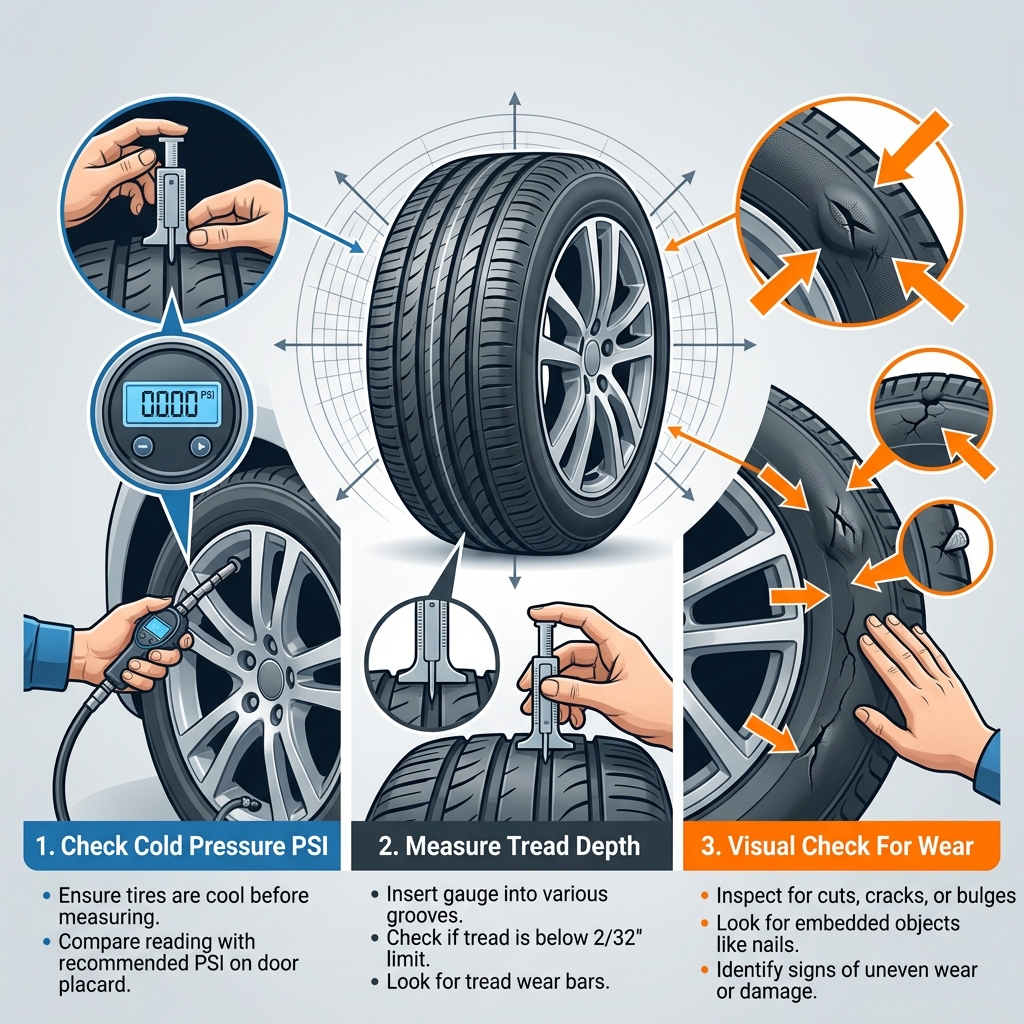
To inspect car tires at home, check cold inflation pressure using an accurate pressure gauge, measure tread depth across all major grooves with a Lincoln penny or depth tool, and complete a full visual check for cuts, sidewall cracks, bulges, or uneven edge wear. Comparing outer tread wear against center wear reveals underlying alignment or inflation issues before severe tire damage occurs.
Routine monthly inspections help maintain tire performance, driver safety, and optimal fuel economy throughout the year. Home tire checks take less than ten minutes and prevent unexpected flats or blowouts. Drivers traversing unpaved rural routes around Onsted face frequent exposure to gravel, agricultural debris, and uneven road surfaces, making regular tire inspections essential for early puncture detection and tread protection.
Setting up a consistent inspection routine involves three clear steps:
- Conduct a visual sweep around each tire, searching for foreign objects such as nails or sharp stones wedged between tread blocks.
- Check cold inflation pressure at every valve stem before driving the vehicle.
- Measure tread depth in multiple locations across the width of each tire to detect uneven wear patterns.
If a visual check reveals unusual sidewall bulges, severe cracking, or persistent air loss, professional evaluation is required. You can reach our Clinton team by giving us a quick call or visiting our Clinton service center for an in-person assessment.
Table of Contents
- Where Is the Recommended Tire Pressure Located and How Do You Check It?
- When Is the Best Time to Measure Tire Pressure and Prepare for Road Trips?
- At What Tread Depth Should You Start Shopping for Replacement Tires?
- What Happens If You Drive with Overinflated or Underinflated Tires?
- Common Questions About Home Tire Checks and Routine Care
- Professional Tire Care and Maintenance
Where Is the Recommended Tire Pressure Located and How Do You Check It?
The recommended tire pressure for passenger vehicles is printed on the vehicle certification decal located on the driver-side door jamb placard or listed in the owner's manual, typically ranging between 30 to 35 PSI for standard passenger cars and light trucks. Do not use the maximum inflation pressure stamped onto the tire sidewall, as that number represents the absolute maximum structural air limit the tire can hold under maximum load rather than the engineered inflation value for everyday handling, braking, and load balance.
Using an air compressor or portable inflator at home requires following a simple step-by-step process:
- Locate the recommended cold inflation pressure on the driver-side door placard.
- Unscrew the valve cap from the Schrader valves on the wheel stem and place it in a safe spot.
- Press the fitting of a digital or pencil pressure gauge squarely onto the valve stem until hissing air stops completely.
- Read the measurement on the gauge display and compare it with the door placard specification.
- Attach the air compressor hose chuck firmly over the valve stem and add air in short five-second bursts.
- Recheck the pressure with your manual gauge between bursts until the target PSI is achieved.
- Replace the valve stem cap securely to keep out dirt, ice, and road salt.
Vehicles such as the Ram 1500 or Jeep Grand Cherokee utilize an onboard Tire Pressure Monitoring System (TPMS) that tracks internal air pressure through wheel sensors and alerts drivers when pressure drops significantly. While dashboard TPMS warnings provide crucial safety alerts, rely on monthly manual gauge measurements to catch gradual pressure drops before the dashboard warning light activates.
When Is the Best Time to Measure Tire Pressure and Prepare for Road Trips?
The best time to measure tire pressure is early in the morning when the tires are cold, meaning the vehicle has sat parked for at least three hours or has been driven less than one mile. Friction between the tire rubber and the road surface generates heat during operation, expanding the air inside and temporarily raising pressure readings by 2 to 4 PSI above true cold levels.
Checking tire pressure on warm tires leads to incorrect readings and accidental underinflation. If air must be added to a warm tire during a highway trip, fill it to the recommended cold pressure level shown on the door jamb placard rather than venting air out. Recheck and fine-tune the pressure the following morning once the tires have cooled down completely.
Seasonal ambient temperature swings directly influence tire pressure. For every 10-degree drop in outside air temperature during Michigan winters, internal tire pressure drops by approximately 1 PSI. Early morning commuters from Michigan Center driving toward Jackson encounter cold road conditions where underinflated tires increase rolling resistance and impair vehicle handling.
Pre-trip tire pressure checks before long highway drives are vital because carrying full passenger loads and heavy luggage places additional stress on the tire carcass. Proper cold inflation improves high-speed stability, reduces heat buildup, and optimizes fuel efficiency during extended highway trips.
At What Tread Depth Should You Start Shopping for Replacement Tires?
Drivers should start shopping for replacement tires when tread depth reaches 4/32 of an inch, providing adequate time to select quality replacement tires before traction degrades significantly. While federal standards and state laws establish 2/32 of an inch as the absolute legal minimum tread depth, stopping distances on wet or slushy pavement increase dramatically once tread wears below 4/32 of an inch.
| Tread Depth Level | Safety Condition | Recommended Action |
| --- | --- | --- |
| 10/32" to 8/32" | New to Excellent | Routine monthly checks and scheduled rotations |
| 6/32" to 5/32" | Good Condition | Continue monitoring tread wear regularly |
| 4/32" | Shopping Threshold | Begin researching replacement tires |
| 2/32" or less | Unsafe / Legal Minimum | Replace tires immediately |
Measuring tire tread depth at home can be done accurately using the classic Lincoln penny test:
- Take a standard U.S. penny and hold it so Abraham Lincoln's head is pointing downward.
- Insert the penny headfirst into the deepest groove of the tire tread.
- Observe whether the top of Lincoln's head remains covered by the outer rubber tread block.
- If the top of Lincoln's head is completely visible, the tread depth has worn down to or below 2/32 of an inch, requiring immediate tire replacement.
Tires also feature built-in tread wear indicator bars molded into the main tread channels. These raised narrow bridges run perpendicularly across the tread grooves. When the surrounding tread wears down level with these indicator bars, the tire has reached 2/32 of an inch and must be replaced to maintain wet traction.
Selecting replacement tires requires matching the correct tire size, speed rating, and load index specified on your vehicle's door placard. When replacement time arrives, opting for genuine Mopar tires and replacement parts guarantees factory-engineered fitment and performance tailored to your specific vehicle model.
What Happens If You Drive with Overinflated or Underinflated Tires?
Driving on underinflated tires forces the tire shoulder blocks to carry an excessive share of the vehicle weight, generating internal heat that breaks down internal rubber bonds and accelerates shoulder wear. Underinflation increases rolling resistance, lowers fuel economy, impairs steering response, and increases the risk of severe sidewall blowouts at highway speeds.
Overinflated tires balloon outward along the center line, reducing the size of the tire contact patch on the road surface. This narrow contact area reduces grip during emergency braking maneuvers, causes rapid tread wear along the center of the tire, and creates a harsh, uncomfortable ride over minor road bumps.
| Inflation State | Primary Tread Wear Pattern | Vehicle Impact |
| --- | --- | --- |
| Underinflated | Rapid outer shoulder wear | Poor fuel economy, high heat buildup, blowout risk |
| Overinflated | Rapid center tread wear | Reduced wet grip, harsh ride, vibration |
| Misaligned | One-sided diagonal wear | Vehicle pulling, premature tire replacement |
| Proper Inflation | Even wear across full tread width | Maximum tire lifespan, optimal braking, smooth ride |
Maintaining correct air pressure prevents premature wear patterns and ensures predictable vehicle handling under heavy payload or towing demands.
Common Questions About Home Tire Checks and Routine Care
Q: How frequently should tires be rotated on Chrysler, Dodge, Jeep, and Ram models?
Routine tire rotation is recommended every 5,000 to 7,500 miles, which aligns convenient scheduling with regular engine oil changes. Front and rear axles experience different steering forces, braking stress, and weight distributions, causing tires to wear unevenly if left in the same position. Regular rotation spreads mechanical wear evenly across all four tires, maximizing tread life and preserving smooth, quiet ride quality.
Q: Why does the TPMS light turn on during cold winter mornings?
Cold winter weather causes air inside the tire to condense, dropping inflation pressure by approximately 1 PSI for every 10-degree drop in outside temperature. When ambient temperatures plunge overnight, tire pressure can dip below the TPMS illumination threshold. As the vehicle is driven and the tires warm up, pressure rises slightly, which may turn the light off. Drivers should verify cold pressure with a handheld gauge and add air as necessary.
Q: Does a spare tire degrade over time even if it has never been used?
Spare tires degrade from atmospheric aging, moisture exposure, and temperature changes regardless of whether they have ever touched the road. Rubber compounds naturally harden, dry out, and develop microscopic structural cracks over six to ten years. Full-size and compact spare tires older than six years should be inspected regularly and replaced according to manufacturer guidelines, and unused spares should not serve as long-term replacements for worn road tires.
Q: How do driver display systems show current tire pressure readings?
Modern vehicles equipped with a Uconnect touchscreen driver display feature individual tire pressure monitoring screens right on the instrument cluster. Drivers can toggle through vehicle info menus to view real-time PSI figures for each wheel position. While this digital feature provides convenient updates during daily driving, verifying pressure with a manual gauge once a month ensures total sensor calibration accuracy.
Q: What causes tire tread to wear down faster on one side?
Uneven wear concentrated along a single edge of the tire tread indicates wheel misalignment or worn steering and suspension components. Hitting deep winter potholes, striking curbs, or driving regularly over rough unpaved surfaces can knock wheel alignment angles out of factory specification. Correcting alignment promptly restores proper tire contact with the road and prevents premature outer tread wear.
Professional Tire Care and Maintenance
Maintaining proper tire inflation pressure and tracking tread wear depth keeps your vehicle safe, fuel-efficient, and responsive in every driving season. Catching minor pressure loss or uneven tread wear early prevents costly repairs and extends tire life over thousands of miles.
When visual inspections reveal uneven wear, damaged sidewalls, or tread depth approaching 4/32 of an inch, professional service ensures proper tire balancing, precise four-wheel alignment, and expert tire installation. Certified technicians use specialized equipment to diagnose tire issues, calibrate tire pressure monitoring systems, and recommend the best replacement tires for your driving habits.
Take action today to protect your tire investment and maintain vehicle safety. You can schedule a service appointment online, visit our service center at 1111 W Michigan Ave, Clinton, MI 49236, or call our service department at (517) 456-6555 for complete tire care and maintenance assistance.
© 2026 NewGen Chrysler Dodge Jeep Ram of Clinton. All rights reserved.