

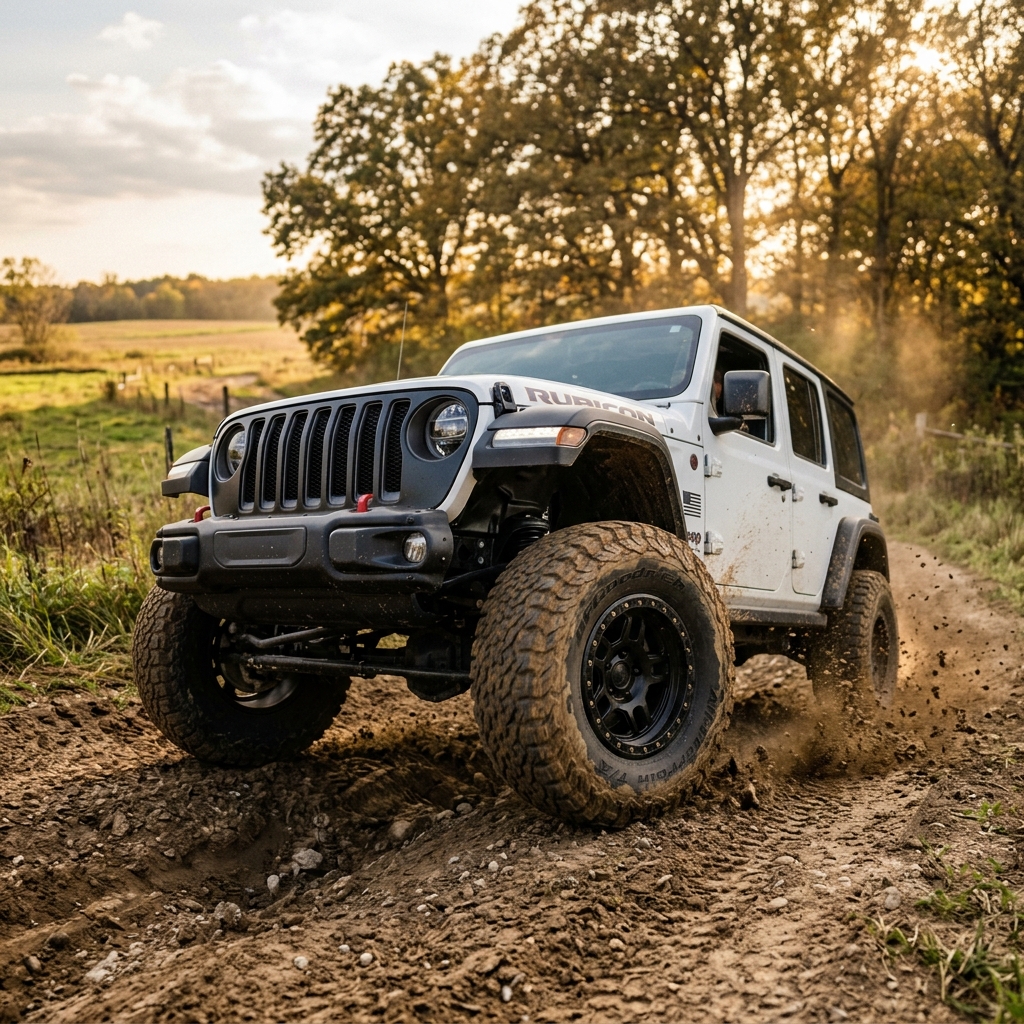
The choice of tire size on a Jeep Wrangler is one of the most critical decisions an owner can make. It dictates how the vehicle handles paved highway stretches, muddy trails, and everything in between. Changing the rolling diameter alters the vehicle's center of gravity, steering geometry, and gear ratios. For example, a larger tire increases the ground clearance under the differential housing, allowing you to pass over tall obstacles without scraping. However, that same change increases rolling resistance and aerodynamic drag, which directly impacts fuel economy.
When drivers in Onsted are navigating soft agricultural fields or towing a fishing boat to Wamplers Lake, having the correct tire size and tread design ensures they maintain traction without bogging down the drivetrain. A wider contact patch distributes the vehicle's weight more evenly on loose soil, while a narrower tire can cut through light snow to find traction on hard pavement. Upgrading to a larger tire size also improves the approach, departure, and breakover angles, which are essential for negotiating steep inclines and deep ruts.
Our service team at NewGen Chrysler Dodge Jeep Ram of Clinton can help you evaluate how different tire configurations will affect your daily drive. If you are looking to purchase a new Jeep Wrangler, we can guide you through the process of selecting the right trim and tire package. You can explore our new Jeep inventory online or check out our hybrid 4xe models to find the perfect balance of efficiency and trail capability. If you already own a Wrangler and want to discuss upgrades, you can schedule certified maintenance or use our convenient online service scheduling tool to book an appointment. For quick tire rotations or pressure checks, feel free to drop by our express service lane during business hours. To find current factory promotions, take a look at our Jeep manufacturer incentives before your visit.
Table of Contents
- Stock Sizing Specs for the 2026 Jeep Wrangler From the Factory
- How Upgrading to 35-Inch Tires Changes the Way Your Wrangler Drives
- Fitting 35s on a Stock 2026 Jeep Wrangler Without a Suspension Lift
- Speedometer Calibration and Mechanical Wear with Larger Tires
- Cost Comparison: Stepping Up to 33s Versus 35s on Your Wrangler
- Common Questions About Wrangler Tire Upgrades
- Finding Your Perfect Wrangler Tire Setup at NewGen Chrysler Dodge Jeep Ram
Stock Sizing Specs for the 2026 Jeep Wrangler From the Factory
Every Wrangler leaving the assembly line is calibrated to a specific tire size depending on its trim level and intended use case. For the 2026 model year, the factory tire size on the entry-level Sport and Sport S trims is 245/75R17. This size translates to an overall diameter of about 31.5 inches with a section width of roughly 9.6 inches. This configuration is optimized to deliver balanced highway comfort, low road noise, and reliable fuel economy while retaining basic trail capability.
Stepping up to the highway-oriented Sahara trim brings 255/70R18 factory tires, which measure approximately 32 inches in diameter and ride on larger 18-inch wheels. For those prioritizing maximum off-road performance, the Rubicon trim comes standard with 285/70R17 tires, measuring roughly 32.7 inches (commonly referred to as a 33-inch tire). The Rubicon's wider tread and taller sidewalls provide a larger contact patch when aired down, which is crucial for climbing over rocks and navigating deep ruts.
If you want to tailor your vehicle's factory specifications from the very beginning, you can submit custom factory orders to select your preferred wheel and tire packages directly from Jeep. Whether you prefer the fuel-efficient highway manners of the standard sizes or the aggressive stance of the Rubicon's 33-inch tires, our team can help you configure a Wrangler that perfectly matches your driving needs.
How Upgrading to 35-Inch Tires Changes the Way Your Wrangler Drives
Upgrading from factory tires to a set of 35-inch tires is one of the most popular modifications for Wrangler owners, but it fundamentally changes the vehicle's driving dynamics. A standard 35-inch tire, such as a 35x12.50R17 or an LT315/70R17, represents roughly a 9% increase in rolling diameter over stock tires. This larger circumference means your Wrangler travels further with every single rotation of the axle, which effectively raises your overall gear ratio.
On the highway, this taller gearing causes the engine to run at lower RPMs for any given speed. While this might sound beneficial for fuel economy, it often forces the transmission—especially the 8-speed automatic—to hunt for gears on slight inclines or headwinds because the engine is operating outside its optimal power band. You will likely notice a softer throttle response and slower acceleration from a complete stop. The added weight of the larger tires also increases rotational inertia, meaning it takes more effort to get the vehicle moving and requires greater braking force to bring it to a halt.
If you are transitioning to a Wrangler from a smaller, more street-focused vehicle, such as a model you might find when you browse our used Ford Bronco Sport inventory, the difference in handling will be immediately apparent. The steering will feel heavier, and the vehicle may exhibit more body roll around corners due to the raised center of gravity. For those who want to see how a modified Wrangler compares to other pre-owned options, we invite you to browse our bargain pre-owned vehicles to find a ride that fits your lifestyle and budget.
Fitting 35s on a Stock 2026 Jeep Wrangler Without a Suspension Lift
A common question among off-road enthusiasts is whether a stock 2026 Wrangler can accommodate 35-inch tires without installing an aftermarket suspension lift. The short answer is yes, but with several important caveats. The modern JL generation features larger wheel wells and higher fender arches than its predecessor, meaning a stock Rubicon trim can physically fit 35-inch tires on the street. However, if you drive a Sport or Sahara trim, the lower fender flares make clearance much tighter.
While you might avoid rubbing during straight-line driving on flat pavement, the tires will likely contact the inner fender liners and sway bar end links when you turn the steering wheel to full lock. More importantly, off-road driving will cause significant rubbing as the suspension compresses over obstacles. To prevent damage to your bodywork and tires, installing at least a 2-inch suspension lift or a 2.5-inch suspension lift is highly recommended. This modification ensures your suspension can fully articulate without interference.
Wheel offset is another critical factor. Factory Wrangler wheels feature a deep +44mm offset that keeps the tires tucked close to the frame. When mounting wider 35-inch tires, you will need aftermarket wheels with less backspacing (typically around 4.5 to 5 inches) or hub-centric wheel spacers to push the tires outward. If you are shopping for a pre-owned vehicle that may already have these modifications installed, you can browse our complete used vehicle inventory to find a trail-ready rig that is already built to your exact specifications.
Speedometer Calibration and Mechanical Wear with Larger Tires
Because your Wrangler's computer calculates road speed based on the rotational speed of the driveshaft, changing the overall tire diameter directly disrupts the accuracy of your speedometer and odometer. When you upgrade to larger tires, the tire covers more physical distance per revolution. Consequently, your speedometer will read slower than your actual speed—meaning when your dashboard indicates 60 mph, you may actually be traveling closer to 65 mph. This discrepancy also causes your odometer to underreport your actual mileage over time.
To correct this issue and restore proper shift points on models equipped with the 8-speed automatic transmission, you must recalibrate the vehicle's engine control module using an electronic programmer or tuner. Without calibration, the transmission may fail to engage eighth gear on the highway, leading to increased fuel consumption and a sluggish driving feel. The sluggishness is further compounded by the drop in your effective gear ratio. For example, running 35-inch tires on stock 3.73 gears makes the vehicle perform as if it has 3.40 gears, severely reducing low-end torque.
The added weight and leverage of larger tires also accelerate mechanical wear on your drivetrain and steering components. Ball joints, wheel bearings, steering stabilizers, and axle shafts all experience significantly higher stress. While a performance vehicle like a pre-owned sports car from our used Dodge Challenger inventory is engineered strictly for high-speed pavement grip, a modified Wrangler requires heavy-duty components to handle the mechanical leverage of oversized off-road tires. To prevent premature failures, many owners choose to upgrade to stronger axle shafts and re-gear their differentials to 4.56 gears or 4.88 gears to restore factory-like performance.
Cost Comparison: Stepping Up to 33s Versus 35s on Your Wrangler
When planning your tire budget, it is important to realize that the financial difference between choosing 33-inch tires and 35-inch tires extends far beyond the price tag of the rubber itself. Opting for a quality 33-inch all-terrain tire is highly cost-effective because it is a direct bolt-on upgrade. You can typically mount 33s on your stock wheels, retain your factory suspension, and avoid the need for expensive drivetrain modifications or re-gearing.
In contrast, stepping up to 35-inch tires triggers a domino effect of supporting modifications. To run 35s reliably, you must budget for a suspension lift, aftermarket wheels with proper backspacing, a speedometer calibration tool, and a heavy-duty spare tire carrier reinforcement to prevent the heavier spare from damaging your tailgate. If you live in Michigan Center and frequently commute to Jackson or tow a fishing boat to the Michigan Center Reservoir, you will also likely want to re-gear your axles to maintain highway acceleration, which adds significant parts and labor costs.
Ultimately, while a set of 33-inch tires is a straightforward purchase, a proper 35-inch tire setup is a comprehensive vehicle build. If you want a highly capable daily driver without the added complexity and cost of a full suspension build, staying with 33s is the most practical choice.
Common Questions About Wrangler Tire Upgrades
Q: Does changing my Wrangler's tire size void the factory warranty?
Upgrading your tire size does not automatically void your entire vehicle warranty, but any damage directly caused by the modification will not be covered. For example, if an oversized tire causes premature wear on your ball joints or wheel bearings, those specific repairs will not be covered under your 3-year/36,000-mile bumper-to-bumper warranty or 5-year/60,000-mile powertrain warranty. The rest of your factory coverage remains fully intact.
Q: What tire pressure should I run in larger aftermarket tires?
Larger tires have a greater air volume than factory tires, meaning they require lower pressure to support the same vehicle weight on pavement. While the factory door placard recommends 37 psi for stock sizes, a 35-inch tire typically performs best between 28 psi and 32 psi for daily street driving. Running too much pressure in a larger tire causes the center of the tread to wear prematurely and produces a harsh, bouncy ride.
Q: Do I need to upgrade my brakes when installing 35-inch tires?
While the factory brakes on modern Wrangler models are highly capable, upgrading to 35-inch tires adds significant rotating mass that increases your stopping distance. For daily commuting, your stock brakes are adequate, but if you regularly tow heavy trailers or navigate steep mountain descents, upgrading to heavy-duty brake pads and slotted rotors is a wise safety investment. This is especially true if you are used to the heavy-duty stopping power of larger trucks like those in our used GMC Sierra 2500HD inventory.
Q: Does the local area have off-road parks to test new tires?
Yes, southern Michigan offers excellent destinations for testing your new tire setup under real-world conditions. Bundy Hill Offroad Park in Jerome features steep hill climbs, deep mud pits, and rocky obstacles that will fully test the traction and sidewall durability of your new all-terrain or mud-terrain tires. Alternatively, Holly Oaks ORV Park in Holly provides a controlled environment with sandy scrambles and water crossings to help you dial in your preferred off-road tire pressures.
Q: What should I do if I experience a flat tire or breakdown while traveling?
If you encounter an emergency or a flat tire on the road, you can rely on manufacturer-backed support to get you back on track. You can contact Jeep Roadside Assistance: 800-521-2779 for exclusive, brand-specific towing and flat-tire service. This service connects you with authorized technicians who use genuine parts to protect your warranty and ensure your vehicle is serviced to factory standards.
Finding Your Perfect Wrangler Tire Setup at NewGen Chrysler Dodge Jeep Ram
Selecting the perfect tire size for your Wrangler is all about balancing your off-road aspirations with your daily driving comfort. Whether you want to maintain the quiet, efficient performance of your factory tires or build a highly capable trail machine on 35-inch rubber, our team is here to help. We offer a comprehensive selection of parts, professional installation, and expert advice to ensure your suspension, gearing, and speedometer calibration work in perfect harmony.
If you are ready to find your next adventure vehicle, we invite you to explore our virtual showroom or browse our new Jeep Wrangler inventory online. Our finance experts work with a variety of lenders to secure competitive rates, and you can easily get approved for financing through our secure online portal before your visit. We also make it simple to upgrade your current ride; you can value your trade-in online to receive a competitive purchase offer with no purchase required.
For personalized assistance, you can give our team a quick call or stop by our dealership in person. If you are driving in from the surrounding communities, you can easily get directions to our showroom located at 1111 W Michigan Ave, Clinton, MI 49236. Let us help you build the ultimate Trail Rated machine today.