

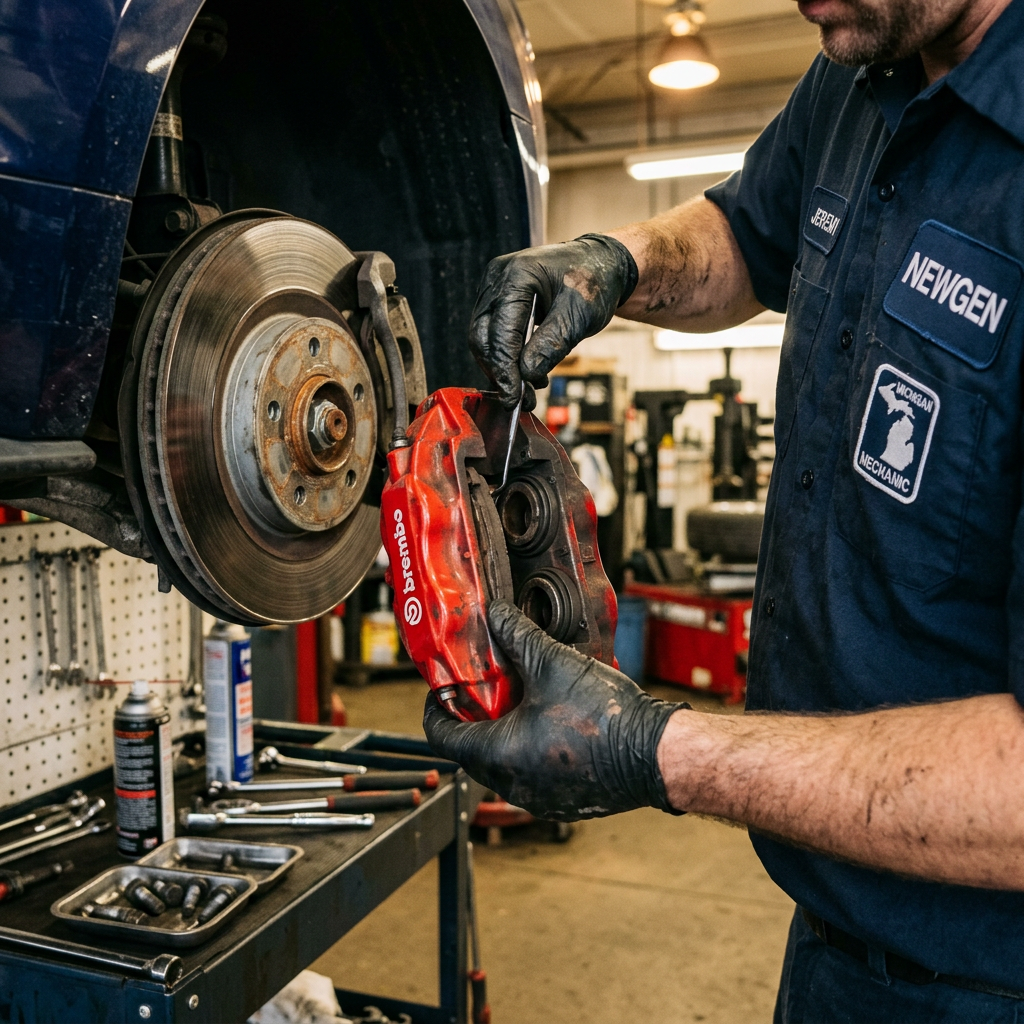
The Real Deal on Brake Caliper Maintenance - From Your Local Service Technician
When Is a Caliper Service Needed for Your Chrysler, Dodge, Ram, or Jeep?
I have spent seven years in the service department here at NewGen Chrysler Dodge Jeep Ram of Clinton, and if there is one safety system that deserves your undivided attention, it is your brakes. While most drivers are familiar with replacing worn pads, they often overlook the hydraulic clamps that actually do the heavy lifting: the brake calipers. A professional caliper service is typically needed when your vehicle exhibits signs of mechanical sticking, hydraulic fluid leaks, or highly uneven pad wear. Under normal driving conditions, these heavy-duty components are engineered to last a long time, often between 75,000 to 100,000 miles, but the harsh road salt and seasonal moisture we experience in southern Michigan can drastically accelerate corrosion and physical wear.
To catch these issues before they turn into expensive repairs or dangerous road hazards, we recommend having your entire braking system inspected every 10,000 to 15,000 miles, which aligns perfectly with your routine tire rotations. If you are towing heavy loads with a rugged truck like the Ram 1500 or navigating muddy trails in a Jeep Wrangler, your braking system is subjected to extreme thermal stress and debris, making regular inspections even more critical. Our certified technicians specialize in servicing all Mopar braking systems, ensuring your vehicle retains its factory-spec stopping power. If you suspect your brakes are dragging or you simply want our team to perform a preventative check, you can quickly schedule your service today to keep your vehicle operating safely.
Preventative maintenance is always more cost-effective than replacing seized components. During a standard inspection, we verify that the caliper pistons compress smoothly and the slide pins move freely within their bores. For drivers utilizing their vehicles for agricultural work or daily commuting around Onsted, the combination of gravel dust and field moisture can easily compromise the rubber dust boots that protect the delicate internal pistons. If you want to drop by for a quick, hassle-free inspection, you can visit our Express Lane for rapid maintenance. Alternatively, for comprehensive brake diagnostics, you can book an appointment to schedule Mopar service with our factory-trained specialists who understand the exact engineering specifications of your vehicle.
If your vehicle's braking performance has felt a bit sluggish lately, our service team is ready to help. You can easily reach out to us by giving our service department a quick call at (517) 456-6555 to discuss your concerns or get an estimate. For those driving in from neighboring communities for their maintenance appointments, finding us is straightforward, and you can get directions to our Clinton showroom and service bays online. We also recommend checking our updated list of service offers to see our current maintenance offers before you arrive.
Table of Contents
- Recognizing the Warning Signs of a Sticking Brake Caliper
- Why Your Vehicle Pulls to One Side During Braking
- What to Expect During a Professional Caliper Inspection and Service
- Comparing a Standard Caliper Service to a Full Brake Job
- Floating vs Fixed Calipers and the Importance of the Bracket
- Replacing Calipers in Pairs and Warranty Coverage
- Why Professional Caliper Care Beats DIY
Recognizing the Warning Signs of a Sticking Brake Caliper
Let me explain how a sticking caliper behaves, because the warning signs are usually quite distinct if you know what to listen and feel for. When a caliper sticks, the internal piston or the slide pins fail to retract, which keeps the brake pad in constant, firm contact with the spinning rotor. This constant friction generates immense thermal energy, which quickly leads to a distinct, highly unpleasant hot brake smell or even visible smoke billowing from the wheel well. You might also notice that your vehicle feels sluggish, as if it is resisting movement or holding back when you lift your foot off the accelerator pedal.
From my experience on the service floor, another dead giveaway of a sticking caliper is a persistent squealing, squeaking, or harsh grinding noise that occurs while you are driving, which sometimes disappears temporarily when you actually press the brake pedal. This happens because the dragging pad is constantly scraping against the disc. Over time, this constant friction will cause one brake pad to wear down dramatically thinner than its counterpart on the same wheel. If you ignore these symptoms, the extreme heat can warp your rotors and ruin your brake pads. If you need replacement components, you can shop Mopar accessories and replacement parts directly through our department to find guaranteed factory-spec matches.
It is also common for a failing caliper seal to leak hydraulic fluid, which you might spot as a wet, oily residue on the inner barrel of your wheel rims or a sudden drop in your dashboard fluid reservoir. A hydraulic leak is an immediate safety emergency because it causes the brake system to lose vital hydraulic pressure, resulting in a soft, spongy brake pedal and a severe loss of stopping power. If you want to learn more about our dealership's commitment to vehicle safety and ownership care, you can visit our homepage to explore our full range of professional resources.
Why Your Vehicle Pulls to One Side During Braking
A question I get most often from local drivers is why their vehicle suddenly veers or pulls hard to one side the moment they apply the brakes. When you press the brake pedal, hydraulic pressure should be distributed perfectly evenly across all four wheels. However, if a caliper piston on one side of the vehicle is seized or sticking, it will create a severe braking imbalance. If the front-left caliper piston is frozen and cannot apply pressure, only the front-right brake will grab, violently pulling the steering wheel to the right. Conversely, if a caliper is stuck in the "on" position, that wheel will drag constantly, causing a continuous pull toward that side even when you aren't touching the pedal.
This pulling behavior is not just annoying; it is a major safety hazard, especially when navigating wet or icy roads around Michigan Center. An uneven braking force can easily cause you to lose traction and slide during an emergency stop. When a customer brings a vehicle in with this complaint, our technicians immediately perform a pressure test and inspect the caliper slide pins and pistons to pinpoint the exact source of the mechanical or hydraulic restriction. To help keep your vehicle in peak operating condition, we invite you to view our latest new vehicle specials and service promotions designed to make factory-certified maintenance highly accessible.
What to Expect During a Professional Caliper Inspection and Service
One thing I always tell customers about caliper maintenance is that a professional service is highly systematic and requires specialized tools to execute correctly. When our factory-trained technicians perform a caliper service, we do not just spray some cleaner and call it a day. We lift the vehicle, remove the wheels, and carefully unbolt the caliper from its mounting bracket to inspect the entire hydraulic assembly. We pay close attention to the rubber dust boots; if these boots are torn or cracked, moisture and road grit will enter the chamber, causing deep corrosion and pitting on the piston surface that eventually leads to a seized assembly.
During a standard caliper service, our team performs the following precise steps:
- We inspect the flexible rubber brake hoses for any kinking, swelling, or external cracks.
- We remove the slide pins, clean away old grease and road debris, and inspect them for physical wear or bending.
- We clean rust and built-up corrosion from the caliper bracket abutment flats and hardware clips where the pads slide.
- We apply high-temperature, silicone-based lubricant sparingly to the slide pins and the metal contact points of the pads.
- We compress the caliper piston back into its bore using a professional spreader tool to verify smooth, unhindered movement.
- We reassemble the components, torque all mounting bolts to exact factory specifications, and bleed the hydraulic lines to purge any trapped air.
If our inspection reveals that a caliper has suffered internal piston damage or a blown seal, we will recommend replacing the unit with a high-quality Mopar replacement. You can easily order genuine parts online through our site to ensure your vehicle is fitted with components engineered specifically for your model's weight and towing specifications.
Comparing a Standard Caliper Service to a Full Brake Job
This is something we see a lot in the service bays: customers confusing a targeted caliper service with a standard brake replacement. A standard caliper service is a highly focused maintenance procedure aimed at cleaning, lubricating, and restoring the free movement of the caliper's mechanical parts, such as the slide pins, brackets, and clips. It is designed to prevent sticking and extend the life of your existing pads and rotors. A full brake job, on the other hand, is a comprehensive wear-item overhaul that typically involves replacing the friction materials—specifically the brake pads and the rotors—across an entire axle.
If your calipers are in excellent structural shape but are simply dirty or dry, a quick cleaning and lubrication service is all that is required to keep them operating smoothly. However, if a caliper has suffered physical damage, deep rust pitting, or a fluid leak, it must be replaced as part of your brake service. When we install new pads and rotors, we always inspect the calipers to ensure they are capable of applying even pressure; installing brand-new pads onto a vehicle with a sticking caliper will quickly ruin the new friction material in a matter of weeks. If you have questions about your vehicle's specific maintenance needs, you can contact our team today to speak directly with an expert advisor.
Floating vs Fixed Calipers and the Importance of the Bracket
Another important thing to know about your braking system is the physical design of your calipers, which typically fall into two categories: floating or fixed. Floating calipers are the most common style found on everyday passenger vehicles and SUVs. They feature one or two pistons located exclusively on the inboard side of the rotor. When you step on the brakes, the piston pushes the inboard pad directly against the rotor, and the caliper body slides along the guide pins to pull the outboard pad into contact. Because they rely entirely on sliding movement, keeping the slide pins clean and well-lubricated is absolutely paramount to prevent uneven pad wear.
Fixed calipers, often found on high-performance vehicles or heavy-duty trucks, are bolted directly to the steering knuckle and do not move. Instead, they feature pistons on both sides of the rotor that compress simultaneously to clamp the brake pads. Regardless of the design, the caliper bracket plays a critical role; it securely holds the caliper housing in place over the rotor and features precise channels where the ears of the brake pads must slide freely. If rust builds up in these bracket channels, the pads will bind and drag, mimicking the symptoms of a seized piston. For any replacement brackets, pins, or boots, our Mopar parts center stocks authentic components designed to maintain your vehicle's structural safety.
Replacing Calipers in Pairs and Warranty Coverage
Many of our customers wonder if they are required to replace their brake calipers in pairs, similar to how we always replace brake pads and rotors. Technically, you do not have to replace calipers in pairs. If only one caliper is leaking or has a torn dust boot, it is perfectly safe and acceptable to replace just that single unit, provided the caliper on the opposite side of the axle is inspected and verified to be in excellent, fully functioning condition. However, if your vehicle has high mileage and one caliper has seized due to age and internal wear, there is a very high probability that the opposite caliper is nearing the end of its operational lifespan as well, leading many drivers to opt for dual replacement to guarantee perfectly balanced braking performance.
When it comes to the financial side of brake repairs, customers often ask if these components are covered under vehicle service contracts or extended warranties. In most cases, brake calipers are classified as mechanical components and are fully covered under comprehensive extended warranties, unlike wear-and-tear friction materials like pads and rotors, which are excluded. We recommend having our service advisors review your specific contract details to confirm your coverage. To find current information on preventative care, you can browse our current promotions to see if we have active specials on brake inspections or fluid flushes.
Why Professional Caliper Care Beats DIY
Working with complex hydraulic systems is something that is best left to factory-trained professionals. While a highly experienced home mechanic might feel comfortable cleaning slide pins, performing a full caliper replacement or hydraulic system bleed is a high-stakes job. Modern vehicles are equipped with advanced anti-lock braking systems and electronic parking brakes that require specialized scan tools to put the calipers into "service mode" before they can be safely compressed. Attempting to force a piston back without disabling these electronic systems can easily cause thousands of dollars in damage to the internal actuators and sensitive ABS modules.
Furthermore, any mistake made while bleeding the brake lines can leave air trapped in the system, resulting in a sudden and catastrophic loss of braking pressure on the road. Our certified technicians have the precise training, diagnostic computers, and specialized fluid exchange machines required to service your hydraulic system safely and efficiently. If you suspect your vehicle needs brake attention, please give our service advisors a call at (517) 456-6555 or stop by our service center at 1111 W Michigan Ave, Clinton, MI 49236 to ensure your vehicle is ready for the road.
© 2026 NewGen Chrysler Dodge Jeep Ram of Clinton. All rights reserved.