

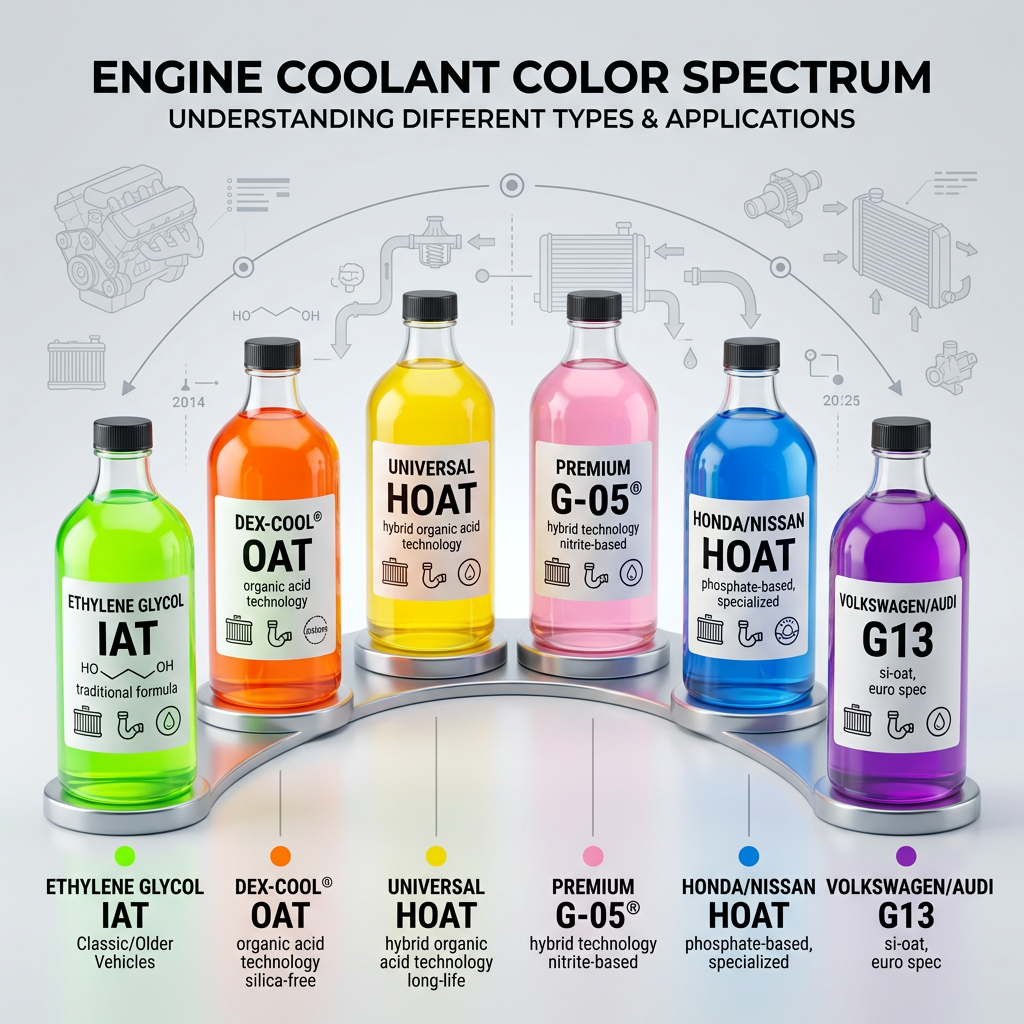
Selecting the correct engine fluid is one of the most critical aspects of routine vehicle maintenance, yet the array of vibrant hues in the automotive aisle often leaves vehicle owners confused. Engine coolant, commonly referred to as antifreeze, is dyed bright shades of green, orange, yellow, pink, blue, or purple by manufacturers. These distinct colors are not decorative choices; they serve as a visual coding system to identify the specific chemical additives and corrosion inhibitors used in the fluid. Using the incorrect formulation can lead to severe cooling system damage, making it essential to understand what these colors represent before topping off your reservoir.
Historically, identifying the right fluid was simple because virtually every vehicle on the road utilized the same bright green formula. As automotive engineering advanced, manufacturers transitioned to more complex engine designs featuring lightweight aluminum heads, multi-metal radiators, and sophisticated alloy components. These modern designs require highly specialized chemical packages to prevent scale buildup, cavitation, and electrochemical corrosion. The dye added to the coolant is designed to help vehicle owners and technicians quickly identify the underlying chemical technology, ensuring the vehicle receives the exact protection its metallurgy requires.
For drivers navigating the local roads of Onsted, keeping the cooling system in peak condition is vital for reliable daily travel. The demands of driving through rural landscapes, hauling equipment, or managing seasonal temperature swings mean your engine relies heavily on a clean, properly formulated cooling system. If you are ever unsure about the condition or color of the fluid currently in your vehicle, you can easily get directions to our Clinton service center to have our certified technicians perform a professional inspection. If you prefer to speak with a specialist first about your vehicle's specific maintenance schedule, feel free to give our team a quick call for direct assistance.
Table of Contents
- Understanding Coolant Chemistry: IAT, OAT, and Hybrid Organic Acid Technology (HOAT)
- The Risks of Mixing Different Coolant Colors and Chemical Formulations
- Concentrated vs. 50/50 Pre-Diluted Coolant: Cost-Effectiveness and Practicality
- Crucial Safety Protocols: Why You Must Never Open a Hot Radiator Cap
- How to Safely Check Coolant Levels, Inspect Fluid Condition, and Handle Used Fluid
- Answers to Common Questions About Engine Coolant Care
- Trust NewGen Chrysler Dodge Jeep Ram of Clinton for Expert Cooling System Service
Understanding Coolant Chemistry: IAT, OAT, and Hybrid Organic Acid Technology (HOAT)
To fully comprehend what coolant colors represent, it is necessary to examine the three primary chemical technologies used in modern automotive manufacturing. Each technology relies on a distinct set of active ingredients to protect the internal passages of your engine from corrosion, rust, and mineral deposits.
- Inorganic Additive Technology (IAT): This is the traditional, bright green coolant that dominated the automotive industry for decades. It relies on fast-acting inorganic inhibitors, primarily silicates and phosphates, to form a protective layer over iron and aluminum surfaces. While highly effective at preventing immediate corrosion, these inhibitors deplete rapidly, requiring a complete flush and replacement every 2 years or 30,000 miles.
- Organic Acid Technology (OAT): Typically dyed orange, red, or deep pink, OAT formulations do not contain silicates or phosphates. Instead, they utilize organic acids to provide long-term corrosion protection. This chemistry is designed for extended service life, often lasting up to 5 years or 150,000 miles. It is highly effective at protecting aluminum and nylon components found in modern cooling systems.
- Hybrid Organic Acid Technology (HOAT): This advanced formulation combines the rapid-acting benefits of silicates or phosphates with the long-lasting durability of organic acids. Often dyed orange, yellow, or purple, HOAT is the factory specification for many Chrysler, Dodge, Ram, and Jeep vehicles. It provides robust protection for aluminum water pumps and prevents cavitation in high-demand engines.
Understanding these chemical differences is particularly important for owners of modern, high-tech powertrains. For example, drivers exploring the advanced engineering of innovative Jeep plug-in hybrid models will find that hybrid cooling systems have highly specific fluid requirements to manage both the combustion engine and battery cooling loops. Similarly, keeping up with proper maintenance is just as critical for budget-conscious drivers who rely on dependable transportation from our pre-owned vehicles under $20,000. No matter what technology powers your vehicle, using the manufacturer-specified chemical formulation is the only way to guarantee long-term durability and prevent premature component failure.
The Risks of Mixing Different Coolant Colors and Chemical Formulations
A common misconception among vehicle owners is that all coolants are fundamentally the same and can be freely mixed as long as the reservoir is filled to the proper level. In reality, mixing different coolant colors and chemical formulations is one of the most damaging mistakes you can make in vehicle maintenance. When incompatible chemical packages are combined, the organic acids and inorganic inhibitors can react negatively, neutralizing their corrosion-protective properties and leaving your cooling system vulnerable to rapid degradation.
The physical consequences of mixing incompatible fluids can be severe and costly to repair. For instance, combining traditional green IAT coolant with orange OAT coolant often triggers a chemical reaction that causes the silicates to drop out of solution. This results in the formation of a thick, gel-like sludge that settles in the narrow passages of your radiator, heater core, and engine block. This sludge restricts the flow of fluid, leading to localized hot spots, water pump failure, and eventual engine overheating.
To avoid these severe cooling system failures, it is always best to consult your owner's manual or speak with a professional before adding any fluid to your vehicle. If you are performing a flush at home and need to secure the exact fluid specified for your engine, you can order genuine parts online directly through our department. For those who want to learn more about vehicle care tips, preventative maintenance, and detailed technical guides, you can read our latest blog posts to stay informed on best practices for keeping your vehicle running smoothly.
Concentrated vs. 50/50 Pre-Diluted Coolant: Cost-Effectiveness and Practicality
When purchasing engine coolant, you will generally find two formats on the shelf: concentrated formula and 50/50 pre-diluted fluid. Understanding the practical and financial differences between these two options can help you make the best decision for your garage and your maintenance budget.
| Coolant Type | Composition | Convenience Level | Mixing Required | Recommended Water Type |
|---|---|---|---|---|
| Concentrated | 100% pure coolant chemical | Moderate (Requires manual mixing) | Yes (Must be diluted 50/50) | Distilled water only |
| 50/50 Pre-Diluted | 50% coolant, 50% purified water | High (Ready to pour immediately) | No (Direct use) | None (Pre-mixed) |
From a purely financial standpoint, concentrated coolant is typically more cost-effective. Purchasing a single gallon of concentrated fluid and mixing it with a low-cost gallon of distilled water yields two full gallons of usable coolant. This approach provides a lower cost-per-gallon compared to buying two individual bottles of pre-diluted fluid. However, this method requires you to carefully measure a precise 50/50 ratio and demands that you use only distilled water, as tap water contains minerals that can create harmful scale buildup inside your radiator.
On the other hand, 50/50 pre-diluted coolant offers maximum convenience and eliminates the risk of mixing errors. It is formulated with highly purified, demineralized water, making it safe to pour directly into your reservoir during an emergency or quick top-off. For drivers who prefer hassle-free maintenance or do not have distilled water readily available, the slightly higher cost of pre-diluted fluid is often a worthwhile investment. If you are managing the upkeep of an older vehicle and want to keep maintenance costs low, you can also browse our current pre-owned inventory for valuable service and parts opportunities.
Crucial Safety Protocols: Why You Must Never Open a Hot Radiator Cap
Under operating conditions, an engine's cooling system is highly pressurized to raise the boiling point of the fluid, allowing it to absorb massive amounts of heat from the engine block. The radiator cap acts as a pressure relief valve, maintaining a system pressure of roughly 15 psi. Because of this extreme pressure and heat, you must never attempt to open the radiator cap or the coolant expansion tank while the engine is hot or even warm.
Opening the cap on a hot system instantly releases this pressure, causing the superheated fluid to instantly boil and erupt out of the filler neck. This can spray boiling liquid and pressurized steam directly onto your hands, face, and chest, resulting in severe, deep tissue burns. To safely service or inspect the system, the engine must be turned off and allowed to cool completely for at least one hour. Only when the upper radiator hose feels cool to the touch and is no longer firm should you attempt to slowly turn the cap to release any residual pressure.
If your vehicle has experienced an overheating event or you suspect a leak in the pressurized system, it is safest to let certified professionals handle the diagnosis. You can easily contact our service team today to discuss your vehicle's symptoms or arrange for a safe inspection. Using professional diagnostic equipment, our technicians can pressure-test your cooling system without exposing anyone to the dangers of superheated fluid.
How to Safely Check Coolant Levels, Inspect Fluid Condition, and Handle Used Fluid
Regularly inspecting your engine fluid is a simple yet effective way to catch potential cooling system issues before they turn into major repairs on the road. To check the fluid level safely, locate the translucent plastic expansion reservoir under the hood while the engine is completely cold. The liquid level should sit comfortably between the molded "Min" and "Max" (or "Cold" and "Hot") markings on the side of the tank.
Beyond checking the volume, you should also inspect the physical condition of the fluid. Healthy coolant should look bright, translucent, and free of debris. If the fluid appears muddy, brown, or rusty, it indicates that the corrosion inhibitors have broken down and the system requires a professional flush. If you notice a milky appearance or oil floating on top of the fluid, this is a serious warning sign of internal engine contamination, such as a leaking head gasket. For drivers in Michigan Center, managing these routine checks is especially important before taking long trips or towing heavy trailers.
| Fluid Appearance | System Condition | Required Action |
|---|---|---|
| Bright, Clear, and Translucent | Healthy system with active inhibitors | No immediate action needed |
| Rusty, Muddy, or Dark Brown | Depleted inhibitors and rust buildup | Complete system flush and refill |
| Milky, Cloudy, or Mixed with Oil | Internal engine contamination | Immediate professional diagnosis |
| Floating Debris or Black Specks | Degrading hoses or failing seals | Component inspection and fluid replacement |
When draining or replacing fluid, handling the waste responsibly is critical. Engine coolant is highly toxic to humans and pets, yet its sweet smell can attract animals if left exposed. Unlike motor oil, standard auto parts retailers do not typically accept used coolant for recycling due to contamination risks. You must store the old fluid in a sealed, labeled container and contact your local municipality to find an approved hazardous waste disposal site. If you are looking to transition to a vehicle with a simpler maintenance profile, you can use our online vehicle finder tool to specify your exact preferences for your next ride.
Answers to Common Questions About Engine Coolant Care
Q: Can you mix different brands of coolant if they are the exact same color?
Yes, you can generally mix different brands of coolant if they utilize the exact same chemical technology, but color alone is not a guarantee of compatibility. Because different manufacturers sometimes use similar dyes for different chemical formulas, you must always verify that the fluid meets the specific OEM specifications listed in your owner's manual before mixing.
Q: What is the price difference between universal and OEM-specific coolant?
Universal coolants are typically the most budget-friendly option, generally costing around $12 to $18 per gallon for pre-diluted formulas. OEM-specific coolants, which are custom-tailored to the exact metallurgy of your engine, typically range from $20 to $40 per gallon but provide superior long-term protection and help preserve your factory warranty.
Q: How often does a typical Chrysler, Dodge, Jeep, or Ram vehicle need a coolant flush?
Most modern vehicles from these brands utilize an extended-life HOAT or OAT formulation that is rated to last up to 10 years or 150,000 miles from the factory. However, driving conditions, extreme seasonal weather, and heavy towing can accelerate fluid degradation, making regular inspections at our service center highly recommended.
Q: Can I use tap water to dilute concentrated coolant in an emergency?
You should avoid using tap water because it contains minerals like calcium and magnesium that react with coolant inhibitors to form hard scale deposits inside your radiator. In an emergency, tap water can be used to get you to safety, but the system should be flushed and refilled with the proper 50/50 distilled water mixture as soon as possible.
Trust NewGen Chrysler Dodge Jeep Ram of Clinton for Expert Cooling System Service
Maintaining the correct coolant chemistry is essential for protecting your engine from the harsh demands of daily driving and extreme seasonal temperatures. At NewGen Chrysler Dodge Jeep Ram of Clinton, our factory-trained technicians understand the exact fluid specifications your vehicle requires to perform at its best. Whether you are commuting from Napoleon or managing agricultural work in the surrounding countryside, keeping your cooling system clean and properly pressurized is the key to long-term reliability.
If your vehicle is due for a routine inspection, showing signs of fluid discoloration, or requiring a complete system flush, our service department is ready to help. You can easily schedule your service online today to choose a time that fits your busy schedule. Let our dedicated team provide the transparent, professional care your vehicle deserves to keep you moving safely on every journey.
© 2026 NewGen Chrysler Dodge Jeep Ram of Clinton. All rights reserved.