

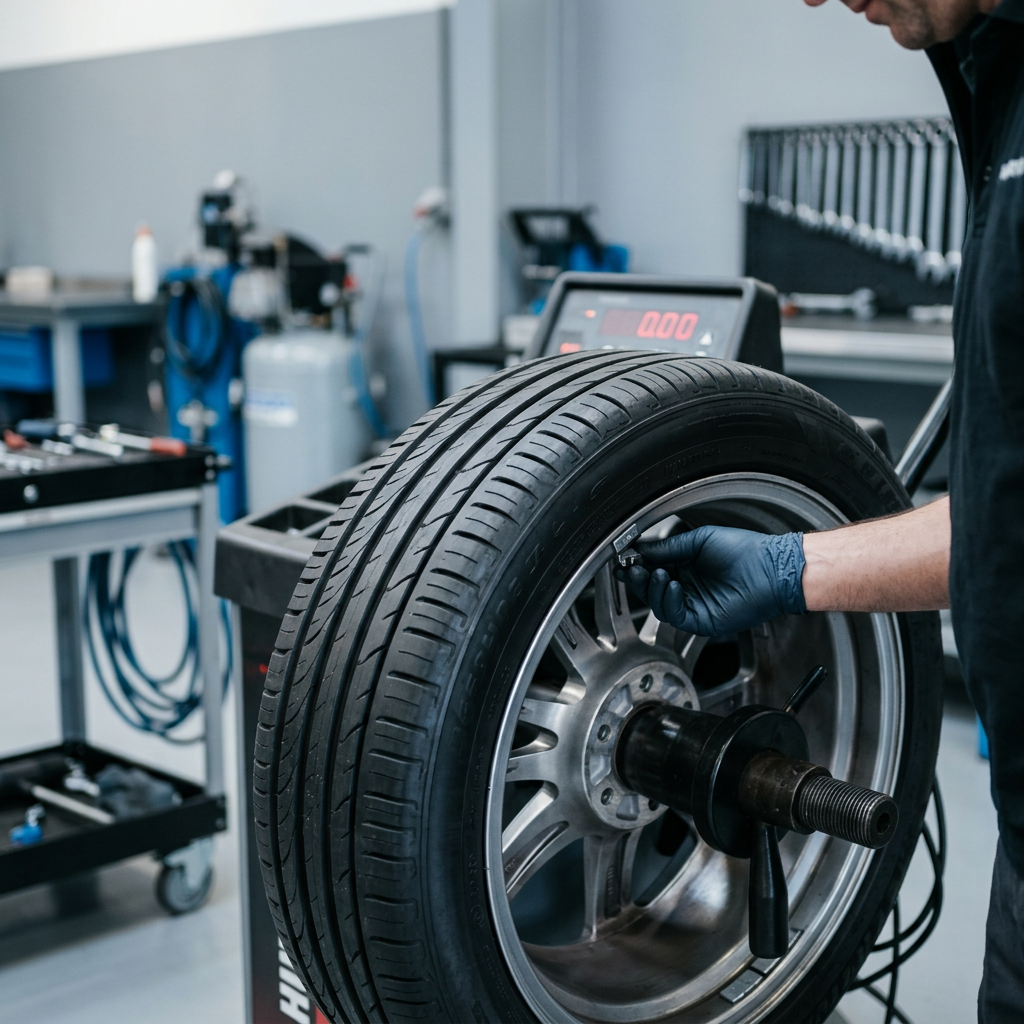
Every tire and wheel assembly, even when fresh off the production line, possesses minor imperfections in shape and weight distribution. These tiny variations can lead to a rough, unstable ride once the vehicle reaches cruising speeds. Tire balancing is the precise mechanical service that corrects these microscopic weight discrepancies, ensuring that the tire and wheel spin with a perfectly uniform center of gravity. When a vehicle drives down the road, an unbalanced wheel assembly creates centrifugal force that pulls the tire upward and downward, or side to side, resulting in a persistent vibration.
By strategically placing small counterweights on the wheel rim, service technicians can neutralize these heavy spots. This maintenance process is critical for preserving the integrity of your suspension, ensuring even tread wear, and maintaining optimal fuel economy. Drivers traveling along the rural routes around Onsted often notice tire imbalances quickly, as the transition from farm lanes to paved state highways makes even minor wheel vibrations highly apparent at cruising speeds. Addressing these minor shifts early prevents broader mechanical wear across your entire drivetrain.
When you notice a slight shimmy in your steering wheel, bringing your vehicle in for a quick diagnostic check is the best way to protect your automotive investment. Drivers can easily drop by to visit our express lane for rapid tire inspections, or they can use our online platform to schedule your service today to have a certified technician perform a comprehensive wheel check. If you prefer to set up your appointment through our dedicated brand portal, you can also schedule Mopar service online. For those who want to discuss their vehicle's specific symptoms with a specialist first, feel free to give our team a visit at our Clinton location or give us a quick call at (517) 456-6555 to speak directly with our service desk. We also maintain a high-quality selection of reliable vehicles for those looking to upgrade their daily drive, including an affordable inventory of used vehicles under $20,000.
Table of Contents
- What Is the Step-by-Step Process of Balancing Tires?
- Recognizing the Warning Signs and Symptoms of Unbalanced Tires
- When Is an Advanced Road Force Balance Absolutely Necessary?
- How Often to Schedule This Service and What It Costs
- Answers to Your Common Tire Maintenance Questions
- Keep Your Ride Smooth at NewGen Chrysler Dodge Jeep Ram of Clinton
What Is the Step-by-Step Process of Balancing Tires?
To balance a tire, a professional service technician must utilize highly specialized diagnostic equipment. The process begins by removing the wheel and tire assembly from the vehicle and securing it onto a computerized spin balancing machine. This machine rotates the assembly at high speeds to measure the exact amount of force variation and identify where the weight distribution is uneven. The computer calculates the precise ounce of weight required to correct the imbalance and pinpoints the exact location on the wheel where the counterweight must be applied.
Once the machine identifies the heavy spots, the technician cleans the wheel surface to ensure proper adhesion or attachment. Depending on the wheel design, the technician will either tap clip-on weights onto the rim flange or apply adhesive-backed weights to the inner barrel of the wheel. After the weights are installed, the technician spins the assembly on the machine a second time to verify that the balance is perfect, ensuring a ± 0.01 oz imbalance resolution. This double-check guarantees that the tire will roll smoothly without any vertical hop or lateral wobble.
- Assembly Mounting: The wheel is mounted onto the balancer shaft using precise centering cones.
- Spin Testing: The machine spins the tire to measure both static and dynamic forces.
- Weight Application: Counterweights are applied to the inner or outer planes of the wheel.
- Verification Spin: A final spin confirms the forces are fully neutralized before reinstalling the wheel.
Using advanced machinery is the only way to achieve this level of precision. To see our technicians utilizing these diagnostic systems, you can watch our video gallery to get a closer look at our service department in action. If you are looking to customize your vehicle's styling while keeping your rolling assemblies perfectly balanced, you can shop Mopar accessories to explore our certified wheel options. For those searching for a specific vehicle configuration suited for rugged utility, you can also use our CarFinder tool to locate the ideal model.
Recognizing the Warning Signs and Symptoms of Unbalanced Tires
How do you know when your vehicle is overdue for a tire balancing service? The most common indicator is a distinct physical vibration that travels through the steering wheel, floorboards, or driver's seat. Typically, these vibrations are barely noticeable at lower speeds but become highly pronounced once you reach highway speeds of 45 mph or higher. If you feel the shaking primarily in the steering wheel, the issue is usually located in the front tires. If the vibration is felt more in the seat or cabin floor, the rear tires are likely the culprit.
Ignoring these early warning signs can lead to rapid, uneven tire wear, often resulting in cupped tread patterns that permanently ruin the tire's ride quality. Over time, the constant shaking puts excessive stress on your suspension components, accelerating wear on your shocks, struts, and steering linkages. This mechanical strain can also cause a noticeable drop in fuel efficiency, as your engine has to work harder to overcome the erratic rolling resistance of the unbalanced rubber.
- Steering Wheel Shaking: A classic sign of front-wheel imbalance felt at highway speeds.
- Floorboard or Seat Vibrations: Indicates that one or both of the rear wheels are out of balance.
- Cupped Tread Wear: Distinct scalloped dips in the tire tread caused by the tire bouncing on the road.
- Decreased Fuel Economy: Increased rolling resistance forces the engine to burn more fuel.
Regularly inspecting your tires is key to avoiding these costly issues. You can visit our homepage to browse our full range of maintenance resources and care tips. If you notice uneven tread wear during your visual checks, you can shop OEM parts online to find replacement tires designed specifically for your vehicle. For personalized assistance with any unusual vehicle vibrations, please contact our team today to speak with a certified technician.
When Is an Advanced Road Force Balance Absolutely Necessary?
While a standard spin balancer is highly effective for everyday driving conditions, certain persistent vibrations require an advanced diagnostic approach known as road force balancing. A road force balancer utilizes a specialized diagnostic load roller that presses down on the tire with up to 1250 lbs of force, simulating the actual weight of the vehicle on the road. This test measures the structural uniformity of the tire and wheel assembly, detecting hard and soft spots in the rubber sidewall that a traditional free-spinning balancer completely misses.
This diagnostic method is absolutely necessary when standard balancing services fail to eliminate a persistent highway vibration. It is also highly recommended for modern vehicles equipped with large-diameter alloy wheels and low-profile tires, which are naturally more sensitive to minor force variations. By measuring radial and lateral runout to a precision of 0.002 inches, the machine can determine if the tire needs to be rotated on the wheel rim—a process called force matching—to align the stiffest part of the tire with the lowest spot of the wheel, neutralizing structural vibrations entirely.
For drivers navigating the undulating paved roads around Michigan Center, where consistent road contact is crucial for a smooth ride, a road force balance can make a night-and-day difference in cabin comfort. If your vehicle requires new components to restore its original ride quality, you can order genuine Mopar parts directly through our department. To stay informed on the latest automotive care technologies and maintenance advice, you can read our latest blog posts. If you are planning to order a brand-new vehicle built to your exact specifications, you can also custom order your vehicle through our dealership portal.
How Often to Schedule This Service and What It Costs
As a general rule of thumb, tires should be balanced every 5,000 to 7,500 miles, or roughly every time you bring your vehicle in for a routine oil change and tire rotation. Keeping to this consistent schedule ensures that as your tire tread naturally wears down, the weight distribution remains perfectly uniform. You should also have your wheels balanced immediately whenever you install new tires, have a tire repaired after a flat, or notice any new vibrations while driving.
The cost of tire balancing is highly affordable, typically ranging from $15 to $30 per tire depending on the wheel size, tire profile, and the complexity of the balancing technology required. Standard spin balancing sits on the lower end of this range, while advanced road force balancing with force matching carries a modest premium due to the specialized diagnostic equipment and labor involved. Investing in this routine service saves you hundreds of dollars in the long run by preventing premature tire replacement and protecting your suspension from costly wear.
To help keep your maintenance costs as low as possible, we recommend checking our rotating current service offers before your visit. You can view service specials online to find current offers on tire care, or check our alternative portal to view service specials for additional offers. If your vehicle requires specialized hardware or replacement wheel weights, our Mopar parts center is fully stocked with factory-certified components to ensure a perfect fit and long-lasting durability.
Answers to Your Common Tire Maintenance Questions
Understanding the difference between various tire services can help you make informed decisions about your vehicle's upkeep. Many drivers wonder why their car is behaving a certain way on the road, and our service team is always here to clarify these common maintenance scenarios.
Q: What is the difference between dynamic and static tire balancing?
Static balancing is a traditional method that uses a single weight placed along one plane of the wheel to correct an up-and-down hopping motion. Dynamic balancing is a more modern, comprehensive technique that places weights on both the inner and outer sides of the wheel to correct side-to-side wobble as well as vertical vibration.
Q: Do I need an alignment or balancing if my car pulls to one side?
If your vehicle is actively pulling to the left or right, you need a wheel alignment, which adjusts the angles of the steering and suspension systems. Tire imbalance causes vibrations in the steering wheel or seat but does not typically cause the vehicle to drift or pull to one side.
Q: Can hitting a pothole knock a tire out of balance?
Yes, hitting a pothole can easily knock a wheel weight off the rim, bend the wheel itself, or damage the internal structural belts of the tire. If you experience a hard impact while driving near Napoleon, it is highly recommended to have your wheel assemblies inspected for physical damage and rebalanced.
Q: Can unbalanced tires ruin wheel bearings?
Yes, the continuous, high-frequency vibrations caused by unbalanced wheels place extreme stress on your wheel bearings. Over time, this constant shaking can cause the grease inside the bearing to break down, leading to premature bearing failure and a costly repair.
Q: What is "force matching" in tire balancing?
Force matching is the process of using a road force balancer to find the stiffest point of the tire and the lowest point of the wheel rim. The technician then deflates the tire and rotates it on the wheel so these two points align, which minimizes the overall high spot and drastically reduces physical vibration.
If you have any further questions about your tires, you can order genuine parts or replacement tires online. For direct support, you can get directions to our service center to drop by for an inspection, or call our service desk directly at (517) 456-6555.
Keep Your Ride Smooth at NewGen Chrysler Dodge Jeep Ram of Clinton
Maintaining perfectly balanced tires is essential for enjoying a quiet, comfortable, and safe ride on every commute. At NewGen Chrysler Dodge Jeep Ram of Clinton, we value your time and are committed to keeping your vehicle running strong. Our factory-trained, certified technicians use state-of-the-art diagnostic equipment to identify and correct even the most stubborn wheel vibrations, ensuring your vehicle handles beautifully.
Whether you need a quick tire rotation, a standard spin balance, or an advanced road force diagnostic test, our team is ready to provide transparent pricing and efficient service tailored to your schedule. Do not let minor vibrations turn into expensive suspension repairs down the road. Use our convenient online scheduling tool to book your tire service today, and experience the peace of mind that comes with professional, local automotive care.
© 2026 NewGen Chrysler Dodge Jeep Ram of Clinton. All rights reserved.