

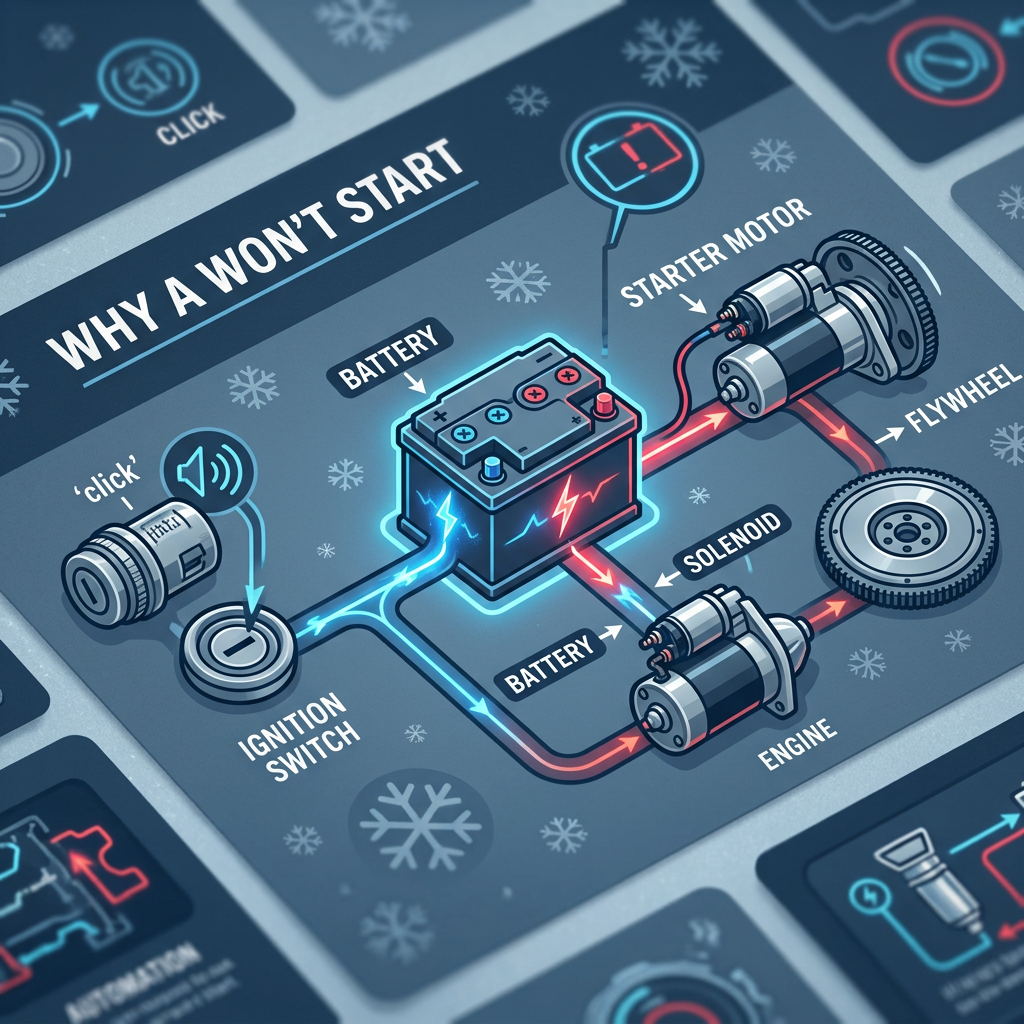
Turning the ignition key or pressing the start button only to hear a clicking sound is a frustrating experience for any driver. This common issue indicates that while your vehicle's electrical control system is attempting to initiate the starting sequence, there is a failure in delivering sufficient electrical current or mechanical force to rotate the engine. When you hear that distinct click, it means the starter solenoid is receiving some level of electrical power, but the starter motor itself cannot spin the engine's flywheel to bring the vehicle to life.
The underlying mechanics of this problem typically point to a breakdown in the electrical starting circuit. This circuit relies on a healthy battery, clean low-resistance connections, a functional starter motor, and a proper engine ground. If any of these components fail, the high amperage required to crank a large engine cannot be delivered. For example, a heavy-duty vehicle with high electrical demands requires robust starting power to turn over, and even a minor drop in voltage can halt the process entirely.
Cold weather significantly compounds these starting issues. During harsh Michigan winters, sub-freezing temperatures cause engine oil to thicken, which increases the mechanical resistance the starter must overcome. Simultaneously, extreme cold slows down the chemical reactions inside an automotive battery, reducing its cranking power. If you are stranded in your driveway, you can reach out to our service team by calling (517) 456-6555 for immediate troubleshooting advice. For those nearby who need to arrange a flatbed tow or plan a visit, our service department is located at 1111 W Michigan Ave, Clinton, MI 49236. If your vehicle is older and requiring frequent, costly repairs, it might be time to transition to a newer model backed by a fresh manufacturer warranty; you can browse our new vehicle inventory to see our latest dependable options.
Table of Contents
- Deciphering the Sounds: Single Loud Click vs Rapid Clicking Explained
- How to Tell if Your No-Start Issue Is a Dead Battery or a Bad Starter Motor
- Five Quick Diagnostic Tests You Can Perform in Your Own Driveway
- Recognizing Failing Alternator Warning Signs Before Your Battery Dies
- Professional Starter Replacement Timelines and Mopar Service Standards
- Common Questions About No-Start Diagnoses and Battery Maintenance
Deciphering the Sounds: Single Loud Click vs Rapid Clicking Explained
The specific pattern and volume of the clicking sound provide critical diagnostic clues about which component in the starting system has failed. Paying close attention to these auditory signals can help narrow down the root cause before you even open the hood.
- A Rapid, Continuous Clicking Sound: This rapid-fire noise is almost always a symptom of a severely depleted or discharged battery. When you turn the key, the battery has just enough voltage to energize the starter solenoid, pushing the starter gear forward. However, the moment the solenoid attempts to bridge the high-amperage connection to the starter motor, the weak battery's voltage instantly drops. This sudden drop causes the solenoid to disengage, pulling the gear back. With the load removed, the voltage bounces back up, re-energizing the solenoid and repeating the cycle rapidly.
- A Single, Loud Click: If you hear one distinct, heavy click when trying to start the engine, the diagnostic focus shifts toward the starter motor or its solenoid. This single click indicates that the solenoid is successfully engaging and pushing the starter drive gear into the engine's flywheel, but the starter motor itself is unable to spin. This can be caused by burnt internal electrical contacts within the starter, a seized starter motor armature, or a mechanical lock between the starter gear and the flywheel.
Understanding these differences can save you time and prevent unnecessary parts replacement. To see visual demonstrations of these electrical behaviors and other diagnostic tips, you can explore our video library. If you are unsure of what your vehicle's starting noises mean, feel free to reach out to our service advisors for professional guidance. For those interested in joining a team dedicated to solving these complex automotive problems, you can apply for our open technician positions online.
How to Tell if Your No-Start Issue Is a Dead Battery or a Bad Starter Motor
Differentiating between a failed starter motor and a depleted battery requires looking at how the rest of the vehicle's electrical systems behave under load. Since both issues prevent the engine from turning over, observing auxiliary components is the easiest way to isolate the culprit.
Start by turning on the headlights or the cabin dome light and watching them while you attempt to crank the engine. If the lights are bright but do not dim at all when you turn the key to the start position, the battery is likely holding a healthy charge, and the electrical current is not reaching the starter. This scenario strongly points to a failed starter motor, a bad starter solenoid, or an open circuit in the starter control wiring. Conversely, if the lights are incredibly dim or go completely dark the moment you attempt to start the car, the battery is either heavily discharged or has suffered internal cell damage.
Another indicator is the behavior of the dashboard electronics. Modern SUVs, such as a 2026 Jeep Grand Cherokee, feature sophisticated infotainment displays and digital instrument clusters that require a stable voltage threshold to boot up. If these screens flicker, reset, or display low-voltage warning messages when you press the push-button start, the battery is the primary suspect. If you want to learn more about our dealership's commitment to keeping your vehicle in peak operating condition, you can visit our main homepage. For drivers looking to configure a brand-new vehicle with a factory-fresh starting system and warranty coverage, you can submit a custom factory order. You can also view current offers to find specials on models equipped with the latest automotive technology.
Five Quick Diagnostic Tests You Can Perform in Your Own Driveway
Before calling for a tow truck, there are several straightforward diagnostic procedures you can perform yourself to identify or temporarily bypass the starting fault. These tests require minimal tools and can help determine if the issue is a simple fix.
The Gear Selector Shift Test
If your vehicle has a faulty neutral safety switch, it will prevent the starter from engaging because it incorrectly senses that the transmission is in gear. If you hear a click or nothing at all in Park, keep your foot firmly on the brake, shift the gear selector to Neutral, and try turning the key. If the engine starts, the neutral safety switch is failing and needs to be serviced.
The Jumper Cable Ground Test
A corroded or broken engine ground strap prevents electrical current from returning to the battery, stopping the starter from operating. You can test this by clamping one end of a single black jumper cable to the negative terminal of your battery and clamping the other end to a clean, unpainted metal bolt on the engine block. If the vehicle starts with this cable in place, your engine ground wire is damaged and must be replaced.
The Starter Tapping Method
If the starter motor has developed a "dead spot" on its internal armature or if the electrical brushes are sticking, physically vibrating the starter can sometimes restore contact. Gently tap the body of the starter motor with a screwdriver handle or a small wrench while an assistant attempts to turn the key. This temporary fix can shake the internal components back into alignment for one last start so you can drive to a repair facility.
Terminal Inspection and Cleaning
Corrosion acts as an electrical insulator, blocking the high current needed to start the engine. Inspect your battery terminals for a white or green powdery substance. If corrosion is present, disconnect the cables, clean the posts and clamps with a wire brush and a mixture of baking soda and water, and tighten them securely before trying to start the vehicle again.
Battery Voltage Verification
Using a digital multimeter, check the static voltage of your battery across the terminals. A fully charged automotive battery should read approximately 12.6 volts or higher. If the multimeter reads below 12.0 volts, the battery is discharged and cannot reliably engage the starting system.
For more maintenance tips and DIY automotive guides, you can read our latest blog posts. If you would like to discuss these diagnostic steps with our certified service team, you can meet our staff members online to find the right specialist. Additionally, if you enjoy the outdoor Jeep lifestyle and want to connect with other local enthusiasts, consider checking out how to participate in our next community event.
Recognizing Failing Alternator Warning Signs Before Your Battery Dies
While a dead battery is often the immediate cause of a clicking start, the alternator is frequently the root source of the failure. The alternator is responsible for generating electricity to power your vehicle's electronics and keep the battery charged while the engine is running. If the alternator fails, the vehicle will run entirely off the battery until the battery's reserve capacity is completely exhausted.
There are several warning signs that indicate an alternator is on its way to failure before it leaves you stranded. You might notice your headlights dimming or flickering at idle, or your power windows operating much slower than usual. Modern vehicles with high electrical loads, like a 2026 Dodge Durango with its extensive cabin electronics, may trigger battery warning lights on the dashboard or experience temporary glitches in the infotainment system when system voltage fluctuates. A whining or growling noise from the engine bay can also indicate a failing alternator bearing.
If you suspect your charging system is weak, you can search for a replacement vehicle using our online vehicle finder tool. For those looking for excellent value on a new vehicle with a fully functional charging system, you can view our current offers. We also make it easy to maintain your current vehicle by allowing you to explore brand-specific service incentives designed to keep your maintenance costs manageable.
Professional Starter Replacement Timelines and Mopar Service Standards
When a starter motor fails, replacing it is the only reliable long-term solution. A professional starter replacement is a precise procedure that involves disconnecting the electrical system, removing the mounting bolts, aligning the new starter drive gear with the engine's flywheel, and torquing all fasteners to factory specifications.
The time required to complete this repair varies depending on the vehicle's engine configuration. On most rear-wheel-drive trucks, the starter is easily accessible from underneath the vehicle, allowing a certified technician to complete the replacement in roughly 1 to 2 hours. However, on some modern vehicles with tightly packed engine bays, the starter may be buried beneath the intake manifold or behind exhaust heat shields, which can increase the labor time to 3 to 4 hours. Our factory-trained technicians use specialized diagnostic equipment to verify the starter failure before performing any work, ensuring we get you back on the road quickly and efficiently.
To minimize downtime, you can utilize our convenient service express lane for rapid battery testing and diagnostic checks without an appointment. If your vehicle requires replacement components, our parts department allows you to order genuine OEM parts directly. We stock a complete inventory of factory-authorized components, and you can request authentic Mopar parts designed specifically for your vehicle's starting system. If you prefer to customize your vehicle's utility, you can also browse our catalog of Mopar accessories.
To ensure your vehicle receives the highest standard of care, we recommend that you schedule certified Mopar service with our team. You can easily book your appointment online by using our direct service scheduling tool. Before you visit, make sure to review our current service promotions and check our latest maintenance specials to save on your next visit.
Common Questions About No-Start Diagnoses and Battery Maintenance
Q: Will a jump-start permanently fix a battery that causes rapid clicking?
A: No, a jump-start is only a temporary emergency measure. While it provides the external electrical boost needed to crank the engine, it does not repair the underlying battery condition. If the battery is depleted because you left the lights on, the alternator may recharge it during a long drive; however, if the battery is old or has internal cell damage, it will fail to hold a charge and will click again the next time you try to start it.
Q: How long does it take to fully recharge a discharged car battery?
A: Using a standard 10-amp trickle charger, it typically takes between 4 and 12 hours to bring a completely discharged battery back to a healthy, fully charged state. Fast chargers can boost a battery in under an hour, but slow charging is highly recommended by battery manufacturers because it minimizes heat buildup and prevents internal plate damage.
Q: What is the average life cycle of an automotive battery before it completely dies?
A: In the harsh, cold-winter climate of southern Michigan, automotive batteries typically last between 3 and 5 years. The combination of freezing winter temperatures and extreme summer engine bay heat accelerates the degradation of the active lead plates inside the battery, eventually causing it to lose its capacity to hold a charge.
Q: Should you clean corroded battery terminals before replacing any parts?
A: Yes, always clean the terminals first. Heavy corrosion creates high electrical resistance, which can mimic the exact symptoms of a dead battery or a failed starter. Cleaning the terminals with a wire brush is a simple, zero-cost diagnostic step that frequently restores the necessary electrical connection and resolves the starting issue entirely.
Q: Can extreme winter weather cause a starter motor to fail?
A: Cold weather does not directly damage the internal electrical windings of a starter, but it heavily increases the mechanical load on the starting system. Because cold engine oil is highly viscous, the starter must work much harder to turn the engine over, which can cause an already weak or aging starter motor to burn out under the extra strain.
If you are experiencing persistent starting issues, our service advisors are ready to assist. You can give our service department a call to discuss your vehicle's symptoms, or get directions to our dealership to bring your battery in for a professional load test. To learn more about our commitment to providing transparent, high-quality automotive care for our community, you can read about our dealership values. Additionally, if you want to understand the advanced electronics in your vehicle's cabin, you can learn about Uconnect infotainment technology and how it manages your vehicle's power settings.
© 2026 NewGen Chrysler Dodge Jeep Ram of Clinton. All rights reserved.