

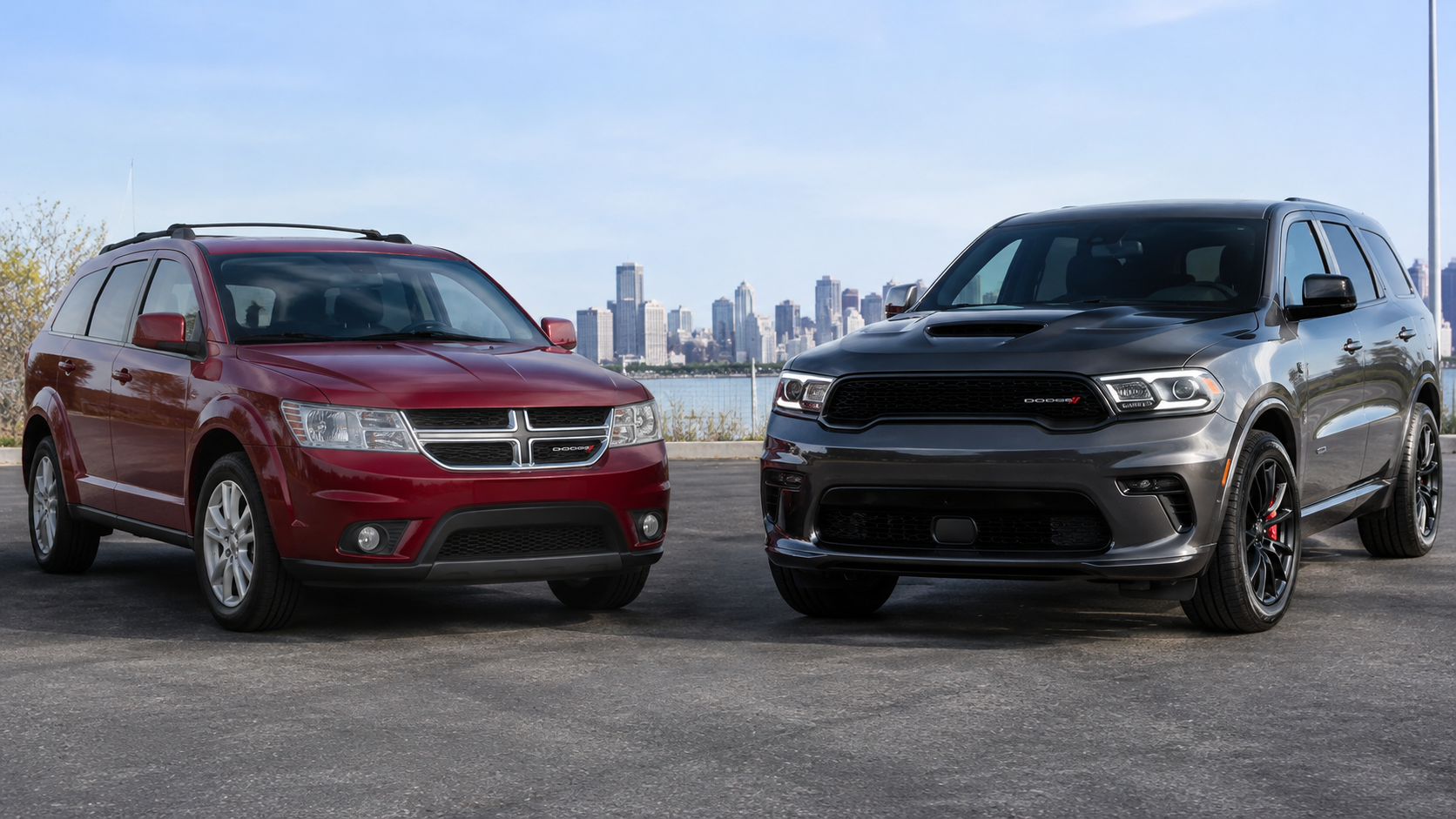
The Dodge Journey offers basic three-row functionality and accessible pre-owned pricing, but modern family crossovers outclass it across power, cargo capacity, passenger room, and active safety technology. While a pre-owned Dodge Journey delivers practical transportation, current midsize crossovers provide significantly larger third-row legroom, expanded cargo volume behind the rear seats, and standard automated driver-assist features that were never offered on the Journey platform.
When evaluating multi-passenger utility, comparing a legacy vehicle like the Dodge Journey to contemporary alternatives helps clarify what your daily driving demands. The Dodge Journey was designed as a compact-to-midsize crossover option, offering standard or available seven-passenger seating within a modest exterior footprint. U.S. production ended after the 2020 model year, leaving the pre-owned market as the sole destination for shoppers considering this nameplate.
Modern crossovers have grown in dimension, refined their suspensions, and made high-tech safety equipment standard gear. For drivers balancing carpools, weekend road trips, and changing seasonal road conditions, knowing how the Dodge Journey stacks up against modern alternatives makes finding the right family fit much easier. If you are comparing pre-owned crossovers or looking to upgrade your current ride, you can find our Clinton showroom address easily or give our team (517) 456-6555 to discuss available inventory.
Table of Contents
- How Does the Dodge Journey Compare to Modern Crossovers Like the Kia Telluride and Honda Pilot?
- What Are the Seating, Cargo, and In-Floor Storage Features of the Dodge Journey?
- Did the Dodge Journey Come with Automated Emergency Braking and Driver-Assist Tech?
- How Does the Dodge Journey Compare to the Dodge Durango for Families?
- Does Buying a Used Dodge Journey Represent a Good Value Proposition?
- Common Questions About the Dodge Journey and Modern Family Crossovers
- Explore New and Pre-Owned Family SUVs at Local Dealerships
How Does the Dodge Journey Compare to Modern Crossovers Like the Kia Telluride and Honda Pilot?
The Kia Telluride and Honda Pilot, both modern family crossovers, showcase advancements that the Dodge Journey lacks in design and technology. Modern three-row crossovers deliver 285 to 291 horsepower from smooth V6 powerplants, up to 5,000 lbs of maximum towing capacity, and over 31 inches of third-row legroom. In contrast, late-model Dodge Journey vehicles were powered by a 2.4L four-cylinder engine producing 173 horsepower paired with a 4-speed automatic transmission, yielding a maximum tow rating of just 1,000 lbs.
The differences become immediately apparent in highway merging and full-passenger performance:
- Powertrain Efficiency and Output: A 2.4L four-cylinder Dodge Journey manages an EPA rating of 19 mpg city / 25 mpg highway, yet its 173-horsepower output requires heavy throttle input when carrying a full load of passengers. Modern entries like the Honda Pilot or Kia Telluride utilize sophisticated multigear automatics (8-speed or 10-speed transmissions) that optimize torque delivery while maintaining competitive fuel economy.
- Towing and Utility: With a maximum trailer capacity of 1,000 lbs, the Dodge Journey is limited to light utility trailers. Newer midsize crossovers routinely tow between 5,000 lbs and 5,500 lbs when properly equipped, making them capable of hauling boats, campers, and recreational equipment.
- Ride Comfort and Handling: Modern crossovers utilize rigid platforms with advanced multi-link suspensions that isolate cabin noise and absorb rough road surfaces far better than older crossover architectures.
Keeping any crossover running smoothly requires routine upkeep. Whether you drive a pre-owned Dodge Journey or a late-model SUV, maintaining your vehicle is easy when scheduling a Mopar service appointment with factory-trained technicians.
What Are the Seating, Cargo, and In-Floor Storage Features of the Dodge Journey?
The Dodge Journey features a flexible interior layout with standard seven-passenger seating, second-row in-floor storage bins, and up to 68 cubic feet of maximum cargo space. However, its 11 cubic feet of cargo space behind the third row and 25 inches of third-row legroom lag behind modern family crossovers that offer between 75 and 87 cubic feet of maximum cargo room.
For families packing gear for local outings around Onsted, where rolling farmland and nearby recreational lakes require extra space for coolers and sports equipment, interior versatility is essential. The Dodge Journey excels in clever small-item organization, featuring second-row in-floor storage compartments with removable, washable liners that can hold tools, gear, or iced beverages.
However, passenger accommodations in the rearmost seats remain tight:
- Third-Row Legroom: The Dodge Journey provides 25 inches of legroom in the third row, which is tight for adults or older teenagers on long trips. Contemporary crossovers like the Honda Pilot offer over 32 inches of rearmost legroom.
- Cargo Space Behind Seats: With all three rows upright, the Dodge Journey holds just 11 cubic feet of cargo. Folding the third row expands cargo capacity to 37 cubic feet, while folding both rear rows flat yields 68 cubic feet. Modern rivals provide 18 to 21 cubic feet behind the third row and upwards of 85 cubic feet overall.
Finding a vehicle with flexible seating that fits your monthly budget is simple when applying for financing online before taking a test drive.
Did the Dodge Journey Come with Automated Emergency Braking and Driver-Assist Tech?
No, automated emergency braking and forward collision warning were never offered on the Dodge Journey throughout its entire production run. Modern driver-assist technologies like adaptive cruise control, active lane keeping, and automatic emergency braking are standard on current crossovers but were absent from the Journey lineup.
Safety tech evolved rapidly during the last decade, leaving legacy models without the active driver-assist systems found in contemporary vehicles. The final 2020 Dodge Journey models came equipped with mandatory passive safety equipment and basic driver aids:
- Standard Safety Gear: ParkView rear backup camera, ParkSense rear park assist, electronic stability control, electronic roll mitigation, and multi-stage front and side-curtain airbags.
- Missing Driver-Assist Features: Blind-spot monitoring, rear cross-traffic alert, lane departure warning, adaptive cruise control, and automated emergency braking were not engineered into the Journey platform.
For owners maintaining a pre-owned vehicle, keeping safety and braking components in top condition is vital. Our department makes maintaining your vehicle simple by providing direct access to ordering genuine Mopar parts for all factory-recommended replacement needs.
How Does the Dodge Journey Compare to the Dodge Durango for Families?
The Dodge Durango represents a major upgrade over the Dodge Journey in size, structural platform, performance, and towing capacity. Built on a rear-wheel-drive architecture with standard or available all-wheel drive, the Durango offers V6 or V8 engines and up to 8,700 lbs of towing capability, whereas the front-wheel-drive Journey was designed strictly as a light-duty crossover.
For drivers who regularly commute to Jackson from Michigan Center, taking local highways in harsh winter conditions requires confident traction and strong power. The Dodge Durango delivers a muscular design, expansive passenger space, and modern technology that outmatches the former Journey in every category.
Comparing key specifications highlights the performance gap:
- Engine Performance: While the Journey relied on a 173-horsepower four-cylinder, a new Dodge Durango offers powerful engine options, including a 295-horsepower V6 or available HEMI V8 engines producing over 350 horsepower.
- Towing Capability: The Durango hauls heavy loads with ease, offering a tow rating between 6,200 lbs and 8,700 lbs depending on engine configuration, compared to the Journey's 1,000 lbs limit.
- Modern Safety Features: Models like the 2027 Dodge Durango GT AWD include advanced safety systems such as Full Speed Forward Collision Warning Plus, Adaptive Cruise Control with Stop, and Blind Spot Monitoring.
If you want muscle-car styling combined with true three-row utility, explore our new Dodge Durango inventory or check out new Dodge Durango GT AWD models to see current availability.
Does Buying a Used Dodge Journey Represent a Good Value Proposition?
A pre-owned Dodge Journey can serve as a strong value option for buyers needing seven seats on a strict budget, provided its maintenance history is verified. While its 2.4L four-cylinder engine paired with a 4-speed automatic transmission delivers basic daily transportation, buyers prioritize its low acquisition price relative to larger three-row SUVs.
Families evaluating pre-owned three-row vehicles on our lot often ask to test the third-row folding mechanism before taking a test drive. Checking how easily seats fold flat and inspecting interior wear helps determine if a pre-owned model fits your daily routine.
When shopping for pre-owned crossovers, consider these key practical factors:
- Target Trims: Look for Crossroad or GT trim models equipped with the 3.6L Pentastar V6 engine and 6-speed automatic transmission for significantly improved acceleration and highway passing confidence over four-cylinder models.
- Value Alternative: Buyers seeking updated tech, higher towing limits, and greater overall cabin space often choose a pre-owned Dodge Durango instead.
You can compare options directly by exploring our new Dodge Durango showroom details or reviewing our pre-owned Dodge Durango inventory. If you have a vehicle to trade in toward your purchase, start by evaluating your trade-in online to estimate your current vehicle's worth.
Common Questions About the Dodge Journey and Modern Family Crossovers
Q: Is the Dodge Journey still in production for U.S. buyers?
No, official production of the U.S.-market Dodge Journey ended following the 2020 model year. Shoppers interested in a Dodge Journey will find them available strictly as pre-owned vehicles. Buyers searching for a new three-row Dodge SUV today can explore the Dodge Durango lineup.
Q: How much can a Dodge Journey tow compared to a modern three-row crossover?
The late-model Dodge Journey has a maximum towing capacity of 1,000 lbs when powered by its standard 2.4L four-cylinder engine. Modern three-row crossovers, including the Dodge Durango, Kia Telluride, and Honda Pilot, typically offer tow ratings ranging from 5,000 lbs up to 8,700 lbs when properly equipped.
Q: Does the Dodge Journey have built-in second-row storage?
Yes, the Dodge Journey features second-row in-floor storage bins. These compartments include removable, washable plastic liners, making them ideal for storing small items, travel supplies, or ice and drinks during road trips.
Q: What safety features are missing on a used Dodge Journey?
The Dodge Journey does not feature active driver-assist technologies such as automated emergency braking, forward collision warning, lane-keeping assist, or adaptive cruise control. It comes equipped with standard passive safety features, including airbags, a backup camera, stability control, and rear parking sensors.
Q: What current Dodge SUV should buyers compare to a used Dodge Journey?
Shoppers evaluating a Dodge Journey should compare it to the Dodge Durango. The Durango offers standard three-row seating, significantly more interior passenger and cargo volume, advanced Uconnect 5 infotainment technology, higher towing capacity, and available all-wheel drive.
Explore New and Pre-Owned Family SUVs at Local Dealerships
Choosing the right crossover comes down to balancing your seating needs, daily commute requirements, and vehicle budget. While a pre-owned Dodge Journey offers a practical option into three-row seating, modern SUVs like the Dodge Durango provide the power, safety technology, and towing capacity that busy families rely on every day.
Our team is dedicated to providing transparent pricing and a pressure-free environment to help you find the ideal vehicle. Whether you want to test drive a robust three-row SUV or evaluate your current vehicle for trade, we are here to support your search. You can visit our Clinton dealership today, contact our sales department at (517) 456-6555, or get started online by exploring our pre-owned vehicle specials.
© 2026 NewGen Chrysler Dodge Jeep Ram of Clinton. All rights reserved.