

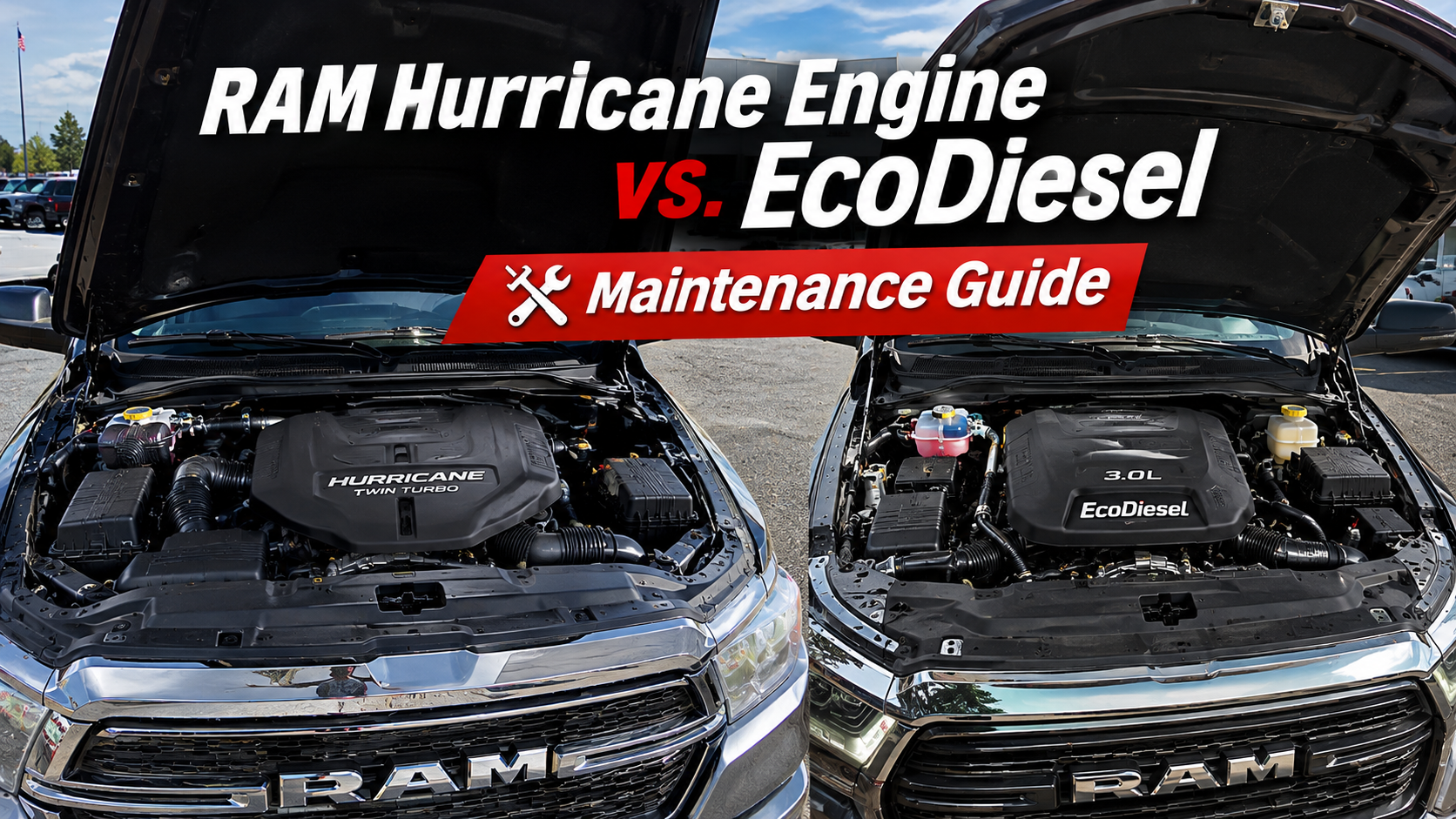
Ram Hurricane Engine vs EcoDiesel: Maintenance Guide
What Are the Primary Maintenance Requirements for the Ram 3.0L Hurricane Twin-Turbo Engine?
Maintaining the 3.0L Hurricane twin-turbo inline-six engine requires adhering to strict fluid specifications, timely oil monitor alerts, and periodic ignition component swaps. Routine care centers around full-synthetic oil changes every 10,000 miles or 12 months, air filter replacements at 30,000 miles, and fresh spark plugs at 60,000 miles. Because twin turbochargers demand clean oil and stable thermal management, keeping up with oil change intervals and coolant inspections protects internal bearings and prevents boost-system failure over long miles.
When servicing the 3.0L Hurricane Standard Output engine delivering 420 hp and 469 lb-ft of torque, Stellantis specifies 0W-20 full-synthetic motor oil meeting MS-6395 standards. For drivers running the High Output variant producing 540 hp and 521 lb-ft of torque, the factory schedule requires 0W-40 full-synthetic motor oil to handle increased cylinder pressures and higher turbo temperatures. Oil change indicators track driving conditions, engine load, and operating hours, so severe service—like frequent short trips or pulling trailers—may trigger an oil change well before the 10,000-mile cap.
Because twin turbochargers run at high speeds, engine oil acts as both a lubricant and a critical coolant for turbo center bearings. Allowing dirty oil to circulate leads to carbon varnish on shaft seals and oil feed lines. In addition to oil service, the dual intake air filters must stay clean to ensure unrestricted airflow to both turbo compressors. For drivers hauling gear around Onsted, local farm dust, and unpaved back roads can clog filters faster than highway driving, making 15,000-mile air filter checks a smart habit.
Our certified technicians handle complete factory maintenance using original Mopar fluids and filters. You can stop by our service center in Clinton or give our service desk a quick call to verify your truck's specific maintenance requirements.
Table of Contents
- What Required Routine Service Items Are Specific to the Ram 3.0L EcoDiesel Engine?
- How Do Long-Term Powertrain Repair Costs Compare Between Ram Hurricane and EcoDiesel Engines?
- What Is the Real-World Fuel Cost Difference per Mile Between Ram Hurricane and EcoDiesel?
- What Is the Maximum Towing Capacity of the Ram 1500 with a 3.0L Hurricane Engine?
- How Difficult Is Changing Spark Plugs and Servicing the Ram 3.0L Hurricane Engine?
What Required Routine Service Items Are Specific to the Ram 3.0L EcoDiesel Engine?
Routine maintenance for the 3.0L EcoDiesel engine revolves around managing diesel exhaust emissions systems and maintaining ultra-clean fuel delivery. Primary service demands include replenishment of Diesel Exhaust Fluid every 5,000 to 10,000 miles, dual fuel filter replacement every 20,000 to 30,000 miles, and strict adherence to 5W-40 synthetic diesel oil schedules with a 10.5-quart sump capacity. Managing these diesel-specific fluids prevents costly emissions system clogging and fuel injector damage.
Unlike gasoline powerplants, the EcoDiesel relies on a high-pressure common-rail fuel system that operates under extreme hydraulic pressures. Water or particulate contamination in diesel fuel quickly scoring precision injector nozzles and fuel pumps. Replacing the primary chassis-mounted fuel filter and the secondary engine-mounted filter on schedule shields the high-pressure pump from premature wear.
Exhaust emissions maintenance represents another major ongoing requirement for the EcoDiesel. The Selective Catalytic Reduction system requires consistent quality fluid refills, while the Diesel Particulate Filter requires periodic passive or active regeneration cycles to burn off trapped soot. Short driving cycles without sufficient highway warm-up time cause incomplete regenerations, soot buildup in the EGR valve, and eventual filter restriction. Drivers commuting from Michigan Center to nearby Jackson often get enough highway distance to complete natural soot burn-off, whereas persistent low-speed idling requires manual regeneration or shop intervention.
Keeping your truck running smoothly requires regular monitoring of oil life and emissions monitors. When it is time for routine maintenance, drivers can easily schedule service online with our certified team. If you are comparing pre-owned diesel models with modern twin-turbo gasoline options, explore our new Ram 1500 inventory to see the latest twin-turbo technology.
How Do Long-Term Powertrain Repair Costs Compare Between Ram Hurricane and EcoDiesel Engines?
Long-term repair costs for the 3.0L EcoDiesel tend to accumulate around complex exhaust emissions control hardware, whereas long-term care for the 3.0L Hurricane twin-turbo centers on thermal management and forced-induction components. Over 100,000 miles, the EcoDiesel incurs higher scheduled maintenance expenses due to fuel filter replacements, larger oil capacities, and DEF replenishment, alongside potential out-of-warranty repairs for EGR coolers, soot sensors, and DPF filters. The Hurricane inline-six eliminates diesel exhaust components entirely, placing long-term service focus on cooling circuits, intercoolers, and dual turbochargers.
The 3.0L EcoDiesel was offered in the Ram 1500 through the 2022 model year, meaning most diesel trucks on the road today are out of or nearing the end of factory coverage. Out-of-warranty repairs on diesel emissions hardware—such as replacing clogged DPF units or failed SCR injectors—represent substantial component costs. High-pressure fuel pump service also requires specialized labor and precision clean-room assembly procedures.
By contrast, the 2026 Ram 1500 features the Hurricane engine family and may be backed by a 10-year/100,000-mile limited powertrain warranty, depending on model and configuration. The Hurricane inline-six uses direct fuel injection and dual overhead camshafts, avoiding complex diesel exhaust fluid systems. While dual turbochargers and variable valve timing mechanisms require clean, high-grade synthetic oil to protect internal bearings and cam phasers, routine maintenance costs remain predictable.
Using genuine factory components during routine service ensures your engine operates within tight internal tolerances. You can easily order original Mopar parts directly through our dealership to keep your powertrain running like new.
What Is the Real-World Fuel Cost Difference per Mile Between Ram Hurricane and EcoDiesel?
Real-world fuel cost per mile between the 3.0L Hurricane twin-turbo engine and the 3.0L EcoDiesel is surprisingly close, despite the diesel engine's higher highway fuel efficiency ratings. While the EcoDiesel achieves superior miles per gallon during steady highway cruising, the higher average retail cost of diesel fuel relative to regular unleaded gasoline offsets much of the raw mileage advantage at the pump.
Calculating operating expense per mile requires factoring in regional fuel price variances alongside fluid additions. The EcoDiesel delivers impressive range on long trips, but adding the ongoing cost of Diesel Exhaust Fluid every few thousand miles increases its total cost per highway mile. When diesel fuel carries a 15% to 20% price premium over unleaded gas, the per-mile fuel expenditure between a standard Hurricane engine and a used EcoDiesel yields a minimal cash difference over typical annual mileage.
For truck owners who haul light loads or run daily mixed commutes, the Hurricane Standard Output offers strong efficiency without requiring specialized fuel pumps or diesel additives. Higher-mileage drivers who spend hours on the interstate may see slight operational savings with diesel, but overall routine service costs narrow the net financial gap between the two powerplants.
What Is the Maximum Towing Capacity of the Ram 1500 with a 3.0L Hurricane Engine?
When properly equipped, a 2026 Ram 1500 powered by the 3.0L Hurricane Standard Output engine reaches a maximum towing capacity of up to 11,560 lbs. This heavy-duty hauling capability is supported by 420 hp and 469 lb-ft of torque, delivering strong low-end pulling force that rivals traditional V8 engines while maintaining responsive acceleration under load.
Proper equipment for maximum towing includes appropriate axle ratios, integrated trailer brake controllers, and heavy-duty engine cooling packages. The twin-turbo design builds peak torque low in the RPM band, allowing the transmission to hold higher gears during highway pulls rather than constantly downshifting on grades. For work applications or towing recreational boats to local waters, this sustained low-end torque provides smooth trailering stability.
Truck owners comparing capability across trims will find impressive utility throughout the model lineup. Drivers interested in experiencing this pulling power firsthand can browse our selection of new Ram 1500 trucks or check out popular configurations like our new Ram 1500 Big Horn models to match their towing needs.
How Difficult Is Changing Spark Plugs and Servicing the Ram 3.0L Hurricane Engine?
Changing spark plugs on the 3.0L Hurricane twin-turbo inline-six engine rates as moderate in difficulty, primarily requiring the removal of top engine plastic covers, intake air ducting, and charge air pipes to reach the ignition coils. Because the inline-six cylinder configuration places all six spark plugs in a clean row along the top of the cylinder head, accessing the plugs is straightforward once the upper engine bay shrouding is cleared.
The factory service schedule calls for spark plug replacement at 60,000 miles. High-boost twin-turbo engines place greater electrical demand on spark plugs than naturally aspirated engines, making plug gap retention and electrode wear critical to preventing cylinder misfires under heavy acceleration. Using exact-fit OEM iridium spark plugs prevents pre-ignition and maintains clean combustion chamber burning.
Truck owners who come in for service often ask whether changing from the EcoDiesel to the Hurricane inline-six means more time in the shop for turbo maintenance. In practice, modern liquid-cooled turbo housings and electronic wastegates require minimal direct maintenance beyond keeping clean engine oil and fresh air filters in place.
If your truck is approaching its major maintenance interval, our certified technicians have the specialized tools to service your ignition and intake systems quickly. Visit our service center in Clinton or call our team at (517) 456-6555 to schedule your maintenance appointment today.
© 2026 NewGen Chrysler Dodge Jeep Ram of Clinton. All rights reserved.