

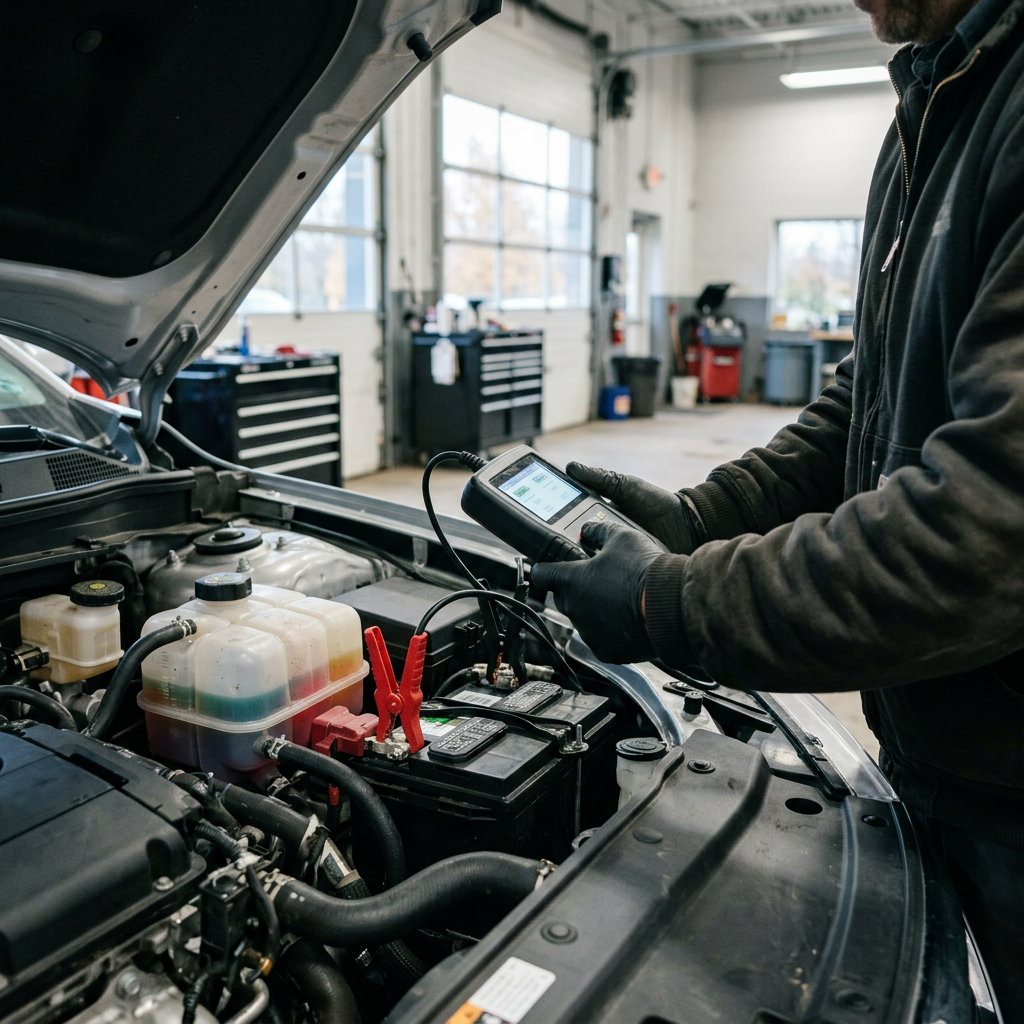
Michigan drivers should prepare car batteries and cooling systems for winter by conducting a load test on the battery to ensure sufficient cranking amperage, verifying that the coolant mixture protects against temperatures down to -34 degrees Fahrenheit, inspecting hoses and drive belts for wear, cleaning terminal corrosion, and topping off fluids with OEM-specified formulations before the first hard freeze. Taking these steps in late fall prevents sudden morning start failures and protects internal engine components from severe freezing damage.
Preparing a vehicle for harsh winter conditions requires a systematic approach focused on the two components most vulnerable to extreme temperature drops: the 12-volt battery and the engine cooling system. Sub-zero temperatures put simultaneous stress on both systems. Cold weather slows down the chemical reactions inside a battery, reducing available cranking power, while cold engine oil thickens, requiring significantly more energy to turn the crankshaft. At the same time, liquid coolant must maintain proper fluid viscosity and chemical balance to prevent ice crystal formation inside the radiator, heater core, and engine block.
A comprehensive winter preparation checklist includes essential maintenance steps that should be completed before freezing weather arrives:
- Battery Load and Voltage Testing: Measure rest voltage with a multimeter (a fully charged battery reads roughly 12.6 volts) and perform a conductance load test to check remaining cold cranking capacity.
- Terminal and Cable Care: Clean white or green oxidation off lead terminals using a wire brush and neutralizing solution, then tighten terminal clamps and hold-down brackets to eliminate power resistance and vibration damage.
- Coolant Freeze-Point Inspection: Use a optical refractometer or hydrometer to check the exact freeze-point protection level of the antifreeze in the overflow reservoir.
- Cooling System Pressure Test: Apply pressure to the radiator cap and cooling lines to identify micro-cracks, weeping water pump seals, or loose hose clamps before high pressure and deep freezes expand small leaks.
- Belt and Hose Inspection: Examine serpentine belts for cracking, fraying, or tension loss, and squeeze radiator hoses to ensure rubber remains firm yet pliable without soft or brittle spots.
For drivers navigating open rural routes around Onsted, where overnight wind chills drop ambient temperatures rapidly, taking care of these checks before deep winter sets in is essential for reliable daily driving. Performing these inspections early in the autumn ensures your vehicle starts reliably on the coldest mornings and protects expensive mechanical components from winter stress. If you prefer professional preparation, you can drop by our Clinton facility at 1111 W Michigan Ave or give our team a quick phone call to set up a pre-winter inspection.
| Winter Maintenance Task | Key Inspection Parameter | Target Specification / Condition |
|---|---|---|
| Battery Voltage Check | Rest state electrical charge | ~12.6 Volts fully charged |
| Cold Cranking Amps | Low-temperature starting power | 600 to 800 CCA minimum rating |
| Coolant Freeze Rating | Fluid freezing threshold | -34 degrees Fahrenheit (50/50) or -84 degrees Fahrenheit (70/30) |
| Coolant Chemistry | Inhibitor formulation | Silicate-free OAT (MS-90032 for 2013+ Mopar) |
| Terminal Integrity | Physical contact & cleanliness | Zero corrosion, tight clamps, secure tray bracket |
Table of Contents
- How Does Sub-Zero Weather Impact Battery Life and Cold Cranking Amps (CCA)?
- Do AGM Batteries Last Longer Than Standard Flooded Batteries in Deep Cold?
- What Is the Difference Between IAT, OAT, and HOAT Antifreeze Formulations?
- How Cold Can a 50/50 vs 70/30 Coolant Mixture Protect Your Engine?
- What Does a Professional Coolant Flush Cost near Clinton, MI?
- Frequently Asked Questions About Winter Battery and Antifreeze Maintenance
- Prepare Your Vehicle for Michigan Winter Weather Today
How Does Sub-Zero Weather Impact Battery Life and Cold Cranking Amps (CCA)?
Sub-zero weather reduces a lead-acid car battery's available electrical output by up to 50% at 0 degrees Fahrenheit due to slowed chemical reactions inside the cell plates, while simultaneously requiring up to twice as much current to crank an engine filled with cold, thickened motor oil. For dependable winter starting in Michigan, passenger vehicles require a battery rated for a minimum of 600 to 800 CCA, while larger trucks and V8 engines need 750 to 850 CCA or higher.
Cold Cranking Amps, commonly abbreviated as CCA, is an industry-standard rating defined by the Battery Council International. It measures the exact discharge current in amperes that a new, fully charged 12-volt battery can deliver continuously for 30 seconds at 0 degrees Fahrenheit while maintaining a terminal voltage of at least 7.2 volts. As ambient temperatures fall below freezing, the sulfuric acid electrolyte solution inside flooded and AGM batteries becomes more viscous. This slowing of ion movement prevents the battery from transferring chemical energy into electrical current efficiently.
When a battery is three to five years old, normal plate sulfation has already degraded a portion of its storage capacity. In mild summer weather, a compromised battery may deliver enough amperage to spin a warm engine without noticeable effort. However, when the first severe winter cold snap arrives, the combined effect of reduced internal battery capacity and increased engine cranking resistance causes extremely slow starter engagement or complete electrical failure.
Vehicles with larger engines—such as a Ram 1500 equipped with a 5.7L HEMI V8 or a Dodge Durango—require heavy starter motors that pull massive initial current spikes. Ensuring your replacement battery matches or exceeds factory CCA specifications prevents unexpected stranding. Drivers can ensure winter readiness by scheduling a Mopar battery inspection online before cold weather takes its toll.
Do AGM Batteries Last Longer Than Standard Flooded Batteries in Deep Cold?
Absorbed Glass Mat ( AGM) batteries last between 4 to 7 years in severe cold climates compared to 3 to 5 years for conventional flooded lead-acid batteries because their micro-fiberglass matting keeps electrolyte immobilized against the lead plates, preventing plate degradation, acid stratification, and freezing. AGM designs provide lower internal electrical resistance, allowing faster recharges and higher sustained cranking power during extreme temperature drops.
In a traditional flooded battery, liquid electrolyte flows freely around vertical lead plates. During cold-weather driving, repeated short trips with high electrical loads can cause acid stratification, where heavier concentrated acid settles to the bottom of the casing, accelerating grid corrosion and reducing effective CCA. In contrast, an AGM battery absorbs the liquid acid solution completely inside ultra-thin fiberglass separators. This construction keeps the electrolyte in constant, uniform contact with active plate materials, maximizing power density and preventing fluid loss or freezing even if the battery state of charge drops temporarily.
The performance advantages of AGM technology become especially noticeable in modern vehicles equipped with electronic start-stop systems, high-output cabin heaters, heated seats, heated steering wheels, and advanced driver-assist screens. These systems place massive continuous electrical loads on the 12-volt system. An AGM battery offers up to three times the cycle life of a standard battery, accepts alternator recharges up to five times faster, and retains superior starting power when vehicles are parked outdoors in freezing temperatures overnight.
Daily commuters driving from Michigan Center toward regional highways during sub-zero mornings benefit significantly from the increased reserve capacity and steady electrical delivery of an AGM battery. When upgrading or replacing a worn battery, vehicle owners can select factory-engineered fitments by ordering genuine Mopar parts built specifically for their vehicle platform.
What Is the Difference Between IAT, OAT, and HOAT Antifreeze Formulations?
The primary differences between IAT, OAT, and HOAT antifreeze formulations center on their chemical corrosion inhibitors, service life spans, and metallurgic compatibility, with modern OAT formulations providing silicate-free protection for up to 10 years or 150,000 miles. Using the correct formulation prevents internal corrosion, scale buildup, and chemical erosion inside aluminum, cast iron, and copper cooling passages.
Inorganic Additive Technology ( IAT) is the traditional green coolant chemistry used in older automotive platforms. It utilizes inorganic salts, silicates, and phosphates that quickly form a thick protective barrier over iron and aluminum surfaces. However, silicates deplete rapidly over time and can form abrasive scale, requiring complete fluid replacement every 3 years or 36,000 miles to prevent cooling system clog issues.
Organic Acid Technology ( OAT) represents the modern industry standard for current production vehicles, including 2013 and newer Chrysler, Dodge, Jeep, and Ram models requiring specification MS-90032. OAT coolants contain non-depleting organic carboxylate acids and contain zero silicates or phosphates. Rather than coating every square millimeter of internal metal, OAT chemicals react selectively at active corrosion sites. This allows OAT fluid to maintain stable heat transfer properties and provide protection for up to 10 years or 150,000 miles.
Hybrid Organic Acid Technology ( HOAT) combines organic acids with a small concentration of silicates to deliver rapid surface passivation along with long-term protection. Typically orange or yellow in color, HOAT formulas (such as specification MS-9769) were factory-filled in many 2000 to 2012 vehicles and feature a 5-year or 100,000-mile service interval.
Mixing different coolant chemistries—such as pouring IAT or HOAT coolant into an OAT system—causes a severe chemical reaction. The organic acids and inorganic silicates react negatively, causing the corrosion inhibitors to drop out of solution. This forms a thick, gel-like sludge that clogs narrow radiator core tubes, blocks heater core passages, and destroys water pump mechanical seals.
How Cold Can a 50/50 vs 70/30 Coolant Mixture Protect Your Engine?
A standard 50/50 pre-mixed coolant solution protects engine cooling systems against freezing down to -34 degrees Fahrenheit and guards against boil-over up to 265 degrees Fahrenheit, whereas a 70/30 coolant-to-water concentration lowers the freezing threshold down to approximately -84 degrees Fahrenheit for severe Midwestern winter conditions. Maintaining the correct glycol-to-water ratio is crucial because both under-concentrated and over-concentrated mixtures compromise thermal protection.
Ethylene glycol, the active chemical base in most automotive antifreeze, exhibits a physical property known as freezing-point depression when dissolved in pure water. Surprisingly, pure 100% ethylene glycol freezes at roughly 0 to -5 degrees Fahrenheit. Water molecules are necessary to disrupt the crystalline structure of the glycol, creating a liquid mixture that stays fluid at temperatures well below the freezing point of either individual component.
While a 50/50 blend offers complete protection for standard winter conditions, vehicles parked outdoors during prolonged polar vortex events can benefit from increasing the concentration up to 70% coolant and 30% water. However, the mixture should never exceed 70% antifreeze. Concentrating fluid beyond 70% drastically reduces the heat transfer capacity of the liquid—since pure water absorbs and dissipates heat far more efficiently than glycol—which can lead to engine overheating during hard towing or summer driving.
Our service team often notes that drivers testing or maintaining their vehicles before winter usually ask whether a standard 50/50 coolant mix is enough for overnight sub-zero snaps before they ask about battery voltage. Checking your fluid concentration with a handheld optical refractometer provides an immediate, precise reading of your exact freezing threshold so you can adjust ratios accurately before winter conditions worsen.
What Does a Professional Coolant Flush Cost near Clinton, MI?
A professional automotive coolant flush generally costs between $100 and $180, depending on the total fluid volume of the cooling system, engine size, and whether a secondary heater core or auxiliary radiator flush is required. Investing in a professional flush ensures old, acidic coolant, suspended rust particles, and breakdown debris are completely purged before fresh OEM fluid is added.
Service costs vary depending on vehicle configuration and fluid specifications:
- Standard Passenger Cars and Crossovers: Typically range from $100 to $140, utilizing standard fluid volumes (roughly 2 to 3 gallons of premixed coolant).
- Trucks and Performance V8 Engines: Larger systems found in full-size trucks or performance platforms require higher fluid volumes, placing costs between $130 and $180.
- Vehicles with Rear Heating or Auxiliary Coolers: Models like the Chrysler Pacifica with rear passenger climate systems require additional labor to bleed trapped air pockets across extended fluid lines.
Attempting to skip regular cooling system flushes or relying on quick drain-and-fill methods leaves up to 50% of old, contaminated fluid trapped inside the engine block and heater core. Over time, spent coolant loses its pH-buffering additives, turning acidic and eating away at aluminum cylinder heads, intake manifold gaskets, and radiator solder joints.
Repairing the secondary damage caused by acidic, neglected coolant is exponentially more expensive than routine maintenance. Replacing a corroded heater core requires disassembling the entire dashboard, costing over $1,200 in labor, while repairing a blown head gasket or warped cylinder head caused by overheating can easily exceed $2,500. Drivers can protect their vehicle investment by contacting our service center in Clinton or giving our team a quick call to (517) 456-6555 to get an exact estimate and schedule routine cooling maintenance.
Frequently Asked Questions About Winter Battery and Antifreeze Maintenance
Q: Which battery and cooling-system checks are recommended before the first cold snap?
Before the first severe winter freeze, drivers should perform a battery conductance load test, inspect terminals for corrosion, test coolant freeze-point protection with a refractometer, and check all cooling lines for cracks or leaks. Verifying that your battery meets minimum cold cranking specifications and ensuring your coolant protects down to at least -34 degrees Fahrenheit prevents sudden morning start failures and guards your engine block against catastrophic freezing damage.
Q: Are free battery testing services available at local automotive parts stores?
Yes, national auto parts retailers and certified dealership service centers offer complimentary in-store battery testing. A service technician uses a digital handheld analyzer to measure current voltage, state of charge, and remaining cold cranking capacity without requiring an appointment. Having your battery tested in late fall gives you clear advanced warning before cold weather exposes a weakened cell.
Q: Does jump-starting a frozen car battery cause permanent damage?
Attempting to jump-start a frozen battery is extremely dangerous and can cause internal plate damage or a battery explosion. When a battery casing feels bulged or exhibits internal ice, applying a heavy electrical charge creates rapid hydrogen gas expansion that can crack the plastic shell. A frozen battery must be brought indoors and allowed to thaw completely to room temperature before testing, charging, or jump-starting.
Q: What is the typical battery replacement interval for vehicles driven in Michigan?
Car batteries in Michigan typically last between 3 to 5 years due to harsh seasonal temperature swings. Severe summer heat degrades internal chemical plates and evaporates water content, while sub-zero winter temperatures place high electrical demands on the already weakened battery. Proactively replacing a battery after four years prevents sudden failures during winter cold snaps.
Q: Can I mix different colors or formulations of coolant in my Jeep or Ram vehicle?
No, you should never mix different coolant colors or chemical formulations. Modern vehicles use specific organic acid formulations—such as Mopar OAT coolant—that are chemically incompatible with older silicate or phosphate formulations. Mixing different coolants causes chemical precipitation, creating a thick sludge that clogs radiator passages, blocks heater cores, and causes severe engine overheating.
Prepare Your Vehicle for Michigan Winter Weather Today
Navigating Michigan winters with complete confidence requires ensuring your vehicle's battery, starter, and cooling system are fully prepared before severe winter weather arrives. Performing routine voltage checks, maintaining the proper antifreeze concentration, and replacing aged components before they fail saves time, prevents expensive roadside emergencies, and extends the operating lifespan of your vehicle.
Our team of factory-trained, certified technicians uses genuine OEM parts and specialized diagnostic equipment to keep your vehicle running smoothly through every season. Whether you need a quick battery load test, a complete cooling system flush, or genuine replacement parts, we provide professional, transparent service tailored to your schedule.
Don't wait for the first hard freeze to discover a weak battery or compromised coolant. Take a moment to protect your vehicle today by booking your service appointment online or contacting our service department to ensure your vehicle is ready for winter and ready for every winter drive.
© 2026 NewGen Chrysler Dodge Jeep Ram of Clinton. All rights reserved.