
Routine maintenance performed at a quick-lube shop does not automatically void a new vehicle warranty under the Magnuson-Moss Warranty Act. Federal consumer protection law prohibits vehicle manufacturers and dealerships from denying warranty claims simply because maintenance was completed outside an authorized franchise facility. However, if a quick-lube shop uses non-compliant motor oil, incorrect fluid viscosity, or improper oil filters that directly cause internal engine damage, the manufacturer can legally deny warranty coverage for those specific repairs.
Under federal law, the burden of proof rests on the vehicle manufacturer or dealer to demonstrate that a specific third-party service or aftermarket component directly caused a mechanical failure. To maintain complete warranty protection, vehicle owners must keep detailed, dated service receipts showing mileage, exact fluid specifications, and filter part numbers for every oil change. If engine failure occurs and the maintenance records show that an unapproved oil specification or sub-standard filter was used, the vehicle owner faces potential out-of-pocket repair costs that would otherwise be covered under factory powertrain protection.
For drivers navigating rural roads around Onsted, towing recreation equipment or traversing dusty farm paths puts extra strain on internal engine components. Using motor oil that meets exact manufacturer standards ensures that high-load operating conditions do not trigger accelerated engine wear. Keeping precise service logs protects your warranty rights while keeping your vehicle performing reliably over thousands of miles.
If you ever have questions regarding factory-recommended maintenance intervals or warranty compliance, you can drop by our Clinton facility or give our team (517) 456-6555 to speak with a factory-trained service advisor.
Table of Contents
- What Is the Technical Difference Between Dealership Service and Quick-Lube Shops?
- Do Quick-Lube Shops Use the Correct Oil Specifications and OEM Filters?
- Is a Dealership Oil Change a Different Value Than a Quick Lube?
- How Factory Diagnostic Tools, Recalls, and Certified Technicians Protect Your Engine
- Common Questions About Dealership Maintenance vs. Quick-Lube Service
- Schedule Authorized Maintenance at NewGen Chrysler Dodge Jeep Ram
What Is the Technical Difference Between Dealership Service and Quick-Lube Shops?
The primary technical difference between dealership service centers and quick-lube facilities lies in technician training, specialized diagnostic equipment, and vehicle-specific service procedures. Dealership service departments employ factory-trained technicians certified directly by the vehicle manufacturer to work on specific engine families, transmissions, and electronic architectures. Quick-lube shops operate on a high-volume business model using general automotive technicians trained primarily in rapid fluid replenishment across all vehicle makes and models.
Modern powertrains rely on intricate electronic control networks, multi-stage oil pumps, and variable valve timing systems that demand precise maintenance techniques. Dealership technicians utilize proprietary diagnostic hardware and software, such as the WiTECH 2.0 system, to scan vehicle control modules, monitor real-time sensor data, and perform computerized system resets during service visits. In contrast, quick-lube personnel generally rely on universal code readers that only scan basic engine fault codes without access to manufacturer-level diagnostic subroutines.
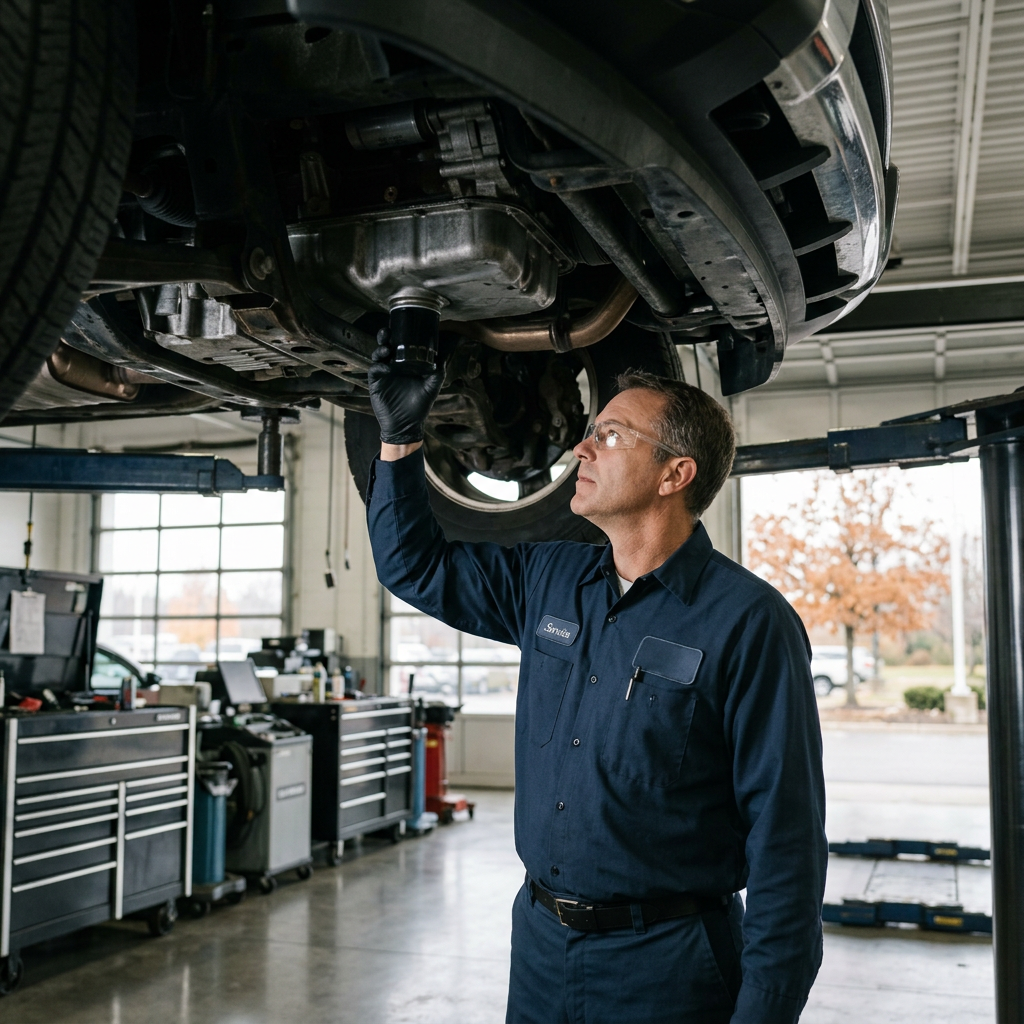
Routine fluid service at a dealership also includes comprehensive multi-point inspections that evaluate critical vehicle systems under the chassis:
- Brake System Evaluation: Measuring brake pad thickness, rotor wear, and hydraulic line condition.
- Drivetrain Inspection: Inspecting transfer case fluid levels, front and rear differential oil clarity, and drive axle boots.
- Suspension and Steering Check: Examining ball joints, tie-rod ends, sway bar links, and shock absorbers for play or fluid leakage.
- Fluid Degradation Testing: Testing coolant pH levels, transmission fluid oxidation, and brake fluid moisture absorption.
Our advisors frequently see vehicle owners who relied on fast drive-through oil changes miss early signs of differential fluid degradation or suspension wear until severe mechanical failure occurred. Because quick-lube bays prioritize fast turnarounds, technicians rarely perform the detailed underbody evaluations necessary to catch minor mechanical issues before they develop into expensive breakdowns.
For automotive professionals interested in mastering factory-level diagnostic systems, we regularly invite skilled applicants to explore career opportunities on our technical team.
Do Quick-Lube Shops Use the Correct Oil Specifications and OEM Filters?
Quick-lube facilities frequently rely on bulk-dispensed aftermarket synthetic oils and universal oil filters engineered for broad compatibility across multiple vehicle brands rather than specific engine designs. Modern high-output engines require specialized oil formulations engineered to meet precise manufacturer material standards—such as Chrysler MS-6395 or MS-12633 specifications—along with strict viscosity ratings like 0W-20 or 5W-30. Using generic bulk oil that lacks these exact material approvals can lead to thermal breakdown, internal varnish buildup, and premature engine wear.
| Feature / Spec | Generic Quick-Lube Components | OEM Mopar Factory Components |
|---|---|---|
| Oil Material Approvals | General API SP / GF-6 standards | Exact OEM specs (MS-6395, MS-12633) |
| Filter Media Construction | Low-density cellulose paper | Synthetic blend high-micron media |
| Anti-Drainback Valve | Nitrile rubber (hardens over time) | High-temp molded silicone seal |
| Bypass Valve Calibration | Generic pressure threshold (12-15 PSI) | Calibrated to exact engine oil pump |
| Internal End Caps | Fiberboard or glued paper | Stamped metal or composite end caps |
Engine protection relies equally on filter construction. Genuine Mopar oil filters feature synthetic blend filter media designed to capture microscopic contaminants without restricting oil volume. They incorporate high-temperature silicone anti-drainback valves that retain oil inside the filter when the engine is shut off, preventing dry metal-on-metal wear during cold starts. Universal aftermarket filters often utilize cheaper nitrile rubber valves that harden over time, allowing oil to drain back into the pan and leaving critical valvetrain components unlubricated upon ignition.
Commuters driving daily from Michigan Center along high-speed corridors require maximum thermal stability and fluid integrity from their motor oil. Modern engines featuring variable valve timing depend on precise oil pressure to actuate hydraulic lifters and camshaft phasers. Sub-standard oil or restrictive filters can cause oil pressure fluctuations, triggering engine misfires or causing check engine light illumination.
Vehicle owners who prefer maintaining their own vehicles can source exact-fit filters, specialized lubricants, and factory gaskets by ordering genuine OEM components through our parts center.
Is a Dealership Oil Change a Different Value Than a Quick Lube?
While quick-lube shops frequently advertise low introductory prices for basic conventional oil service, dealership oil changes offer superior long-term financial value when comparing identical full-synthetic oil grades, OEM filters, and comprehensive vehicle inspections. When a quick-lube shop upgrades a customer from basic oil to premium full-synthetic motor oil matching modern engine requirements, the total invoice price often equals or exceeds the standard retail price of a dealership service visit.
The true cost difference becomes clear when considering the long-term protection provided by specialized maintenance. Dealership service includes factory-backed technical inspections that identify minor maintenance items—such as a weeping water pump seal, a cracked serpentine belt, or uneven tire wear—long before they cause on-road breakdowns. Catching maintenance needs early prevents cascading mechanical failures that lead to thousands of dollars in major repairs.
Furthermore, quick-lube shops operate under strict speed quotas, increasing the risk of costly installation errors. Common quick-lube service mishaps include:
- Cross-Threaded Drain Plugs: Over-tightening aluminum oil pan drain plugs with pneumatic tools, stripping threads and requiring complete oil pan replacement.
- Incorrect Oil Capacity Fill: Overfilling or underfilling engine oil due to inaccurate bulk-dispenser meters, leading to oil foaming or crankshaft seal damage.
- Double-Gasketing Filters: Failing to verify that the old rubber oil filter gasket was removed, causing immediate oil pressure loss and catastrophic engine seizure upon start-up.
- Incorrect Fluid Type: Accidentally topping off transmission or cooling systems with incompatible multi-vehicle fluids, damaging internal seals and clutch packs.
Maintaining a verified service history at an authorized dealership preserves higher vehicle resale and trade-in value. Documented maintenance performed by factory-certified technicians provides prospective buyers with verifiable proof of proper care, offsetting the minor upfront price differences over the lifespan of ownership.
How Factory Diagnostic Tools, Recalls, and Certified Technicians Protect Your Engine
Authorized dealership service departments maintain a direct digital link to manufacturer databases, allowing service advisors to check for open safety recalls and technical service bulletins during every visit. The National Highway Traffic Safety Administration mandates that vehicle safety recall repairs must be completed free of charge by authorized franchise dealerships [1.1]. Quick-lube shops have no access to proprietary factory networks and cannot identify or perform open safety recall repairs, leaving critical safety updates unaddressed.
During routine oil changes, dealership technicians automatically check for software updates issued for the Engine Control Module and Transmission Control Module. Vehicle manufacturers regularly release software refinements that improve shifting performance, optimize fuel delivery, fix false diagnostic trouble codes, and prevent engine knock under heavy acceleration. These software recalibrations require specialized factory diagnostic terminals and cannot be uploaded by quick-lube facilities or independent shops.
| Maintenance Service Capabilities | Authorized Dealership | Quick-Lube Facility |
|---|---|---|
| Factory Recall Lookup & Repair | Free & Automated | Not Available |
| ECU / PCM Software Calibration | Included via WiTECH | Not Available |
| Brand-Specific Certified Techs | Factory Certified | General On-the-Job |
| OEM Warranty Claims Processing | Direct Factory Claims | Not Authorized |
| Dedicated Hydraulic Lift Bays | Full Underbody Access | Pit Bays / Drive-Thru |
When unexpected mechanical issues occur on the road, factory protection extends far beyond the service bay. Owners of Jeep, Dodge, Chrysler, and Ram vehicles enjoy manufacturer-backed emergency support through dedicated 24/7 Roadside Assistance programs. Covered services include towing to the nearest authorized dealership, battery jump-starts, flat tire changes, fuel delivery, and lockout assistance. Drivers in need of emergency towing or roadside support can connect directly with factory support representatives by calling 1-800-521-2779 for prompt assistance.
Common Questions About Dealership Maintenance vs. Quick-Lube Service
Q: Is dealership maintenance required to maintain a Certified Pre-Owned (CPO) warranty?
Federal law does not require routine maintenance to be performed exclusively at an authorized dealership to keep a Certified Pre-Owned warranty intact. However, vehicle owners must strictly follow the factory-recommended maintenance schedule and retain complete service records proving that all installed oils, fluids, and filters met exact manufacturer specifications. If a CPO warranty claim is filed for engine damage, the manufacturer may request maintenance documentation to verify that proper lubrication standards were maintained.
Q: What happens if a quick-lube shop uses the wrong oil viscosity?
Using an incorrect oil viscosity—such as filling an engine designed for 0W-20 with heavier 10W-30 oil—increases internal fluid drag, reduces fuel efficiency, and delays critical oil flow to valvetrain components during cold starts. Incorrect viscosity can also disrupt hydraulic pressure in variable valve timing solenoids, triggering engine fault codes, sluggish throttle response, and accelerated camshaft wear. Severe oil misapplication can lead to oil starvation in tight-tolerance bearings, causing long-term mechanical damage.
Q: How do labor rates compare between dealerships and independent service centers?
Dealership labor rates reflect the investment in specialized factory training, continuous technician certification programs, expensive diagnostic software, and dedicated OEM tools. While independent repair shops and quick-lube centers may charge lower hourly labor rates, dealer technicians complete complex diagnostic routines faster and pinpoint subtle mechanical issues accurately. Paying for factory expertise reduces diagnostic guesswork and ensures repairs are completed correctly the first time using genuine factory components.
Q: How long does a routine oil change take at a quick lube versus a dealership?
Quick-lube facilities perform fluid changes in 15 to 30 minutes in a drive-through pit bay, focusing purely on rapid drain-and-fill services. A dealership oil change appointment typically takes 45 to 90 minutes because technicians perform a comprehensive multi-point safety inspection, check computer systems for open factory updates or recall notices, and thoroughly inspect chassis components under full vehicle hoist elevation.
Q: Do quick-lube shops use OEM or aftermarket parts?
Quick-lube shops almost exclusively install generic aftermarket oil filters, drain plug gaskets, and multi-vehicle fluids designed for broad compatibility across various auto brands. Dealership service departments install genuine Original Equipment Manufacturer parts engineered specifically for your engine's exact operating pressures, flow rates, and internal clearance tolerances. OEM components guarantee proper fitment, optimal filtration, and total compatibility with factory warranty requirements.
If you have additional questions regarding maintenance schedules or wish to lock in your next service appointment, you can utilize our online service scheduling system or explore detailed facility information through our dedicated Clinton service department page.
Schedule Authorized Maintenance at NewGen Chrysler Dodge Jeep Ram
Protecting your vehicle's engine performance, fuel efficiency, and warranty coverage requires strict adherence to factory maintenance standards, exact fluid specifications, and genuine OEM parts. While quick-lube facilities offer fast drive-through convenience, they lack the specialized diagnostic software, brand-certified technicians, and comprehensive safety inspection protocols provided by an authorized service department.
Choosing factory-authorized care ensures that your vehicle receives exact-fit Mopar oil filters, approved synthetic lubricants, and automatic software updates during every routine visit. Our factory-trained service team is committed to keeping your vehicle running reliably whether you are commuting daily, hauling heavy work payloads, or setting off on weekend family trips.
Take the next step in protecting your investment by scheduling your routine maintenance with our certified technicians today. You can visit our Clinton service center at 1111 W Michigan Ave, Clinton, MI 49236, book your service online, or call our service department directly at (517) 456-6555 to speak with a service advisor.
© 2026 NewGen Chrysler Dodge Jeep Ram of Clinton. All rights reserved.