
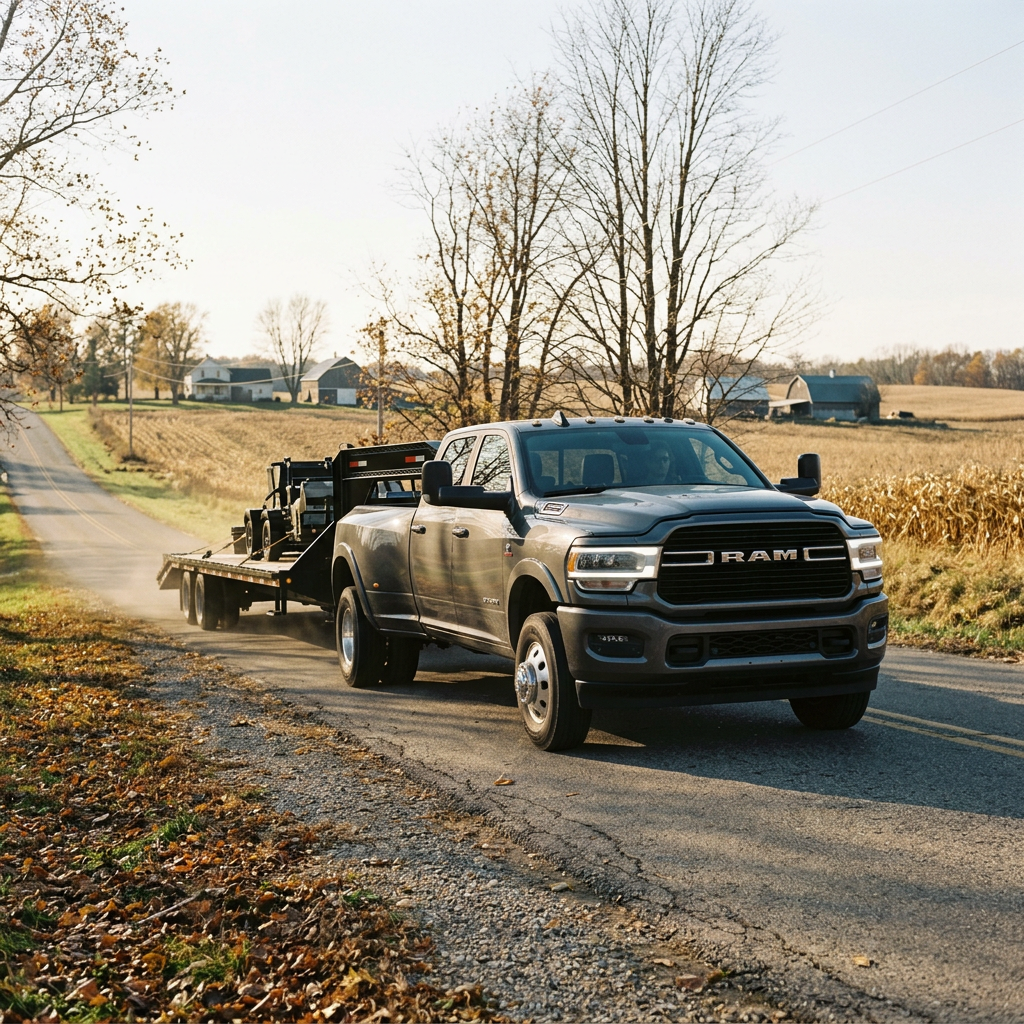
Engage the exhaust brake on a Ram Heavy Duty truck powered by the 6.7-liter Cummins High-Output turbo-diesel whenever you are towing heavy trailers, hauling substantial payload in the truck bed, descending steep grades, or navigating heavy traffic. The system uses variable turbocharger geometry to create backpressure, delivering supplementary engine braking that slows the vehicle without wearing down friction brakes. You should also leave the exhaust brake active during routine dry-weather driving, as exercising the internal mechanism prevents carbon buildup within the turbocharger housing.
The exhaust brake comes standard on all Ram 2500 and Ram 3500 Heavy Duty pickups equipped with the 6.7-liter Cummins Turbo Diesel I6 engine. Light-duty pickups like the Ram 1500 utilize standard service braking and transmission calibration rather than a diesel exhaust brake system. For heavy-duty operators, combining the exhaust brake with Tow/Haul mode creates maximum deceleration torque. When Tow/Haul mode is engaged, the transmission initiates aggressive downshifts to hold higher engine RPMs, which directly maximizes the backpressure generated by the Cummins turbocharger.
Drivers hauling equipment or agricultural livestock around Onsted frequently rely on this integrated braking force to maintain control on rolling rural routes. By allowing the engine to absorb energy during deceleration, you preserve the service brakes for emergency stops while preventing thermal fade on extended descents.
If you ever experience a drop in engine braking performance or want your truck inspected before peak trailering season, get directions to our Clinton dealership for expert maintenance, or start by calling our service center at (517) 456-6555 to consult with our factory-trained technicians.
Table of Contents
- How Do You Activate the Ram Exhaust Brake and How Does It React to Acceleration?
- When Is Auto Mode Preferred Over Full Exhaust Brake Mode While Towing or Unloaded?
- Should You Use the Ram Exhaust Brake on Icy or Slippery Roads?
- What Mechanical Components Power the Exhaust Brake and How Does Usage Prevent Turbo Failure?
- How Much Money Can an Exhaust Brake Save on Brake Pad and Rotor Replacements?
- How Does Ram Exhaust Braking Compare to GM Duramax and How Do Certified Service Technicians Maintain It?
- Essential Answers for Ram Cummins Exhaust Brake Maintenance and Operation
- Keep Your Ram Heavy Duty Performing at Peak Capability in Clinton
How Do You Activate the Ram Exhaust Brake and How Does It React to Acceleration?
To activate the Ram exhaust brake, press the dedicated push-button located on the lower center switch bank of the instrument panel, cycling the system between Full mode, Smart mode (also known as Auto mode), and Off. The current operational status illuminates clearly on the driver digital cluster display. The system automatically disengages the instant you press the accelerator pedal and re-engages seamless engine braking as soon as you lift your foot off the throttle.
Because the system is managed by the Electronic Control Module (ECM), driver input on the accelerator pedal takes immediate priority. You do not need to manually turn off the exhaust brake when merging onto a highway or passing another vehicle. The ECM opens the turbocharger vanes completely during acceleration to build boost pressure and supply full engine horsepower. Once you release the accelerator to coast or brake, the ECM instantly adjusts the nozzle vanes to re-establish exhaust backpressure.
Operating the exhaust brake does not require complex driver adjustments. Key mechanical and operational behaviors include:
- Full Mode Activation: Pressing the button once lights up a yellow indicator icon in the cluster, delivering maximum available backpressure the moment you lift off the throttle.
- Smart / Auto Mode Activation: Pressing the button a second time displays an "Auto" text icon in the cluster, regulating backpressure dynamically based on brake pedal pressure and vehicle speed.
- Immediate Disengagement: Throttle input immediately opens the variable geometry turbocharger (VGT) vanes to allow normal power delivery without mechanical restriction.
- Automatic Brake Light Engagement: When the exhaust brake generates significant deceleration force, the ECM activates the rear brake lights to alert trailing traffic.
If your dash switch fails to cycle modes or the instrument cluster displays an exhaust system warning light, you can easily schedule a service appointment online with our certified team. Truck owners comparing gas and diesel setups can also review options like new Ram 1500 Big Horn Crew Cab 4x4 models to evaluate light-duty versus heavy-duty braking designs.
When Is Auto Mode Preferred Over Full Exhaust Brake Mode While Towing or Unloaded?
Select Smart mode (Auto mode) for smooth speed maintenance while driving empty, cruising on open highways, or operating with light loads, while reserving Full mode for steep mountain descents and heavy trailering. Full mode applies maximum backpressure immediately upon throttle release, which can feel abrupt when driving an unladen truck. Smart mode uses vehicle speed sensors and brake pedal position to adjust turbocharger vane restriction, smoothly maintaining your current road speed without aggressive slowing.
When driving downhill with cruise control engaged, Smart mode functions as an intelligent downhill speed manager. If a long grade causes the vehicle to accelerate past the set cruise speed, the ECM modulates the diesel exhaust brake to gently hold the vehicle at the targeted mph. Unlike Full mode, which attempts to bring the truck to a complete stop if your foot stays off the gas, Smart mode backs off as soon as the truck slows to the desired velocity.
- Unloaded Daily Driving: Smart mode provides gentle deceleration that mimics standard engine braking without harsh downshifts.
- Highway Cruise Control: Automatically holds target speeds on gentle rolling highway hills without disengaging cruise control.
- Moderate Towing: Prevents trailer push on mild grades while keeping trailer towing smooth for passengers and cargo.
- Heavy Grade Downhills: Full mode remains the superior selection when managing high gross combination weight ratings (GCWR) down steep mountain passes.
Leaving the truck in Smart mode during everyday driving keeps the system ready for action without interrupting normal vehicle momentum.
Should You Use the Ram Exhaust Brake on Icy or Slippery Roads?
Never use any mode of the exhaust brake on icy, snowy, or slick road surfaces. Applying sudden braking force strictly to the rear drive wheels on low-traction pavement can cause the rear tires to lose grip, initiating a sudden rear-wheel skid or dangerous jackknife situation when trailering. Owner manuals across all model years explicitly mandate turning the system off whenever road conditions become slippery.
On low-friction surfaces like packed snow or black ice, the friction between the tires and the road surface is extremely limited. When the exhaust brake engages upon throttle release, the sudden drag on the rear axle can exceed the available tire traction. This mechanical imbalance can force the rear of the truck to slide sideways before traction control systems can fully compensate.
Safety protocol on winter roads requires specific driver habits:
- Turn System Completely Off: Ensure both Full mode and Smart mode are switched off before driving on snow-covered or icy roadways.
- Disable Tow/Haul Engine Braking: Avoid aggressive transmission downshift modes that might lock rear wheel speed on slick descents.
- Use Service Brakes Gently: Rely on the vehicle four-wheel antilock braking system (ABS), which modulates hydraulic pressure across all four wheels independently to preserve steering control.
- Verify Road Conditions Early: Moisture on rural bridges and shaded country roads in Michigan Center can freeze faster than open pavement, making pre-emptive system deactivation essential.
Drivers interested in comparing heavy-duty diesel safety characteristics with light-duty four-wheel-drive configurations can explore our new Ram 1500 inventory to learn how modern traction systems manage challenging winter weather.
What Mechanical Components Power the Exhaust Brake and How Does Usage Prevent Turbo Failure?
The Ram exhaust brake operates using a variable geometry turbocharger (VGT) featuring an internal sliding nozzle ring controlled by an electronic actuator. Rather than using an external inline butterfly valve, the ECM signals the VGT actuator to slide internal nozzle vanes closed, restricting exhaust gas flow out of the engine manifold. This restriction creates high backpressure inside the engine cylinders, acting as a pneumatic damper against rising pistons to slow crankshaft rotation.
Regularly using the exhaust brake directly protects the turbocharger from mechanical failure. In a diesel engine, exhaust gas carries fine soot and carbon particles. If the VGT sliding ring remains in one position for long periods—which happens if the exhaust brake is never activated—soot and carbon accumulate in the clearance gaps around the sliding vanes. Over time, this carbon bakes into hard varnish, causing the VGT actuator to stick and triggering engine fault codes or complete turbocharger replacement.
Key mechanical components and their functions include:
- Variable Geometry Turbocharger (VGT): Houses the movable nozzle vanes that continuously adjust exhaust restriction and boost pressure.
- Electronic Actuator: Receives high-speed CAN-bus commands from the ECM to physically move the internal sliding mechanism.
- Electronic Control Module (ECM): Monitors throttle position, engine RPM, vehicle speed, and brake pedal sensors to manage backpressure timing.
- Engine Valve Train & Springs: Heavy-duty exhaust valve springs withstand internal cylinder backpressure without floating.
Using the exhaust brake during daily commutes continuously cycles the sliding ring through its full stroke, sweeping soot off the internal guide pins and keeping the turbocharger mechanism clean. For drivers performing routine maintenance, ordering genuine Mopar parts like high-efficiency fuel filters and engine oil filters ensures clean lubrication for the high-precision VGT actuator.
How Much Money Can an Exhaust Brake Save on Brake Pad and Rotor Replacements?
Consistently using the exhaust brake can extend the service life of your truck friction brake pads and rotors by two to three times, potentially reducing routine maintenance costs over heavy trailering ownership cycles. Friction brakes turn kinetic energy into extreme thermal heat. When hauling heavy loads down long hills, brake rotors can exceed 1,000 degrees Fahrenheit, accelerating pad wear, warping steel rotors, and boiling brake fluid.
By allowing the 6.7-liter Cummins Turbo Diesel I6 engine to perform up to 150 retarding horsepower of deceleration, the primary service brakes remain cool and unused until you need to bring the vehicle to a complete stop.
- Reduced Friction Wear: Brake pads that typically require replacement every 30,000 miles during heavy towing can last beyond 75,000 miles when supported by exhaust braking.
- Prevented Rotor Warping: Minimizing extreme heat cycles prevents thermal distortion, rotor cracking, and steering wheel pulsation caused by uneven pad deposits.
- Extended Service Intervals: Lower heat generation preserves caliper seals and prevents premature breakdown of heavy-duty brake fluid.
- Trailer Brake Protection: Electric and hydraulic trailer brakes suffer less heat stress, reducing expensive electric brake shoe and drum replacements on your towed equipment.
The financial benefit is particularly noticeable for owners who haul heavy machinery, campers, or agricultural trailers across rolling terrain, turning engine backpressure into direct operational savings.
How Does Ram Exhaust Braking Compare to GM Duramax and How Do Certified Service Technicians Maintain It?
The Ram Cummins exhaust brake and the GM Duramax diesel system both utilize variable vane turbochargers and transmission downshifts for engine braking, but Ram offers distinct manual driver control through dedicated Full mode and Smart mode switches. While GM integrates engine braking primarily through its Tow/Haul software logic, Ram provides direct instrument-panel control, allowing drivers to select immediate full backpressure or dynamic speed-matching regardless of trailer connection status.
Maintaining this system requires specialized diagnostic equipment and factory-trained expertise. Certified technicians inspect the VGT actuator calibration, test backpressure sensor accuracy, check exhaust manifold seals for leaks, and verify that transmission control software is fully updated to ensure optimal downshift timing.
| Operational & Maintenance Feature | Ram Cummins Exhaust Brake | GM Duramax Engine Brake |
|---|---|---|
| Primary Mechanism | Variable Geometry Turbocharger (VGT) | Variable Vane Turbocharger |
| Driver Control Modes | Selectable Full, Smart (Auto), and Off | Integrated Tow/Haul Logic & Switch |
| Peak Engine Braking Force | High backpressure at 2,000+ RPM | Turbo vane restriction + Allison downshift |
| Preventative Maintenance | Regular daily activation to clear soot | Periodic high-load exercise & ECM updates |
Our service facility features factory-certified technicians equipped with proprietary wiTECH diagnostic tools to diagnose turbocharger actuator performance, perform VGT soot-clearing routines, and service heavy-duty braking components.
When your truck requires routine oil service, multi-point safety inspections, or turbocharger diagnostics, find our location at 1111 W Michigan Ave, Clinton, MI 49236, or get immediate support by contacting our team at (517) 456-6555.
Essential Answers for Ram Cummins Exhaust Brake Maintenance and Operation
Q: What engine RPM range provides maximum exhaust braking force on a Cummins diesel?
Maximum exhaust braking force occurs at higher engine speeds, typically between 2,000 RPM and 2,800 RPM. Because the turbocharger creates backpressure based on engine rotation speed, higher RPMs pump more air into the exhaust manifold against the closed VGT vanes. When descending a grade with a heavy load, engaging Tow/Haul mode prompts aggressive transmission downshifts that automatically keep the Cummins engine operating in this peak RPM band.
Q: Can frequent use of the exhaust brake cause internal damage to a Ram diesel engine?
No, frequent use of the exhaust brake will not damage a Ram Cummins diesel engine. Cummins engineers design the engine valve springs, cylinder head bolts, pushrods, and turbocharger housing specifically to handle continuous exhaust backpressure. In fact, using the system regularly prolongs engine health by keeping turbocharger internal vanes free of carbon deposits and preventing engine overspeed on downhill descents.
Q: Does the Ram exhaust brake turn off automatically when I step on the gas pedal?
Yes, the exhaust brake disengages the moment you press the accelerator pedal. The Electronic Control Module (ECM) detects throttle pedal position and instantly commands the VGT actuator to open the turbocharger vanes completely. This eliminates backpressure so the engine can build turbo boost and deliver full acceleration without drag. The system re-engages automatically as soon as you release the gas pedal.
Q: Is it necessary to turn off the exhaust brake when driving the truck empty without a trailer?
No, it is not necessary to turn off the exhaust brake when driving an empty truck. However, switching the system from Full mode to Smart mode (Auto mode) provides a smoother ride when unloaded. Smart mode moderates engine braking force based on brake pedal pressure, avoiding sudden deceleration while continuing to cycle the turbocharger vanes to prevent soot accumulation.
Q: Do gas engine trucks like the Ram 1500 or 6.4L HEMI V8 offer an exhaust brake?
No, gas engine trucks do not feature a diesel exhaust brake system. Gas engines use a throttle body butterfly valve that naturally creates engine vacuum braking when the throttle closes. Ram gas trucks rely on Tow/Haul mode gear holding and transmission downshifts for downhill speed control, whereas diesel trucks require the VGT exhaust brake due to the unthrottled nature of diesel engine air intake systems.
Keep Your Ram Heavy Duty Performing at Peak Capability in Clinton
Proper operational habits and routine maintenance ensure your Ram Heavy Duty diesel truck delivers uncompromised safety and maximum service life. Exercising your diesel exhaust brake during daily trips prevents costly turbocharger repairs, protects your primary friction brakes, and maintains downhill control under maximum towing loads.
Our factory-certified service center is fully equipped with specialized tools, genuine Mopar parts, and factory-trained technicians to handle all your Cummins diesel, transmission, and braking service needs. Protect your investment and drive with confidence by visiting our certified team for your next multi-point inspection or maintenance service.
© 2026 NewGen Chrysler Dodge Jeep Ram of Clinton. All rights reserved.