

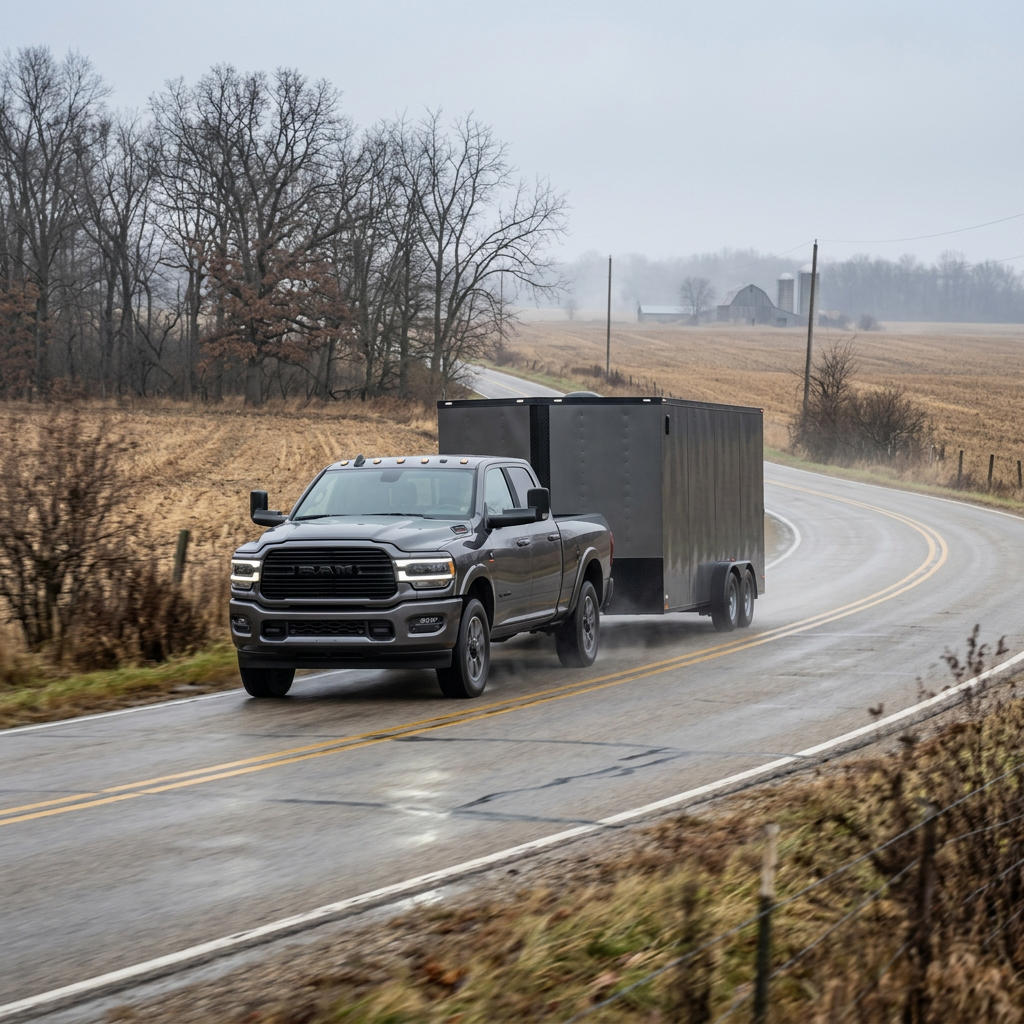
Trailer sway control helps support towing stability by continuously monitoring vehicle motion and responding when a trailer begins to fishtail. Using specialized yaw-rate and lateral-acceleration sensors integrated into the electronic stability control system, the vehicle detects unwanted side-to-side oscillation and selectively applies braking pressure to individual truck wheels while adjusting engine torque. This automated correction counteracts the pivoting force at the hitch ball, pulling the tow vehicle and trailer back into alignment before lateral movement escalates into a dangerous jackknife.
When towing heavy cargo, wind buffeting and road ruts exert lateral forces on the trailer body. Because a trailer pivots freely on a standard hitch ball, any side-to-side momentum transfers rotational torque straight into the rear axle of the tow vehicle. Without intervention, driver overcorrection often amplifies these oscillations. The vehicle stability computer acts in milliseconds, often initiating precise wheel-specific braking before the driver even perceives the movement through the steering wheel. On Ram trucks equipped with a factory integrated trailer brake controller, the system can also pulse the trailer's electric brakes, generating rearward tension that immediately pulls the trailer straight.
While advanced safety systems provide a critical safety net, they do not replace proper hitch setup, correct tongue loading, or attentive driving habits. If electronic intervention engages during a trip, drivers should maintain a steady grip on the wheel, avoid abrupt steering adjustments, and reduce speed gradually without slamming on the brakes. Drivers looking to evaluate capable haulers can reach out to our team at (517) 456-6555 or navigate directly to our showroom using driving directions to our Clinton showroom.
Table of Contents
- What Causes Trailer Sway and Why Do High Driving Speeds Trigger It?
- How Does Electronic Trailer Sway Control Detect Instability and Engage?
- What Percentage of Trailer Weight Should Be on the Tongue to Prevent Sway?
- Can You Have Weight Distribution Without Sway Control, and Are Electronic Devices Worth It?
- Common Questions About Trailer Sway Control and Safe Towing
- Equip Your Truck or SUV for Confident Towing
What Causes Trailer Sway and Why Do High Driving Speeds Trigger It?
Trailer sway originates when aerodynamic disturbances, improper weight distribution, or sudden steering movements create a rotational yaw momentum that trailer tires cannot dampen on their own. Driving at high speeds directly magnifies this instability because aerodynamic drag and kinetic energy increase exponentially as velocity climbs. When traveling above 55 to 65 mph, crosswinds and turbulence from passing commercial semi-trucks deliver substantial lateral shockwaves against the flat sidewalls of a travel trailer, triggering pendulum-like oscillations that overwhelm basic tire traction.
Physics dictates how speed worsens trailer instability:
- Aerodynamic Pressure: Air resistance squares with speed, meaning the force pushing against a trailer at 70 mph is dramatically higher than at 50 mph.
- Oscillation Frequency: At elevated speeds, the frequency of trailer sway cycles accelerates, leaving drivers virtually no time to react manually.
- Tire Lateral Grip: As tow speeds increase, trailer tires operate closer to their lateral adhesion threshold, making it far easier for wind gusts to break tire contact with the pavement.
- Bow Wave Turbulence: Passing large commercial vehicles displace a cone of high-pressure air that first pushes a trailer away and then pulls it inward, creating immediate instability.
Improper trailer loading compounds the danger of high-speed towing. Placing excessive cargo weight behind the trailer axles shifts the center of gravity rearward, lifting tongue weight off the hitch and inducing severe harmonic sway. Sudden emergency maneuvers, uneven tire pressures, and severe pavement grooves along rural county highways also contribute to lateral wandering. For families seeking dependable towing for lightweight camper setups, exploring our new Chrysler Pacifica inventory reveals factory towing options capable of pulling up to 3,600 lbs of towing capacity when properly equipped with standard stability management.
How Does Electronic Trailer Sway Control Detect Instability and Engage?
Electronic trailer sway control operates by reading data from onboard rotational yaw sensors, lateral accelerometers, and steering angle sensors located throughout the tow vehicle chassis. The system computer constantly compares the driver's intended path based on steering wheel angle against the actual rotational movement of the vehicle. When the sensors detect alternating lateral oscillations that do not correlate with steering input, the software identifies trailer fishtailing and triggers an immediate stabilizing sequence.
Once excessive sway is recognized, the vehicle executes targeted interventions:
- Asymmetric Wheel Braking: The stability control module applies hydraulic braking pressure to an individual front or rear wheel on the side opposite the sway direction, creating a counter-yaw moment.
- Powertrain Torque Management: Engine power is momentarily reduced to decrease forward momentum without causing abrupt forward weight transfer.
- Electric Trailer Brake Pulse: On equipped Ram models paired with a factory brake controller, electric brake signals are sent through the seven-pin connector to apply the trailer's electric brakes, straightening the rig.
- Driver Cluster Notification: A visual indicator illuminates or flashes on the digital instrument cluster to inform the driver that active stabilization has occurred.
Buyers comparing tow-ready options frequently examine pre-owned selections such as pre-owned Audi S7 models alongside our core truck lineups, evaluating chassis dynamics and performance. For truck buyers, vehicles like the Ram 1500 deliver up to 12,750 lbs of towing capacity alongside comprehensive Trailer Sway Damping, ensuring stable tracking even when hauling heavy farm implements or commercial equipment through changing surface conditions.
What Percentage of Trailer Weight Should Be on the Tongue to Prevent Sway?
Between 10% and 15% of the total loaded trailer weight must rest directly on the hitch ball to maintain positive downward force and prevent aerodynamic sway. For conventional bumper-pull trailers, maintaining this target ensures the trailer pivots smoothly behind the tow vehicle rather than acting like a rear-heavy seesaw that lifts the truck's rear suspension. Fifth-wheel and gooseneck trailers utilize a different geometry, requiring roughly 15% to 25% of gross trailer weight positioned directly over the truck bed axle.
Towing stability hinges directly on how weight is distributed across the trailer frame:
| Trailer Loading Condition | Recommended Tongue Weight Percentage | Handling Effect on Tow Vehicle | Sway Risk Level |
|---|---|---|---|
| Light Tongue Weight | Under 10% | Lifts tow vehicle rear axle; light steering feel | Severe / Dangerous |
| Optimal Bumper-Pull | 10% to 15% | Balanced axle loading; firm tire traction | Lowest / Stable |
| Excessive Tongue Weight | Over 15% (conventional) | Squats rear suspension; unweights front steering tires | Moderate (induces understeer) |
| Fifth-Wheel / Gooseneck | 15% to 25% | Centered over rear axle; maximum chassis stability | Minimal |
Boaters hauling watercraft out toward Wamplers Lake near Onsted often navigate rolling terrain where shifting fuel, gear, and outboard motor weight can quickly lighten the tongue. Positioning coolers, anchor gear, and heavy supplies ahead of the trailer axle helps keep the hitch ball loaded within that optimal 10% to 15% window. Ensuring regular maintenance on hitch receivers, brake controllers, and vehicle suspension components keeps every setup performing safely; owners can easily schedule certified Mopar service with our certified technician team to confirm tow-readiness before peak hauling seasons.
Can You Have Weight Distribution Without Sway Control, and Are Electronic Devices Worth It?
Weight distribution and sway control address two entirely different mechanical forces, meaning you can have a weight distribution hitch that provides zero sway dampening. A standard weight distribution hitch uses spring bars to distribute heavy downward tongue weight off the vehicle's rear axle and forward onto the front tires and trailer wheels. Unless that hitch includes integrated friction pads, cam-locking arms, or sway brackets, it will level your truck's stance without offering mechanical resistance against side-to-side pivoting.
Combining weight distribution with sway dampening provides distinct operational advantages:
- Round-Bar Hitches with Add-On Friction Bars: Basic leveling hitches often require bolting a separate friction slide bar between the trailer frame and hitch head, which must be loosened before tight backing maneuvers.
- Integrated Trunnion Systems: Advanced hitches integrate multi-point friction pads directly into the spring bar brackets, delivering constant mechanical sway resistance without extra hardware.
- Electronic Trailer-Mounted Sway Devices: Aftermarket trailer-mounted modules install directly on the trailer tongue and wire into the electric brake wiring. Using their own internal gyroscopes, these devices activate the trailer's electric brakes independently on each side in milliseconds, curbing sway long before physical friction bars or tow vehicle stability systems can react.
For owners towing tall travel trailers near Michigan Center Reservoir, where sudden wind gusts sweep across open water and agricultural fields, investing in integrated sway hardware or electronic trailer modules provides invaluable peace of mind. Buyers considering an upgrade to a heavier-duty towing vehicle can complete our convenient vehicle appraisal form to determine current trade value toward a new Ram 2500 or 3500 heavy-duty truck.
Common Questions About Trailer Sway Control and Safe Towing
Q: What dashboard warning light indicates trailer sway control is actively working?
When electronic trailer sway control engages, the electronic stability control icon—depicting an image of a vehicle with two curved squiggly tire tracks—flashes rapidly on the main instrument cluster. Depending on the model year and vehicle software, this indicator light may be accompanied by an audible warning chime and a dedicated text alert reading Trailer Sway Detected across the digital display screen. A continuously illuminated solid stability light indicates a malfunction or that the driver has manually disabled stability systems, whereas a rapidly blinking light confirms the computer is actively pulsing individual brakes to steady the trailer.
Q: Is electronic trailer sway control standard on modern trucks and SUVs?
Electronic trailer sway control is standard equipment on virtually all modern full-size pickup trucks and body-on-frame SUVs. Major manufacturers integrate this software logic directly into the vehicle's electronic stability control and antilock brake system architecture. While light-duty crossover models and small SUVs may require an optional factory towing prep package to unlock the full towing software calibration, trucks across our lineup, including the Ram 1500 and Jeep Gladiator, include Trailer Sway Damping as a standard active safety baseline across all trim levels.
Q: What is the difference between built-in vehicle sway control and a sway control hitch?
Built-in vehicle sway control is a reactive digital safety feature, whereas a sway control hitch is a proactive mechanical dampener. The software inside your truck monitors wheel speeds and yaw rotation, stepping in only after physical trailer sway is already detected to apply wheel brakes and reduce engine output. A sway control hitch uses mechanical friction, dual-cam locks, or hydraulic resistance to actively resist side-to-side pivoting continuously, dampening minor trailer drift before it ever triggers the truck's digital sensors.
Q: Does trailer sway control automatically activate trailer electric brakes?
Trailer sway control automatically pulses the trailer's electric brakes when the tow vehicle is equipped with a factory-integrated trailer brake controller connected through an active seven-pin wiring harness. When the tow vehicle computer identifies severe lateral fishtailing, it transmits a braking signal straight to the trailer axle magnets while simultaneously applying asymmetric braking to the truck's front wheels. This simultaneous engagement creates rearward line tension that pulls the trailer directly into line behind the tow vehicle hitch.
Q: What should you do when trailer sway starts occurring on the highway?
When trailer sway begins, maintain a firm grip on the steering wheel, keep the wheels pointed straight ahead, and gradually ease off the accelerator pedal without stomping on the vehicle brake pedal. If your truck features an integrated manual trailer brake lever on the dash, squeeze that trailer brake slide by hand; engaging only the trailer brakes provides immediate pulling tension that straightens the swaying unit. Avoid rapid steering corrections, as counter-steering almost always exacerbates harmonic fishtailing and can lead to a complete loss of control.
Equip Your Truck or SUV for Confident Towing
Ensuring that your vehicle suspension, hitch receiver, and electronic systems are properly matched to your cargo is essential for safe hauling across Michigan roads. Our Clinton dealership provides the complete lineup of Chrysler, Dodge, Jeep, and Ram vehicles engineered with advanced towing technologies, robust powertrains, and integrated trailer management systems. Whether you need a heavy-duty hauler for agricultural work or a versatile family SUV for weekend camping trips, our factory-trained specialists can match your exact towing requirements.
To configure your ideal towing setup or update your existing hardware, explore these resources with our team:
- Learn more about our vehicle lineup, capabilities, and staff by choosing to learn about our team.
- Discover intuitive cabin connectivity and integrated trailering camera views by reviewing our guide to the Uconnect technology platform.
- Streamline your purchasing process ahead of your visit and apply for financing online through our secure finance center.
- Outfit your pickup or SUV with factory-engineered receiver hitches, wiring harnesses, and ball mounts using genuine Mopar parts.
Stop by our showroom at 1111 W Michigan Ave, Clinton, MI 49236 to inspect our tow-ready truck and SUV inventory in person. You can easily reach our knowledgeable sales staff with a quick call to (517) 456-6555 or plan your visit using driving directions to our Clinton showroom. We are ready to help you hit the road with complete towing confidence.
© 2026 NewGen Chrysler Dodge Jeep Ram of Clinton. All rights reserved.
Categories:
Social