

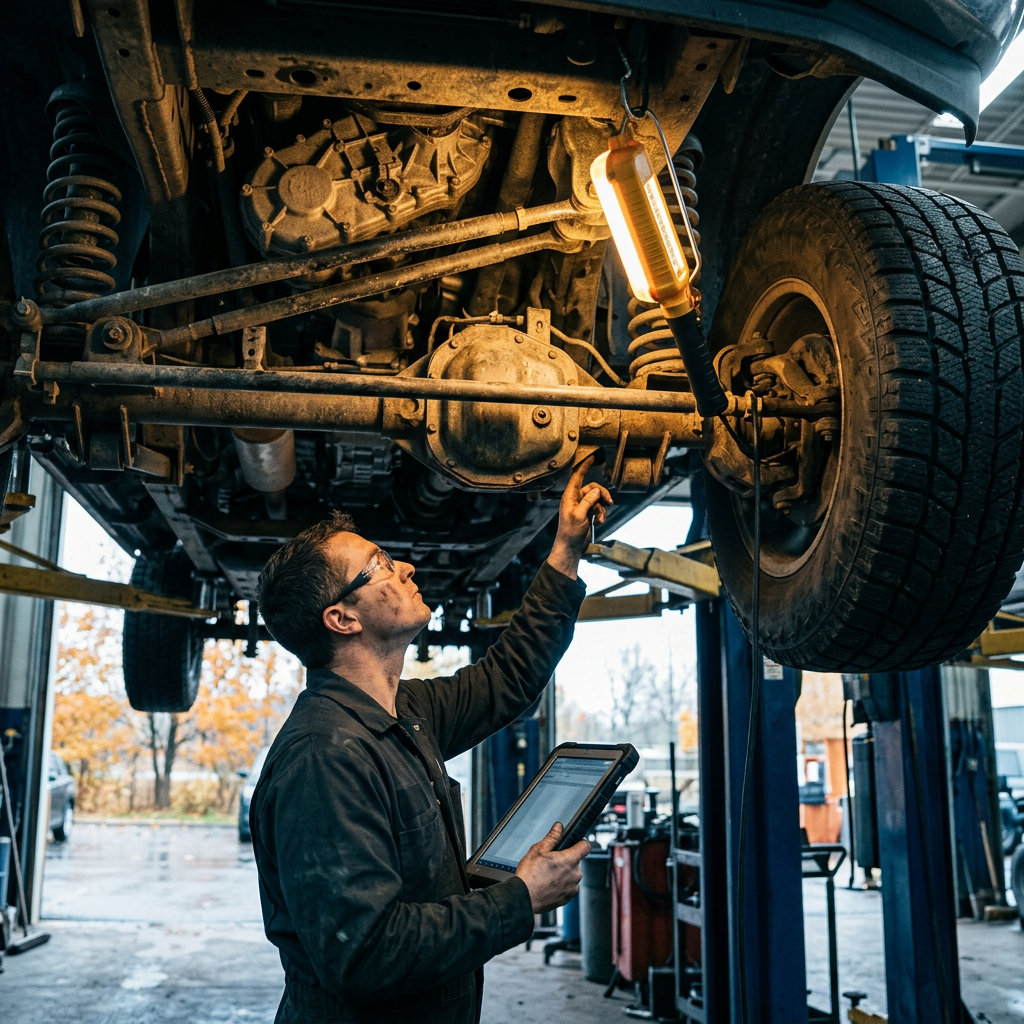
Preparing a Jeep or Ram 4x4 vehicle for winter driving requires inspecting transfer case and differential fluids, testing the battery, verifying 4WD actuator and shift motor engagement, checking tire tread depth, and servicing wiper systems before sub-zero weather arrives. Routine fluid changes and pre-winter electronic diagnostic scans ensure drive modes transfer smoothly when freezing temperatures, heavy slush, and unplowed ice hit rural Michigan roadways.
Late fall in Michigan brings rapid temperature drops, damp fallen leaves, and early morning black ice across unpaved country routes. Drivers navigating the unpaved farm routes around Onsted rely on four-wheel drive performance to maintain steering control and forward momentum. When a 4x4 system sits idle throughout warm summer months, transfer case shift linkage can stiffen, front differential actuators can bind from corrosion, and fluid can break down from heat and condensation. Address drivetrain readiness before the first lake-effect snowstorm hits to ensure four-wheel drive engages reliably without electronic fault codes or mechanical binding.
A complete seasonal inspection focuses on mechanical, fluid, and electrical health across the entire four-wheel drive system:
- Transfer Case Fluid Quality: Fluid breaks down over time due to thermal shearing and fluid breakdown. Checking fluid level and clarity prevents internal chain and clutch pack wear.
- Axle Differential Oil: Inspecting front and rear differential fluid for moisture contamination or metal debris protects ring and pinion gears in high-torque scenarios.
- Electronic Shift Actuators: Testing the transfer case shift motor and front axle disconnect solenoid ensures immediate transition between 2WD and 4x4 modes.
- Battery & Electrical Health: Cold weather reduces battery output by up to 50 percent, which directly impacts the electronic module commanding transfer case shifts.
- All-Weather Traction: Inspecting tire tread depth and mounting snow-rated rubber allows mechanical locking differentials to transfer power to the ground efficiently.
Vehicles built for heavy hauling, such as new Ram 1500 Crew Cab 4x4 models, place high torque demands on front and rear axle assemblies. Setting up a dedicated maintenance baseline before winter protects critical components from premature stress. If you need assistance verifying system operation, stop by our Clinton service center or give our service department a quick call to speak with a technician.
Table of Contents
- What Is the Recommended Maintenance Schedule and Service Process for Ram 1500 Transfer Case Fluid?
- What Is the Difference Between Ram 4WD Auto, 4WD Lock, and 4WD Low Modes in Michigan Winter Driving?
- Can You Safely Use Jeep Command-Trac 4H on Dry Paved Roads, and How Does Full-Time 4WD Differ from Electronic AWD?
- What Are the Symptoms of a Failing Jeep Transfer Case Shift Motor or Actuator?
- Which Winter Tires Pair Best with Jeep Quadra-Drive II Systems for Rural Roads?
- What Does a Professional 4WD Inspection Include Before Winter?
What Is the Recommended Maintenance Schedule and Service Process for Ram 1500 Transfer Case Fluid?
Ram recommends inspecting transfer case fluid every 20,000 to 30,000 miles and replacing it every 60,000 miles under normal driving conditions, or every 30,000 miles if the truck is frequently operated in severe duty environments such as heavy towing, off-road driving, or prolonged sub-zero winter temperatures.
Transfer cases utilize internal multi-plate clutch packs and drive chains to transfer engine torque from the transmission to the front driveshaft. Over time, thermal cycling, clutch friction material wear, and minor condensation cause fluid breakdown. Dirty or degraded fluid leads to delayed engagement, erratic 4x4 shifting, or shuddering when accelerating on slick roads. Commuters driving daily near Michigan Center Reservoir often face wet, slushy winter back roads that strain four-wheel drive hardware, making timely fluid changes essential for mechanical longevity.
Servicing a Ram 1500 transfer case involves precise steps using factory-approved lubricants:
- Fluid Inspection: The vehicle is raised on a lift, and technicians remove the upper fill plug first to ensure it is unseized before draining fluid.
- System Draining: The lower drain plug is removed to evacuate dirty fluid into a waste container while inspecting the magnetic drain plug tip for metallic debris.
- Sealing & Torque: The drain plug is cleaned, fitted with a fresh seal washer or gasket, and torqued to manufacturer specifications.
- Fluid Refill: Fresh Mopar BorgWarner 44-44 fluid (or the specific fluid required for your transfer case specification) is pumped into the fill port until fluid sits level with the bottom edge of the fill hole.
- Final Testing: The fill plug is torqued into place, and the truck is test-operated across all 4WD ranges to verify smooth gear and clutch engagement.
Truck owners driving new Ram 1500 Big Horn Crew Cab 4x4 trucks or managing work rigs from our new Ram 1500 pickup inventory can maintain factory durability by sticking to severe-duty service intervals. To keep your truck running smoothly, schedule Mopar service online for a professional fluid inspection.
What Is the Difference Between Ram 4WD Auto, 4WD Lock, and 4WD Low Modes in Michigan Winter Driving?
Ram 4x4 transfer cases offer distinct operational settings designed for specific surface traction conditions: 4WD Auto dynamically modulates clutch pressure for variable traction on mixed roads, 4WD Lock mechanically splits torque 50/50 between front and rear driveshafts for low-traction surfaces, and 4WD Low engages internal gear reduction for maximum pulling power at low speeds.
Understanding when to select each drive mode prevents drivetrain stress and maximizes stability across changing winter conditions:
- 4WD Auto: Operates like an intelligent electronic system by continuously monitoring rear-wheel slip and instantly engaging the transfer case clutch to route power to the front axle when slip occurs. It can remain turned on continuously during late-fall and winter driving across patchy snow, ice, wet pavement, and dry asphalt without causing driveline binding.
- 4WD Lock: Locks the front and rear driveshafts together to spin at identical speeds. This mode provides solid traction on unplowed snow, deep mud, or loose gravel, but must never be used on dry, high-traction pavement, as forcing both axles to turn at equal speeds during turns causes severe mechanical stress.
- 4WD Low: Multiplies engine torque through a 2.72:1 low-range gear reduction in the transfer case. Designed for low-speed extraction, extreme snowdrifts, or pulling heavy loads up steep, slippery inclines under 25 mph.
Truck owners often ask whether keeping 4WD Auto engaged full-time during winter causes unnecessary wear. Because the internal clutch operates dynamically and permits differential speed variation between axles during cornering, leaving 4WD Auto active throughout late fall and winter is entirely safe and ideal for unpredictable road conditions. When replacement gaskets, seals, or fluid filters are required during routine transfer case servicing, using genuine Mopar parts maintains factory tolerances and component longevity.
Can You Safely Use Jeep Command-Trac 4H on Dry Paved Roads, and How Does Full-Time 4WD Differ from Electronic AWD?
You cannot safely drive a Jeep equipped with the Command-Trac part-time 4x4 system in 4H mode on dry, paved roads. Command-Trac mechanically locks the front and rear driveshafts together without a center differential, forcing the front and rear axles to rotate at identical speeds. When turning on dry asphalt, front wheels must travel along a wider arc and spin faster than rear wheels; without a center differential to absorb this speed difference, the drivetrain binds, resulting in "crow-hopping," severe tire scrubbing, and potential damage to U-joints, axle shafts, and internal transfer case gears.
Understanding the engineering differences between part-time 4WD, full-time 4WD, and electronic all-wheel drive helps drivers select the correct vehicle configuration for winter driving:
| System Type | Center Differential / Clutch | Low Range Gearing | Dry Pavement Safe in 4x4 Mode | Primary Winter Application |
|---|---|---|---|---|
| Part-Time 4WD (e.g., Command-Trac) | No | Yes ( 2.72:1 low range) | No (Causes driveline binding) | Deep snow, dirt trails, unplowed rural roads |
| Full-Time 4WD (e.g., Selec-Trac, Quadra-Trac II) | Yes (Differential or electronic clutch) | Yes ( 2.72:1 low range) | Yes ( 4H Auto / Full-time mode) | Variable winter pavement, black ice, deep snowdrifts |
| Electronic AWD | Electronic clutch pack | No | Yes | Standard highway snow, wet roads, suburban commuting |
Systems featuring a Selec-Terrain traction management dial allow drivers to select Snow mode, which adjusts throttle sensitivity, transmission shift points, and brake-assisted traction control to maximize vehicle stability on slick surfaces. While electronic AWD systems manage light snow, full-time 4x4 systems with selectable low range offer the mechanical strength needed to navigate deep rural drifts and unplowed roads safely.
What Are the Symptoms of a Failing Jeep Transfer Case Shift Motor or Actuator?
A failing transfer case shift motor or front axle actuator on a Jeep prevents the vehicle from transitioning between drive modes, often leaving the vehicle stuck in 2WD or locked in 4WD when conditions change. Electronic actuators control the mechanical engagement inside the transfer case and front axle disconnect housing, making electrical or mechanical failure a primary cause of 4x4 system faults.
Recognizing early failure symptoms allows owners to address small electrical or mechanical issues before being stranded in severe winter weather:
- Dashboard Error Alerts: A illuminated "Service 4WD System" or "SVC 4WD" text warning message or a flashing 4x4 indicator light on the instrument cluster.
- Unresponsive Mode Selection: Pressing a 4x4 switch or turning a drive mode dial yields no response, with the transfer case remaining in its current gear range.
- Audible Clicking or Buzzing: Unusual whirring, grinding, or rapid clicking noises coming from beneath the floorboards as the shift motor attempts and fails to move the shift fork.
- Stuck Drive Modes: The vehicle refuses to disengage 4H or 4L back into 2WD, causing heavy steering effort and binding during tight cornering.
Before replacing a shift motor or axle actuator, technicians perform a structured electrical and diagnostic inspection. Weak vehicle batteries or corroded ground wires can cause low-voltage conditions that trigger false DTCM (Drivetrain Control Module) error codes. Certified technicians check battery charging voltage, verify fuse integrity, inspect harness pins for corrosion, evaluate fluid levels, and run diagnostic scan data before replacing any mechanical actuator.
Which Winter Tires Pair Best with Jeep Quadra-Drive II Systems for Rural Roads?
Jeep models equipped with the Quadra-Drive II 4x4 system pair best with dedicated winter tires bearing the 3-Peak Mountain Snowflake (3PMSF) symbol, such as the Bridgestone Blizzak DM-V2 or Michelin X-Ice Snow SUV. Quadra-Drive II features a rear Electronic Limited-Slip Differential (ELSD) capable of instantly routing up to 100 percent of available torque to the single wheel with the most traction. However, mechanical torque transfer is only as effective as the tire compound's grip on frozen road surfaces.
Standard all-season and all-terrain tires use rubber compounds that stiffen in sub-freezing temperatures, reducing rubber flexibility and surface contact. Dedicated winter tires complement advanced 4x4 systems through specific design features:
- Hydrophilic Rubber Compounds: Specialized silica and canola oil compounds keep tread blocks flexible at temperatures below 45°F, allowing the tire to conform to road surface imperfections.
- High-Density Siping: Thousands of micro-grooves bite into packed snow and create capillary action that removes thin films of surface water on ice.
- Aggressive Tread Channels: Wide circumferential and lateral grooves evacuate heavy slush and mud, preventing hydroplaning and snow packing within the tread.
Installing a set of four dedicated winter tires ensures equal traction across both axles, allowing electronic differentials, ABS sensors, and stability control systems to manage vehicle control accurately during sudden lane changes or braking maneuvers on ice.
What Does a Professional 4WD Inspection Include Before Winter?
A professional pre-winter 4x4 inspection includes a comprehensive mechanical, fluid, and electronic check of the transfer case, front and rear differentials, axle disconnect actuators, driveshaft universal joints, CV boots, and battery charging systems. Having certified technicians evaluate drivetrain health before sub-zero weather identifies weeping seals, low fluid levels, or weak electrical components before they cause winter breakdowns.
Q: Can leaving a Ram in 4WD Auto lower fuel efficiency?
Leaving 4WD Auto engaged causes a minor decrease in fuel economy because the front axle components remain engaged and ready to receive power. However, on patchy ice and changing road surfaces, the safety and traction benefits far outweigh the small friction losses. On completely dry, warm highways, returning to 2WD mode optimizes efficiency.
Q: How often should Jeep differential fluids be checked before winter?
Differential fluid levels and clarity should be inspected every 12,000 to 15,000 miles, or at every oil change interval. If the vehicle has been operated through deep water or muddy trail conditions, inspecting fluid for milky water contamination immediately protects internal ring and pinion gears from rapid corrosion.
Q: What causes a temporary "Service 4WD" warning during extreme cold?
Extreme cold causes battery voltage to drop during engine startup. Because electronic drivetrain modules require clean, consistent voltage to run startup diagnostic routines, a aging battery can trigger a temporary "Service 4WD" light even when the mechanical transfer case components are fully functional.
Q: Why is transfer case fluid dark when drained at 60,000 miles?
Transfer case fluid darkens due to heat buildup and micro-particles released from internal multi-plate clutch friction discs during normal engagement. Dark fluid indicates natural wear, but burned smells or metallic flakes signal thermal breakdown or internal chain and gear wear requiring immediate attention.
Q: Does 4x4 engagement work if the vehicle battery voltage is low?
Low battery voltage often prevents electric transfer case motors and front axle solenoids from engaging. Modern 4x4 systems rely on electronic modules to command shift forks; if system voltage drops below operational thresholds, the system defaults to a protective lockout mode to prevent incomplete mechanical shifting.
Ready Your 4x4 for Winter at NewGen Chrysler Dodge Jeep Ram of Clinton
Ensure your truck or SUV is completely prepared for severe winter weather by scheduling a comprehensive drivetrain inspection with our certified service team. If you require manufacturer-backed emergency assistance while traveling, official Jeep, Dodge, Chrysler, Ram Roadside Assistance: 1-800-521-2779 provides coverage for towing and roadside emergencies. Stop by our Clinton service center or contact our service advisors at (517) 456-6555 to book your pre-snow maintenance appointment today.
© 2026 NewGen Chrysler Dodge Jeep Ram of Clinton. All rights reserved.