

Avoid Winter Tire Traps: Expert Ram 1500 Pressure Tips for Safe, Efficient Driving
How Should You Check and Adjust Ram 1500 Tire Pressure for Winter?
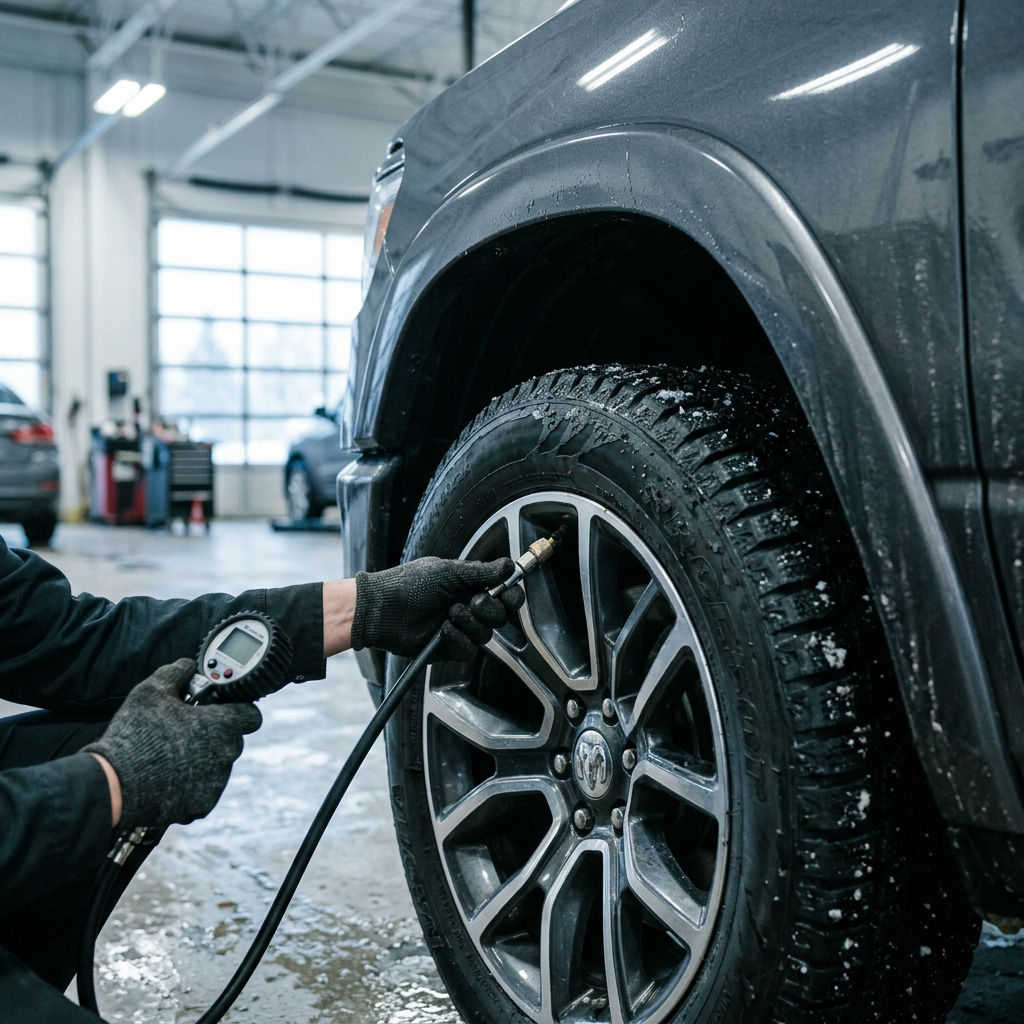
To properly adjust tire pressure for winter on a Ram 1500, check the tires when cold after the truck has sat parked for at least three hours, and set the inflation to the cold pressure specification listed on the driver-door tire placard rather than the maximum rating printed on the tire sidewall. Tire pressure drops approximately 1 to 2 PSI for every 10-degree drop in outside temperature, which means early Michigan freezes can quickly trigger your Tire Pressure Monitoring System light if you do not adjust for ambient air changes.
In my 21 years as a Sales Manager at NewGen Chrysler Dodge Jeep Ram of Clinton, I have seen plenty of truck owners get caught off guard by that low-pressure warning during the first hard frost of the season. Driving on underinflated tires reduces fuel economy, wears down the outer shoulders of your tread unevenly, and compromises handling when you need precise steering control on slick roads. When checking your tires, always use a digital or calibrated pencil pressure gauge before you hit the road, because even a short one-mile drive warms up the air inside the tire and gives you an artificially high reading.
Setting your tires to the placard recommendation—typically 35 PSI on standard light-duty configurations—ensures the tread contact patch stays flat against the pavement. If you inspect your pressure in a heated garage before heading out into sub-zero weather, add roughly 2 to 3 PSI above the placard value to account for the immediate pressure drop when the truck hits the freezing outside air. Truck owners pulling snowmobile trailers across open farm country around Onsted rely on that full contact patch for stability, especially when wind gusts sweep across rural routes. If you ever want our team to check your tread depth or reset your sensors, stop by our Clinton dealership located at 1111 W Michigan Ave or give our service advisors a quick call to get set up.
Table of Contents
- What Essential Mechanical Maintenance Does Your Ram 1500 Need Before Freezing Weather?
- Is an Engine Block Heater Standard or Optional on the Ram 1500?
- What Features Are Included in the Ram 1500 Cold Weather Group Package?
- What Is the Key Difference Between 4WD Auto and 4WD Lock on a Ram 1500?
- What Winter Tire Sizes Fit Stock Ram 1500 18-Inch and 20-Inch Wheels?
What Essential Mechanical Maintenance Does Your Ram 1500 Need Before Freezing Weather?
Essential mechanical maintenance for a Ram 1500 before severe winter weather includes testing battery cold-cranking capacity, verifying engine coolant freeze protection down to sub-zero temperatures, inspecting brake pad thickness and transfer case fluid quality, and refilling the engine with low-viscosity synthetic oil. Performing these services before freezing temperatures settle in prevents strain on internal engine components and protects heavy-duty 4x4 driveline hardware.
Sub-freezing temperatures slow the chemical reactions inside a 12-volt battery and reduce its cranking power by up to 50 percent, right when a cold engine demands maximum amperage to turn over thick oil. During seasonal checkups, our technicians test the battery reserve capacity and verify that cold cranking output measures between 600 CCA and 800 CCA to ensure reliable starting power on severe winter mornings. We also evaluate the engine oil. Running full synthetic 0W-20 or 5W-20 oil—depending on whether your truck features the 3.6L Pentastar V6, the 5.7L HEMI V8, or the twin-turbo 3.0L Hurricane inline-six—guarantees rapid oil circulation to top-end components during a cold start.
Cooling system integrity is another critical focus area for winter readiness. Engine coolant must maintain a 50/50 mixture of distilled water and Mopar Organic Additive Technology coolant to keep freeze protection intact down to -34 degrees Fahrenheit. Old or diluted coolant can freeze inside the radiator core or heater core, leading to engine overheating or cracked engine blocks. To keep your truck running strong all season long, you can easily schedule certified Mopar service online or order genuine Mopar winter parts directly through our department.
Is an Engine Block Heater Standard or Optional on the Ram 1500?
An engine block heater is optional on most Ram 1500 trim levels, though it comes standard or bundled in specific cold-climate equipment packages and heavy-duty regional builds. The block heater uses an electrical heating element inserted into the engine block to warm engine coolant and oil prior to ignition, reducing starter motor drag and mechanical engine wear during extreme cold starts.
When winter ambient temperatures drop into the single digits or below zero, plugging in the block heater for two to three hours before driving warms the engine block enough to deliver immediate cabin heat upon startup. This initial warming minimizes dry-start scuffing on cylinder walls, reduces starter motor load, and helps the engine reach optimal operating temperature much faster. For drivers evaluating our current new Ram 1500 inventory, adding this equipment ensures hassle-free starts during prolonged Arctic cold snaps.
When I walk truck buyers through our lineup, I like to highlight how equipped models feature a weather-protected electrical plug concealed discreetly near the front grille. You do not need to leave the heater plugged in all night long; connecting it to a simple heavy-duty outdoor outlet timer set for two hours before your morning commute saves electricity while giving you full cold-weather protection. Whether you choose a practical work configuration or opt for new Ram 1500 Laramie Crew Cab 4x4 trucks, having block heating capability provides real peace of mind during northern winters.
What Features Are Included in the Ram 1500 Cold Weather Group Package?
The Ram 1500 Cold Weather Group package includes an engine block heater, a factory remote start system, heated front seats, and a heated steering wheel designed to maximize engine readiness and occupant comfort in severe freezing weather. These factory-installed features work together through the vehicle's electrical architecture to pre-condition both the powertrain and the cabin before you start your drive.
Utilizing factory remote start allows the engine to circulate oil and bring coolant up to operating temperature while defrosting the front windshield and side windows. The system automatically engages the heated seats and heated steering wheel when ambient temperatures fall below a preset threshold, warming touchpoints before you climb into the cab. Because steering wheel and seat heating elements draw direct electrical power rather than relying on engine coolant heat, they deliver near-instant physical warmth on sub-zero mornings.
This package provides practical daily value for trade professionals and active families who need their truck ready at a moment's notice. Pre-warming the glass melts heavy windshield frost without risking blade damage or scratching tint films. If you are browsing new Ram 1500 Big Horn Crew Cab 4x4 inventory, asking our sales team to verify cold-weather package options ensures you get every comfort feature tailored for local winter driving.
What Is the Key Difference Between 4WD Auto and 4WD Lock on a Ram 1500?
The primary difference between transfer case settings is that 4WD Auto operates as an on-demand system driving the rear wheels until slippage is detected, whereas 4WD Lock mechanically locks the front and rear driveshafts together for continuous 50/50 power distribution. Understanding when to select each mode preserves transfer case components while maintaining optimal traction across changing winter road conditions.
Selecting 4WD Auto is ideal for variable road conditions where dry asphalt alternates with unexpected slush, packed snow, or icy patches. In this setting, internal sensors continuously monitor wheel speed; the moment the rear wheels lose traction, an internal clutch pack engages the front axle to stabilize the truck. Because 4WD Auto allows the front and rear axles to rotate at slightly different speeds during sharp turns, you can drive at normal highway speeds on mixed pavement without experiencing steering wheel binding or driveline stress.
By contrast, 4WD Lock is engineered for continuous low-traction surfaces such as unplowed snow, deep slush, or icy gravel back roads. Locking the driveshafts together guarantees equal torque delivery to both axles, preventing power loss before wheel slip even starts. Drivers navigating unpaved agricultural routes around Michigan Center after a snowstorm rely on 4WD Lock to maintain forward momentum through heavy drifts. For extreme recovery scenarios or creeping through deep mud under 25 mph, switching to 4WD Low engages lower transfer case gearing to supply maximum low-end torque.
What Winter Tire Sizes Fit Stock Ram 1500 18-Inch and 20-Inch Wheels?
Factory stock tire sizes for the Ram 1500 are 275/65R18 for 18-inch wheels and 275/55R20 for 20-inch wheels, both of which match standard winter tire fitments from major tire manufacturers. Equipping dedicated winter tires in these exact factory dimensions maintains proper speedometer calibration, anti-lock brake calibration, and clearance within the wheel wells.
While standard Mud and Snow rated all-season tires feature tread grooves designed to channel light slush away, dedicated winter tires carry the 3PMSF three-peak mountain snowflake symbol on the sidewall. Tires with the 3PMSF rating are manufactured using specialized silica rubber compounds that remain flexible in sub-freezing temperatures below 45 degrees Fahrenheit. Standard all-season rubber hardens when cold, which reduces road grip even on dry pavement, whereas flexible winter rubber conforms to micro-textures in packed ice and hard snow.
Maintaining adequate tread depth is equally important when preparing for winter driving. A minimum tread depth of 4/32 inches is required to clear slush from beneath the tire contact patch, though 6/32 inches or greater provides significantly shorter stopping distances on slick surfaces. If you want our certified technicians to inspect your current tread depth or mount a set of winter tires on your factory wheels, visit our Clinton dealership location or give us a call at (517) 456-6555 to keep your Ram 1500 performing safely all winter long.
© 2026 NewGen Chrysler Dodge Jeep Ram of Clinton. All rights reserved.