

Jump Starting 101: How Long Should You Drive to Recharge Your Battery?
After a successful jump start, driving continuously for at least 30 minutes at steady road speeds restores enough electrical charge to allow your vehicle to restart on its own. Today, we are interviewing Josh Lewis, Service Advisor at NewGen Chrysler Dodge Jeep Ram of Clinton. With 6 years of automotive service experience, Josh provides practical guidance on vehicle electrical systems, battery care, and roadside safety for local drivers.
Q: How long should you drive after jump-starting a car to recharge the battery?
A: Drivers should maintain a continuous 30-minute drive immediately after jumping a flat battery, keeping the engine running without shutting it off. This timeframe allows the vehicle alternator to push sufficient electrical current back into the 12-volt battery, building up enough reserve power for subsequent starts. Short trips around local farm routes or open spaces in Onsted will not provide adequate engine run time, leaving the battery undercharged and vulnerable to dying as soon as the ignition switches off.
While driving for half an hour helps restore daily operation, it is primarily a temporary recovery step rather than a complete battery refresh. A deeply discharged battery undergoes chemical stress that an alternator cannot fully repair on the road alone. Drivers needing charging system testing can stop by 1111 W Michigan Ave in Clinton or give our team a quick call to confirm their battery health.
Q: How long does a 10-amp trickle charger take to fully charge a dead battery?
A: A 10-amp trickle charger typically takes 4 to 8 hours to fully recharge a standard dead automotive battery. The precise duration depends on the battery capacity, measured in cold-cranking amps, and how deeply the charge was depleted. Standard sedan batteries replenish faster, whereas heavy-duty truck batteries found in commercial Ram trucks require the longer end of that time range.
Using a dedicated plug-in charger is far more effective for long-term battery longevity than relying solely on engine alternator power. Unlike an alternator that divides current between battery recovery and cabin electronics, a bench charger delivers a steady, regulated current that saturates internal battery plates without thermal stress. Vehicle owners who experience recurring charging issues can schedule Mopar service online for a comprehensive electrical inspection.
Q: Why should you connect the negative jumper cable to an unpainted metal surface instead of the dead battery's terminal?
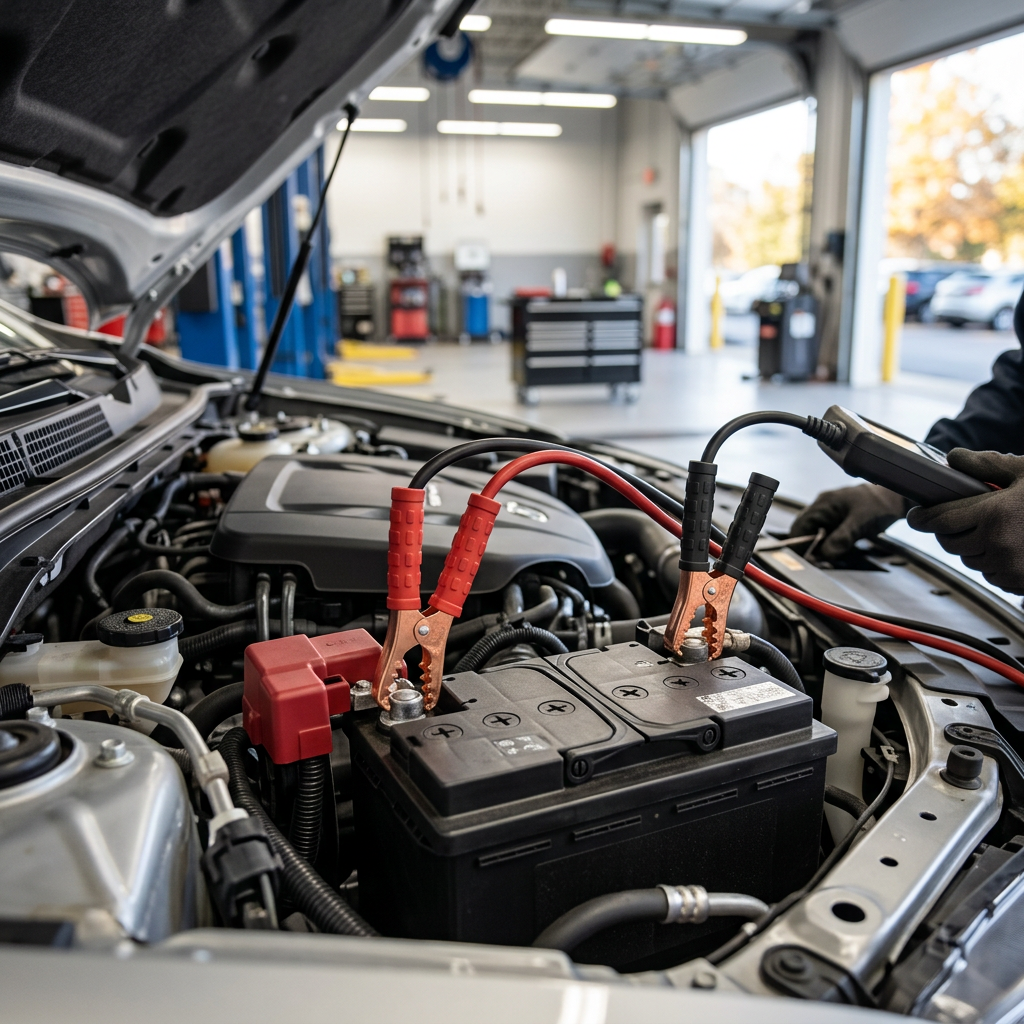
A: Attaching the final negative jumper clamp to an unpainted metal bolt or engine ground point prevents electrical sparks from occurring directly near the battery casing. Discharged lead-acid batteries can vent flammable hydrogen gas during charging and jump starting. Completing the electric circuit several inches away from the battery eliminates the risk of igniting those escaping vapors.
Connecting the final clamp to a dedicated engine ground point also safeguards sensitive onboard control modules from sudden voltage spikes. Modern electronic systems across Chrysler, Dodge, Jeep, and Ram vehicles rely on clean grounding points. Drivers seeking replacement jumper cables, heavy-duty clamps, or terminal maintenance supplies can order genuine Mopar parts engineered specifically for their vehicle electrical specifications.
"Making that final ground connection away from the battery prevents sparks from igniting gases, which keeps both you and your vehicle's electronics safe."
Q: Should you warm up your vehicle before driving after a cold-weather jump start?
A: Letting the engine idle for 1 to 2 minutes following a cold-weather jump start allows vital engine fluids to circulate properly through mechanical components. However, extended driveway idling is inefficient for battery charging because an idling engine produces low electrical output. Transitioning to gentle driving after that initial 1-minute warm-up increases engine speed to 1,500 to 2,000 RPM, allowing the alternator to charge the battery at optimal efficiency.
Cold winter weather places substantial demands on vehicle electrical systems, particularly during early morning trips past the Michigan Center Reservoir. Freezing temperatures slow down internal chemical reactions while drivers demand extra power for defrosters, blowers, and seat heaters. Vehicle owners preparing for winter conditions can custom order your vehicle with cold-weather prep packages, or browse current inventory by looking into new vehicle specials and used vehicle specials featuring heavy-duty electrical components.
Q: What are the signs of a failing alternator versus a dead battery?
A: A weak or dead battery reveals itself before the engine starts, causing symptoms like slow starter cranking, rapid clicking noises, or dark instrument displays. Once jump-started, a vehicle with a functional alternator will continue running smoothly because the alternator supplies operational power to the ignition system. Conversely, a failing alternator causes the engine to stall shortly after jumper cables are disconnected because the vehicle loses its primary power generator.
Drivers can also identify alternator issues while driving by observing dimming headlights, flickering interior displays, or an illuminated battery warning light on the dashboard. Standard charging system tests measure terminal voltage while running; a healthy alternator generates between 13.5 and 14.5 volts, whereas readings near or below 12 volts point directly to charging system failure.
Q: What is the average lifespan of a standard 12V automotive battery?
A: The average service lifespan of a standard 12-volt battery ranges between 3 and 5 years under normal operating conditions. Factors such as extreme temperature shifts, repeated short-distance driving, and extended garage storage determine where a battery falls within that range. Absorbed Glass Mat ( AGM) batteries, frequently installed in vehicles equipped with automatic stop-start systems, offer greater resistance to deep discharge cycles than conventional flooded batteries.
Proactive battery testing becomes vital once a battery reaches its third year of service. Over time, internal lead plates sulfate and lose their capacity to retain charge, leading to sudden failure during sudden temperature drops. Periodic load testing identifies degradation before a vehicle leaves a driver stranded.
Q: When should a vehicle be brought in for a professional battery and charging system test?
A: Vehicle owners should seek a professional battery diagnostic test whenever a vehicle requires more than one jump start in a week, shows swollen battery casing walls, or exhibits physical corrosion around the terminals. Bringing the vehicle to a factory-authorized service department ensures technicians test battery conductance under load, evaluate alternator diode performance, and measure starter draw using calibrated diagnostic equipment.
Our certified technicians at NewGen Chrysler Dodge Jeep Ram of Clinton perform full charging system inspections and install factory-approved Mopar battery replacements. Drivers can stop by our Clinton service center or contact our service desk at (517) 456-6555 to keep their vehicle starting reliably in every season.
© 2026 NewGen Chrysler Dodge Jeep Ram of Clinton. All rights reserved.