

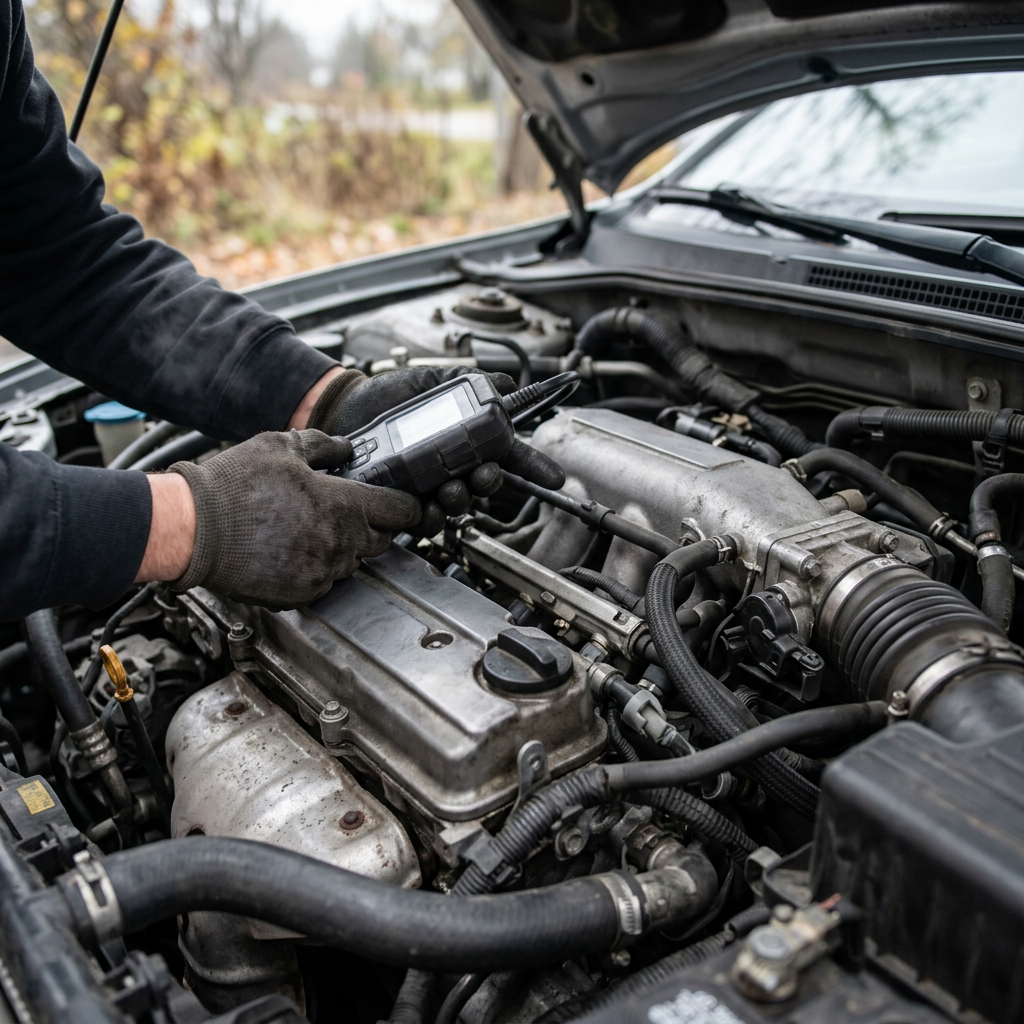
A crank no-start condition occurs when the starter motor successfully spins the engine crankshaft, but the engine fails to ignite and run independently. This usually stems from a breakdown in fuel delivery, missing ignition spark, inaccurate engine-position sensor signals, or security system lockouts rather than a starter or battery failure. Identifying why the starter turns while combustion never catches requires inspecting the fundamental inputs needed for engine operation.
When an engine cranks continuously without starting, the starter motor and ring gear are actively functioning, which confirms that electrical current is reaching the starter. However, internal combustion requires precise timing, proper fuel pressure, and adequate compression inside the cylinders. If any single critical input is missing, the engine control module prevents or limits the ignition process, leaving the vehicle turning over repeatedly until the key is released or the battery drains.
Basic troubleshooting begins with observing the sound and speed of the starter. An engine that cranks faster or higher in pitch than usual may have lost mechanical compression, which occurs when a timing belt or timing chain fails. Conversely, an engine that turns over at normal cranking speed but produces no sputter or partial firing usually points to an interrupted fuel delivery pathway or an electronic signal failure from key engine sensors.
If your vehicle experiences a sudden crank no-start situation on the road or in your driveway, continuing to crank the starter repeatedly can overheat the starter motor and drain the battery completely. For professional technical diagnosis and towing assistance, you can reach (517) 456-6555 or visit our service center in Clinton where our certified service team can perform a complete engine diagnostic check.
Table of Contents
- What Is the Difference Between No-Crank No-Start and Crank No-Start?
- What Are the Technical Requirements an Engine Needs to Fire Up?
- Can a Failed Sensor Cause an Engine to Crank Without Starting?
- How Do OBD-II Scanners and Starter Fluid Pinpoint the Diagnostic Cause?
- What Are Fuel Pump Replacement Costs and When Is Repair Uneconomical?
- Frequently Asked Questions About Engine Diagnostic Services
What Is the Difference Between No-Crank No-Start and Crank No-Start?
The fundamental distinction lies in whether the starter motor physically rotates the engine crankshaft. In a no-crank no-start condition, turning the key or pressing the push-button start yields complete silence, a single heavy click, or a rapid series of metallic clicks without any mechanical rotation of the engine. In a crank no-start condition, the starter motor continuously rotates the flywheel and pistons at standard speed, but internal combustion never initiates.
Understanding this difference narrows down the potential failure points instantly:
- No-Crank No-Start Causes: Discharged or severely corroded battery, failed starter solenoid or starter motor, loose battery cable connections, blown main starter fuse, or a faulty neutral safety switch.
- Crank No-Start Causes: Failed fuel pump or fuel pump relay, clogged fuel filter, bad crankshaft position sensor, failed ignition coils, blown engine management fuse, or security immobilizer lockout.
A common area of confusion involves battery voltage. While a completely dead battery causes a no-crank state, a partially depleted or weak battery can sometimes supply enough amperage to spin the starter motor slowly while lacking sufficient voltage to energize the engine control module, electric fuel pump, or ignition system. When voltage drops below operational thresholds during cranking, the vehicle enters a hybrid state where the engine turns over sluggishly but cannot power the electronics necessary to achieve ignition spark or fuel injector pulse.
Listening carefully during the starting attempt provides critical diagnostic clues. A standard cranking rhythm indicates the starter, starter clutch, and battery are meeting baseline mechanical expectations. If the starter spins rapidly with a high-pitched whirring sound but does not turn the engine over, the starter bendix drive has failed to engage the flywheel ring gear, which represents a starter mechanical failure rather than a true crank no-start issue.
What Are the Technical Requirements an Engine Needs to Fire Up?
An internal combustion engine requires four fundamental technical elements working in exact synchronicity to fire up and sustain independent operation: mechanical compression within the cylinders, precise air-fuel delivery, timed ignition spark, and accurate electronic security authorization. If any one of these pillars is compromised or missing, the engine will crank indefinitely without starting.
The four required systems operate under strict mechanical and electronic parameters:
- Air-Fuel Mixture: Electric fuel pumps deliver pressurized fuel from the tank to the fuel injectors. The engine control unit regulates injector pulse width to mix air and atomized fuel at optimal stoichiometric ratios inside the intake plenum and combustion chambers.
- Ignition Spark: On gasoline engines, ignition coils generate high-voltage electrical charges delivered directly to spark plugs at the precise moment the piston reaches top dead center during the compression stroke.
- Mechanical Compression: Piston rings, intake and exhaust valves, and head gaskets seal the combustion chamber. As the crankshaft turns, the rising piston compresses the trapped air-fuel mixture to increase thermal efficiency upon ignition.
- Engine Timing and Synchronization: A intact timing belt or timing chain synchronizes the rotational position of the crankshaft with the camshafts, keeping valve opening sequences perfectly aligned with piston movement.
Modern vehicles add a fifth requirement: anti-theft immobilizer authorization. Built-in security systems verify the radio frequency signal emitted by the key fob before enabling the fuel injectors and ignition circuit. On push-button start vehicles, if the key fob battery is depleted, holding the fob directly against the engine start button allows the internal transponder chip to communicate with the backup reader in the steering column.
For drivers navigating rural routes near Onsted, seasonal temperature drops and rough road vibration can accelerate wear on electrical connectors, fuel pump relays, and sensor wiring harnesses. When a vehicle cranks without starting after sitting in cold weather, thermal contraction can separate cracked wiring connections inside ignition coils or fuel delivery harnesses, interrupting the electronic signal chain necessary for immediate starting.
Can a Failed Sensor Cause an Engine to Crank Without Starting?
A failed engine sensor can directly cause a crank no-start condition by withholding critical timing data required by the engine control unit. If sensors such as the crankshaft position sensor or camshaft position sensor stop transmitting accurate signals, the computer cannot determine cylinder position and will disable fuel injection and ignition spark entirely as a safety precaution.
The crankshaft position sensor serves as the primary timing reference for the entire powertrain. It monitors the rotational speed and exact position of the crankshaft reluctor ring. Without a clean, continuous signal from this sensor:
- The engine control module cannot determine when cylinder number one reaches top dead center.
- Fuel injector pulsing is immediately halted to prevent unburned fuel from flooding the cylinders and washing oil off cylinder walls.
- Ignition coils receive no firing trigger, eliminating spark across all spark plugs simultaneously.
Similarly, the camshaft position sensor tracks valve position relative to the crankshaft. While some advanced engine management systems can default to a limp mode if a camshaft sensor drops out while running, a total failure during cranking often prevents initial synchronization, resulting in a continuous crank no-start.
Other sensors can also trigger a crank no-start or immediate stall. A severely malfunctioning mass air flow sensor or a shorted engine coolant temperature sensor can cause the engine control unit to miscalculate air density severely, delivering an air-fuel mixture that is far too lean or excessively rich for cold ignition. Replacing a failed sensor with an OEM-spec component restores accurate timing data to the engine controller, allowing immediate startup.
How Do OBD-II Scanners and Starter Fluid Pinpoint the Diagnostic Cause?
Diagnostic tools isolate a crank no-start by separating fuel delivery issues from ignition and electronic sensor failures. Connecting an OBD-II scanner reads stored diagnostic trouble codes and live engine data, while spraying aerosol starter fluid directly into the air intake manifold tests whether the ignition system is capable of firing when fuel is introduced independently.
An OBD-II scanner connects to the diagnostic port beneath the steering column to communicate directly with the vehicle's onboard computers. During diagnostic evaluation, technicians look for key indicators:
- Stored Trouble Codes: Active or pending codes such as P0335 indicate a circuit fault in the crankshaft position sensor system, while codes like P0230 point to fuel pump primary circuit issues.
- Engine RPM Data Stream: Monitoring live data while cranking the engine shows whether the engine computer registers cranking rotational speed (typically between 150 RPM and 300 RPM). If the scanner displays 0 RPM during cranking, the computer is not receiving a signal from the crankshaft position sensor.
- Security Codes: Body control or immobilizer codes reveal whether an anti-theft module is actively blocking ignition output.
Starter fluid provides a fast mechanical check for fuel starvation. By opening the air cleaner assembly and spraying a brief burst of starter fluid into the throttle body, you temporarily introduce a highly volatile vapor into the intake tract.
If the engine fires momentarily, runs for two seconds, and then dies, the ignition coils, spark plugs, engine timing, and mechanical compression are functioning correctly. This outcome proves conclusively that the crank no-start is caused by a fuel delivery problem, such as a dead fuel pump, blown fuel pump fuse, clogged fuel filter, or failed fuel pressure regulator. If the engine continues to crank without firing at all after applying starter fluid, the issue lies in the ignition system, sensor timing network, or internal mechanical compression.
What Are Fuel Pump Replacement Costs and When Is Repair Uneconomical?
Replacing a failed fuel pump typically costs between $400 and $900 across most passenger cars and light trucks, with OEM pump assemblies generally ranging from $200 to $500 and professional shop labor adding $200 to $400 depending on vehicle fuel tank accessibility. In heavy-duty trucks or vehicles where tank removal requires disassembling hitch receivers or exhaust components, labor hours increase accordingly.
Fuel pumps generally exhibit warning signs before total failure occurs. Drivers may notice delayed engine starting, lean-mixture misfire codes under heavy acceleration, or an audible whining noise emanating from the rear fuel tank area. When an electric fuel pump fails completely, the electric motor inside burns out or seizes, causing an immediate crank no-start without prior warning. Checking the fuel pump fuse and swapping the fuel pump relay with an identical horn or wiper relay in the power distribution center is an essential first check before condemning the pump itself.
Evaluating whether an engine repair remains economical depends on total vehicle valuation versus the cumulative cost of mechanical restoration. An engine repair becomes an economic total loss when necessary service expenses exceed the actual fair market value of the automobile. Examples where repairs become uneconomical include:
- Broken timing belts on interference engines causing bent valves, damaged pistons, and cylinder head destruction.
- Internal oil starvation resulting in spun rod bearings, scored crankshaft journals, and block wall damage.
- Severe overheating that warps aluminum engine blocks and cracks cylinder heads beyond machine shop tolerances.
For high-mileage commuters driving toward Jackson from Michigan Center, maintaining routine inspection schedules helps identify minor sensor degradation or fuel system wear before it leads to a unexpected breakdown. When dealing with complex engine diagnostics or replacing critical fuel components, our certified service department uses genuine manufacturer parts designed specifically for your vehicle's engine management architecture. You can easily arrange diagnostic service by scheduling a Mopar service appointment online or by ordering genuine Mopar replacement parts directly through our facility.
Frequently Asked Questions About Engine Diagnostic Services
Q: Can a weak car battery cause a crank no-start condition?
Yes, a weak battery can cause a crank no-start if it holds enough charge to turn the starter motor over slowly but lacks sufficient voltage to power the engine control module, fuel pump, or ignition coils. During cranking, if system voltage drops below roughly 9.5 volts, the computer may fail to energize the fuel injectors or ignition system, resulting in continuous engine rotation without ignition. Testing battery voltage under load quickly clarifies whether battery replacement is necessary.
Q: How do I know if my crank no-start is caused by the fuel pump?
A fuel pump failure can often be identified by switching the ignition key to the run position without starting and listening near the fuel tank for a brief two-second humming sound. If no humming sound occurs, or if spraying a small burst of starter fluid into the throttle intake allows the engine to catch and run for a second before stalling, the issue is almost certainly within the fuel delivery system.
Q: Will an OBD-II code always pop up during a crank no-start?
Not every crank no-start situation immediately triggers a diagnostic trouble code. While electronic sensor failures like a faulty crankshaft position sensor or camshaft sensor usually set stored fault codes like P0335, purely mechanical failures—such as a clogged fuel filter, broken mechanical fuel pump pushrod, or low fuel tank volume—may not trigger a check engine light or fault code right away.
Q: What should I do if my push-button start key fob battery dies?
If your key fob battery is dead and your vehicle will not recognize the key, check your owner's manual for emergency starting instructions. On most vehicles, pressing the physical key fob directly against the engine start button while stepping on the brake pedal allows the vehicle's passive transponder antenna to read the chip inside the fob, bypassing the dead fob battery and enabling the engine to crank and start normally.
Q: How long does a professional engine diagnostic inspection take?
A professional diagnostic evaluation typically takes between one and two hours. Certified technicians connect factory scan tools, test fuel pressure at the fuel rail, verify ignition spark, and test sensor circuits to isolate the precise root cause of a crank no-start. Getting an accurate diagnosis upfront prevents unnecessary parts replacement and ensures the underlying issue is resolved correctly.
When you experience engine starting difficulties or persistent warning lights, having expert factory-trained technicians analyze your vehicle saves time and protects your vehicle's longevity. To schedule a comprehensive inspection or discuss diagnostic options with our team, contact (517) 456-6555, visit our Clinton service department, or learn more about our Clinton dealership team to keep your car, truck, or SUV performing reliably on every journey.
© 2026 NewGen Chrysler Dodge Jeep Ram of Clinton. All rights reserved.