

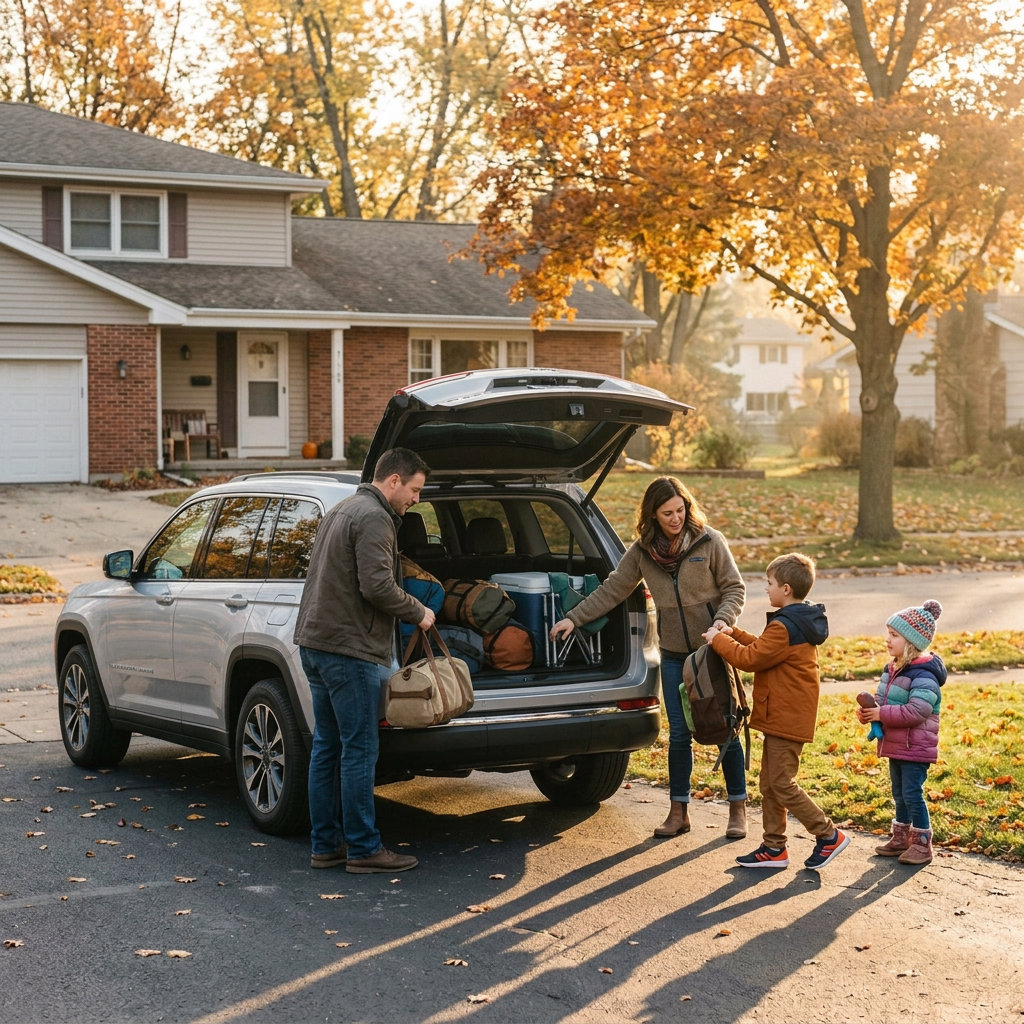
When buying a family SUV, prioritize standard active safety systems like automatic emergency braking, accessible LATCH anchors, flexible cargo capacity that accommodates strollers and luggage, and intuitive rear-seat connectivity. Evaluating seating configurations, long-term maintenance needs, and passenger accessibility ensures the vehicle meets daily routine demands. Balancing seating capacity against usable cargo volume helps narrow down whether a two-row or three-row layout best fits your household.
Finding the right vehicle requires looking beyond high-level brochure numbers to see how features function during daily school runs, road trips, and weekend errands. Active driver-assist features protect your passengers in high-traffic situations, while well-placed USB ports and climate controls maintain peace in the rear seats. Suspension tuning, ground clearance, and all-wheel-drive capability also determine how comfortably a vehicle handles varied seasonal weather and rough road surfaces.
At NewGen Chrysler Dodge Jeep Ram of Clinton, our team works directly with parents to evaluate daily seating needs, car seat compatibility, and cargo space requirements. You can stop by our Clinton showroom location to explore our complete vehicle lineup in person. Whether you need a spacious passenger crossover or are interested in hauling heavy trailered equipment with our new commercial inventory, our staff provides clear guidance on every model. Give us (517) 456-6555 to set up a hands-on walkthrough with an expert.
Table of Contents
- What Safety Features and Driver Assistance Are Most Important in a Family SUV?
- How Is Cargo Space Measured in SUVs and How Much Do You Really Need?
- What Seating Configurations Work Best for Car Seats and LATCH Installation?
- Is a 3-Row SUV Better for Your Family Than a Minivan or 2-Row SUV?
- What Infotainment and Connectivity Features Keep Families Connected on the Road?
- How Much Should You Budget for Annual SUV Maintenance and Ownership Costs?
- Common Questions About Choosing a Family SUV
- Finding the Ideal Family SUV at NewGen Chrysler Dodge Jeep Ram of Clinton
What Safety Features and Driver Assistance Are Most Important in a Family SUV?
The most critical safety features in a family SUV are automatic emergency braking with pedestrian detection, blind-spot monitoring, rear cross-traffic alert, lane-keeping assist, and adaptive cruise control. These active crash-avoidance systems continuously monitor the surroundings to warn drivers or intervene before an impact occurs. Advanced structural engineering and multi-row curtain airbags provide essential passive protection if a collision becomes unavoidable.
Safety technologies divide into two distinct categories: active driver assistance that works to prevent accidents, and passive safety structures designed to absorb impact energy. Active driver assistance features utilize radar, camera sensors, and ultrasonic inputs to detect hazard risks. Essential safety technologies include:
- Forward collision warning and automatic emergency braking to alert drivers and autonomously apply stopping force if a frontal obstacle is detected.
- Blind-spot monitoring and rear cross-traffic alert to detect vehicles hidden in side blind zones or approaching laterally while reversing out of driveways.
- Lane departure warning and lane centering assistance to monitor highway markings and gentle steering inputs to keep the SUV centered.
- Rear seat reminder systems that use door-logic algorithms or interior cabin sensors to alert departing drivers to check the back seat.
National Highway Traffic Safety Administration evaluations emphasize the importance of comprehensive airbag coverage across every passenger row. The 2026 Jeep Grand Cherokee L features standard head-protection curtain airbags covering the first, second, and third rows, alongside standard forward collision warning, crash imminent braking, and lane departure warning. Combining active crash-prevention hardware with full-cabin structural protection delivers maximum confidence behind the wheel.
Keeping these safety technologies functioning properly requires routine maintenance and sensor calibrations over the lifecycle of your vehicle. Drivers can stay proactive with vehicle maintenance by scheduling a service appointment online with our certified service department.
How Is Cargo Space Measured in SUVs and How Much Do You Really Need?
Cargo space in SUVs is measured in cubic feet using standardized Society of Automotive Engineers testing procedures, calculating total usable volume from the load floor to the roofline behind each seat row. Most families require at least 15 to 20 cubic feet of dedicated cargo space behind the rear row for daily groceries and strollers, expanding to 45 to 80 cubic feet when rear seats are folded flat for extended road trips.
Understanding cargo measurements prevents surprises when loading real-world items like sports bags, luggage, or camping equipment. A vehicle's published cubic footage accounts for vertical height, but practical usability depends heavily on floor width, wheel-well intrusion, and tailgate opening shape. Evaluating cargo volume behind active passenger rows ensures you do not have to fold down seats needed for children just to transport everyday gear.
| 2026 Vehicle Model | Cargo Volume Behind Rear Seat | Maximum Cargo Volume | Seating Capacity |
|---|---|---|---|
| 2026 Jeep Grand Cherokee | 37.7 cu ft | 70.8 cu ft | 5 |
| 2026 Subaru Ascent | 17.8 cu ft | 75.6 cu ft | 7-8 |
| 2026 Ford Explorer Active | 16.3 cu ft | 85.8 cu ft | 6-7 |
| 2026 Ford Expedition | 22.9 cu ft | 108.5 cu ft | 7-8 |
The 2026 Jeep Grand Cherokee provides about 38 cu ft of rear cargo space behind its second row, combined with a maximum towing capacity of 6,200 lbs and a payload rating of 1,812 lbs on the Laredo trim. By comparison, three-row alternatives balance passenger accommodation against cargo space differently. The 2026 Ford Explorer Active offers about 16 cu ft behind its third row, while the full-size 2026 Ford Expedition supplies about 23 cu ft in standard-wheelbase form or about 37 cu ft in the extended Expedition MAX configuration. The 2026 Subaru Ascent provides 31.7 inches of third-row legroom and up to about 76 cu ft of total cargo volume with all rear rows folded.
Packing coolers, water gear, and folding chairs for trips to Wamplers Lake near Onsted requires a flat cargo floor and low lift-over height. Families planning to upgrade their current vehicle for improved cargo flexibility can start by evaluating your trade-in online to estimate current vehicle equity.
What Seating Configurations Work Best for Car Seats and LATCH Installation?
Second-row captain's chairs provide the easiest third-row access and physical separation between children, while a second-row bench seat maximizes total seating capacity and allows three car seats across wider cabin interiors. Secure installation relies on lower anchors and top tethers, which attach child restraint systems directly to the structural frame of the vehicle.
The Lower Anchors and Tethers for Children system simplifies installation without using standard vehicle seatbelts. Federal safety standards require lower anchor hardware in at least two rear seating positions, along with top tether anchors designed to limit forward head movement in a crash. Key installation considerations include:
- Lower anchors carry a combined weight limit of 65 lbs, calculated by adding the weight of the car seat to the weight of the child.
- Once the combined weight exceeds 65 lbs, parents must transition to a seatbelt installation while continuing to utilize the top tether anchor.
- Top tethers should always be secured on forward-facing car seats, whether installed via lower anchors or the vehicle lap-and-shoulder belt.
Vehicle interiors accommodate child seats differently depending on seat contouring and hardware layout. National Highway Traffic Safety Administration records confirm lower anchor positions across the second row of the 2026 Jeep Grand Cherokee L. Independent evaluations of the 2026 Chrysler Pacifica identified two fully accessible lower anchor sets in the second row and two sets in the third row, noting that the second-row captain's chair configuration is designed for individual seats rather than fitting three car seats abreast in that row.
When evaluating car seat fit on our lot, families typically bring their actual child seats to test door clearances, front-seat legroom, and third-row pass-through accessibility. Buyers ready to explore monthly budget options for a new family vehicle can begin by submitting an online credit application prior to visiting the showroom.
Is a 3-Row SUV Better for Your Family Than a Minivan or 2-Row SUV?
A three-row SUV is better for families who require higher ground clearance, available four-wheel drive, and heavy towing capabilities, whereas a minivan provides superior interior passenger volume, lower step-in height, and convenient sliding side doors. Two-row SUVs offer easier maneuverability and enhanced fuel efficiency for smaller families who rarely carry extra passengers.
Selecting between these vehicle styles depends on how frequently you haul full passenger loads versus heavy equipment or cargo. Three-row crossover SUVs offer dynamic styling along with all-weather traction systems built to tackle unpaved surfaces or heavy snowfall. Minivans prioritize maximum floor space, ultra-low floor heights for young children, and wide side-door openings that simplify loading in tight parking spots.
Drivetrain performance and structural chassis design also separate these vehicle categories:
- The 2026 Jeep Grand Cherokee L features available all-wheel drive, robust ground clearance, and up to 6,200 lbs of towing capacity for trailering boats or camper rigs.
- The 2026 Chrysler Pacifica delivers a front-wheel-drive platform powered by a 3.6L V6 engine mated to an automatic 9-speed transmission, achieving an EPA-estimated 19 city / 28 hwy mpg with about 32 cu ft of cargo room behind the third row and a 3,600-lb tow rating.
- Two-row models like the standard 2026 Jeep Grand Cherokee offer about 38 cu ft of rear cargo space, an EPA-estimated 20 city / 25 hwy mpg, and identical 6,200-lb towing limits without the extra vehicle length of a third row.
Commuting along the two-lane routes around Michigan Center into Jackson demands predictable all-wheel-drive traction during slushy Michigan winters. For owners looking to outfit their vehicle with specialized utility racks, custom floor protection, or trailering packages, our dealership team assists with ordering genuine Mopar accessories designed specifically for your model.
What Infotainment and Connectivity Features Keep Families Connected on the Road?
Essential family infotainment features include wireless Apple CarPlay and Android Auto integration, multiple USB charging ports distributed across all seating rows, available Wi-Fi hotspot capability, and intuitive touchscreen interfaces. Modern connectivity keeps navigation active on the main dashboard while allowing passengers in rear rows to power devices during extended travel.
Cabin technology has evolved from basic radio units into full digital command centers that serve driver navigation and passenger entertainment simultaneously. High-output USB-A and USB-C ports in the second and third rows prevent device battery depletion on long drives. Integrated cabin intercom systems allow drivers to communicate clearly with third-row passengers without raising their voice over road noise.
Rear-seat entertainment systems also offer specialized viewing options for secondary rows. For example, the 2026 Ford Expedition offers available rear-seat entertainment screens with dedicated USB ports, though manufacturer specifications note these built-in screens cannot be equipped simultaneously with the available seatback digital device holders. Choosing between factory-integrated video screens or flexible device mounts allows parents to tailor back-seat media access to the ages of their children.
How Much Should You Budget for Annual SUV Maintenance and Ownership Costs?
Routine annual maintenance for a non-luxury midsize family SUV typically averages between $500 and $800 during the first five years of ownership, covering scheduled oil changes, tire rotations, cabin filter replacements, and brake inspections. Total ownership costs also account for fuel consumption, comprehensive auto insurance, standard registration fees, and vehicle depreciation.
Following manufacturer-recommended service schedules protects long-term powertrain durability and maintains factory warranty coverage. Adhering to regular 5,000-mile to 10,000-mile inspection intervals helps technicians catch minor wear on brake pads, suspension bushings, and tires before expensive mechanical issues develop.
Vehicle acquisition pricing forms the foundation of overall ownership costs. The 2026 Jeep Grand Cherokee lineup spans multiple trim levels, beginning at $38,920 base MSRP for the Laredo trim, $40,920 for Laredo 4x4, $44,320 for Limited, and $46,320 for Limited 4x4. Premium configurations include the 85th Anniversary Edition at $50,415, Limited Reserve 4x4 at $51,915, and Summit 4x4 at $60,600, each subject to a standard $1,995 destination charge.
Drivers evaluating full ownership budgets can check our dealership directions to visit our showroom, or give a quick call to our sales team to discuss current model availability. If you prefer to explore alternative pre-owned options, you can also browse our pre-owned vehicle lineup online.
Pricing
Pricing by trim
| Trim | Base MSRP | Destination charge |
|---|---|---|
| 85th Anniversary Edition | $50,415 | $1,995 |
| Laredo | $38,920 | $1,995 |
| Laredo 4x4 | $40,920 | $1,995 |
| Laredo Altitude | $44,360 | $1,995 |
| Laredo Altitude 4x4 | $46,360 | $1,995 |
| Laredo X | $41,415 | $1,995 |
| Laredo X 4x4 | $43,415 | $1,995 |
| Limited | $44,320 | $1,995 |
| Limited 4x4 | $46,320 | $1,995 |
| Limited Reserve 4x4 | $51,915 | $1,995 |
| Summit 4x4 | $60,600 | $1,995 |
Common Questions About Choosing a Family SUV
Q: What is a Rear Seat Reminder and how does it operate?
A Rear Seat Reminder alerts drivers to check the back seats for passengers or pets before exiting the vehicle. The system uses door-logic algorithms to monitor whether a rear door was opened prior to starting a drive, triggering visual instrument-cluster prompts and audible chimes when the ignition is switched off at your destination.
Q: What is the primary difference between LATCH and seatbelt car seat installations?
The LATCH system utilizes rigid or flexible hooks attached directly to metal anchors built into the vehicle frame, providing standardized connection points without using seatbelts. Seatbelt installations secure the car seat using the vehicle's standard lap-and-shoulder belt along with a locking mechanism, and both methods require top tether usage on forward-facing car seats.
Q: How much cargo space is needed behind the rear seats for daily errands?
Most families require 15 to 20 cubic feet of cargo room behind the active rear row to fit a standard full-size stroller, diaper bags, and several bags of groceries without obstructing rearward visibility. Models providing 30 or more cubic feet behind the second row offer significantly greater ease when loading bulky sports equipment or camping gear.
Q: Are captain's chairs or bench seats better for installing multiple car seats?
Second-row bench seats are better for installing three car seats side-by-side in wider vehicles, maximizing overall passenger capacity. Second-row captain's chairs provide superior separation between two child seats and clear a center walkway for easy access to the third row.
Q: How does ground clearance impact family SUV everyday usability?
Higher ground clearance improves deep-snow traction, unpaved road navigation, and obstacle clearance, but increases vehicle step-in height for young children. Lower ground clearance reduces step-in height for easier entry and loading, while maintaining adequate clearance for standard suburban driving conditions.
Dimensions & Capacity
Capacity and dimensions by trim
| Feature | 85th Anniversary Edition | Laredo | Laredo 4x4 | Laredo Altitude | Laredo Altitude 4x4 | Laredo X |
|---|---|---|---|---|---|---|
| Seating | 5 | 5 | 5 | 5 | 5 | 5 |
| Cargo | 37.7 cu ft | 37.7 cu ft | 37.7 cu ft | 37.7 cu ft | 37.7 cu ft | 37.7 cu ft |
| Curb weight | 4,413 lbs | 4,238 lbs | 4,365 lbs | 4,238 lbs | 4,365 lbs | 4,238 lbs |
| Towing | 6,200 lbs | 6,200 lbs | 6,200 lbs | 6,200 lbs | 6,200 lbs | 6,200 lbs |
| Payload | 1,637 lbs | 1,812 lbs | 1,685 lbs | 1,812 lbs | 1,685 lbs | 1,812 lbs |
Dimensions & Capacity (continued)
| Feature | Laredo X 4x4 | Limited | Limited 4x4 | Limited Reserve 4x4 | Summit 4x4 |
|---|---|---|---|---|---|
| Seating | 5 | 5 | 5 | 5 | 5 |
| Cargo | 37.7 cu ft | 37.7 cu ft | 37.7 cu ft | 37.7 cu ft | 37.7 cu ft |
| Curb weight | 4,365 lbs | 4,266 lbs | 4,413 lbs | 4,413 lbs | 4,784 lbs |
| Towing | 6,200 lbs | 6,200 lbs | 6,200 lbs | 6,200 lbs | 6,200 lbs |
| Payload | 1,685 lbs | 1,784 lbs | 1,637 lbs | 1,637 lbs | 1,266 lbs |
Finding the Ideal Family SUV at NewGen Chrysler Dodge Jeep Ram of Clinton
Selecting the perfect family SUV comes down to matching seating layouts, safety technologies, and cargo capacity to your family's daily routine. Our experienced team at NewGen Chrysler Dodge Jeep Ram of Clinton is ready to help you compare two-row and three-row models side-by-side, test child safety seat fitment, and explore available four-wheel-drive capability. Visit our Clinton dealership today, or contact our sales specialists to schedule a test drive and experience our complete lineup firsthand.
© 2026 NewGen Chrysler Dodge Jeep Ram of Clinton. All rights reserved.