

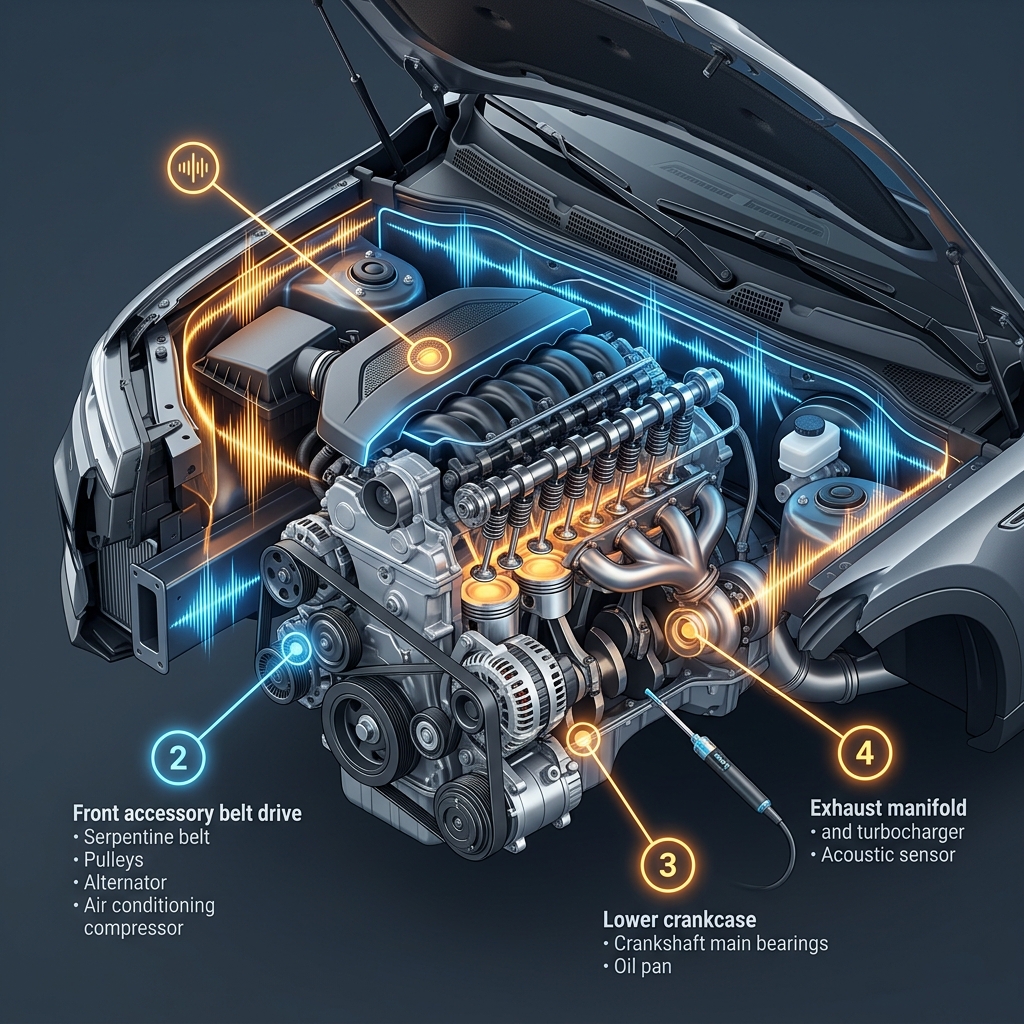
Identifying abnormal engine noises in a 2026 Jeep requires observing the pitch, rhythm, underhood location, and operational conditions under which the sound occurs. Technicians isolate sounds by determining whether the noise varies directly with engine RPM, fluctuates with vehicle speed, or changes as the engine reaches operating temperature. Pinpointing metallic clicks, high-pitched squeals, or deep structural thuds helps distinguish normal component operation from severe mechanical wear.
When evaluating an unusual engine sound, mechanical isolation is the critical first step. Experienced technicians use a mechanic stethoscope to probe specific engine zones, such as the cylinder heads, front accessory drive, engine block, and exhaust manifolds. Isolating the sound to a specific component prevents misdiagnosis and pinpoints whether the issue lies in the upper valvetrain, lower rotating assembly, or belt-driven accessories.
A proper noise evaluation tracks several key operational behaviors:
- Does the sound appear only during a cold startup and fade as engine components heat up and expand?
- Is the noise a fast, light rhythm in the upper engine valve covers or a heavy, dull thud beneath the crankcase?
- Does the sound change cadence strictly when depressing the accelerator while parked in park or neutral?
- Does activating accessories like the air conditioning compressor or turning the steering wheel alter the pitch or intensity?
If an unusual sound develops while commuting, documenting these characteristics helps streamline professional service. Drivers can visit our local Clinton service facility or give our service desk a quick phone call to describe the sound and schedule a multi-point inspection.
Table of Contents
- What Is the Difference Between Engine Ticking, Knocking, and Clicking in a Jeep?
- What Causes a Ticking Noise in a Jeep 3.6L Pentastar Engine?
- Is Direct Injection Noise Normal on 4-Cylinder Jeep Engines vs a Squealing Belt?
- Which Critical Engine Noise Warnings Require Immediate Engine Shutdown?
- Does the Jeep Factory Warranty Cover Diagnostic Fees for Engine Noises?
- Common Questions About Jeep Engine Noise Diagnostics and Service
- Professional Engine Diagnostics at NewGen Chrysler Dodge Jeep Ram of Clinton
What Is the Difference Between Engine Ticking, Knocking, and Clicking in a Jeep?
Engine ticking stems from upper valvetrain clearance issues like worn rocker arms or hydraulic lifters, while clicking typically reflects the normal high-pressure operation of direct fuel injectors. Deep metallic knocking signals lower-end mechanical distress, such as worn rod bearings or crankshaft play, demanding urgent repair.
Understanding these sound characteristics helps owners communicate symptoms accurately to certified technicians. Valvetrain ticking produces a sharp, metallic tapping sound at the top of the engine that speeds up evenly as engine RPM increases. This noise indicates excessive clearance between moving components, often caused by collapsed hydraulic lash adjusters or failed needle bearings inside rocker arms. Left unaddressed, persistent valvetrain ticking can score camshaft lobes and drop metallic debris into the engine oiling system.
Clicking, by contrast, is frequently benign. Modern high-pressure direct injection systems pulse rapidly under intense pressure, creating a steady, sewing-machine-like clicking noise around the fuel rail. This rapid clicking is especially noticeable on advanced engines found across the Jeep hybrid lineup, where silent electric operation makes mechanical fuel system sounds more prominent when the gas engine engages.
Deep mechanical knocking is the most severe of the three sound profiles. Unlike light surface ticking, knocking manifests as a heavy, hollow thud coming from deep within the engine block. This condition often points to severe lower-end wear, such as damaged connecting rod bearings, worn main bearings, or severe engine detonation. When valvetrain or engine components require replacement, installing genuine OEM Mopar parts ensures proper tolerances, factory material standards, and long-term durability.
What Causes a Ticking Noise in a Jeep 3.6L Pentastar Engine?
A ticking noise in a Jeep 3.6L Pentastar V6 engine is most frequently caused by needle bearing failure in the valve rocker arms, collapsing hydraulic lash adjusters, or cold-start exhaust manifold leaks. Over time, worn rocker bearings score the camshaft lobes, creating a persistent, rhythmic metallic tick that matches engine speed.
The 3.6L Pentastar V6 utilizes a double overhead camshaft design with roller rocker arms riding directly on camshaft lobes. Small needle bearings within these rocker arm rollers can experience accelerated wear over high mileage or due to oil breakdown. When these bearings deteriorate, the roller tilts sideways, creating excessive clearance. Each time the camshaft lobe strikes the misaligned roller, it produces a distinct ticking sound. If driving continues with a failing rocker arm, the hardened outer surface of the roller will grind away the camshaft lobe, requiring replacement of both the rocker arm assembly and the camshaft.
Exhaust manifold leaks represent another frequent source of Pentastar ticking noises. Exhaust manifold studs can crack or stretch due to repeated thermal expansion and contraction cycles. This creates a tiny gap between the cylinder head and exhaust manifold gasket. As pressurized exhaust gas escapes through this gap during combustion strokes, it emits a sharp, ticking or snapping sound.
Technicians distinguish between valvetrain tick and exhaust manifold leak ticks through specific diagnostic markers:
- Valvetrain ticking remains consistent in tone and typically grows louder or stays constant as the engine reaches operating temperature.
- Exhaust manifold ticks are usually loudest during a cold start and diminish or completely disappear as the metal manifold heats up and expands to seal the leak.
- Oil pressure drops or degraded engine oil can cause hydraulic lash adjusters to lose bleed pressure, resulting in temporary upper valvetrain tick during start-up.
- For drivers carrying heavy equipment or traveling across rural farm routes around Onsted, sustained engine loads can make a failing rocker arm or valvetrain noise more pronounced under acceleration.
Is Direct Injection Noise Normal on 4-Cylinder Jeep Engines vs a Squealing Belt?
High-pressure direct fuel injection on modern 4-cylinder Jeep engines produces a rapid, light clicking sound that is completely normal and inherent to system design. Conversely, a continuous high-pitch squeal originates from a slipping serpentine belt, a sticking belt tensioner, or a failing accessory pulley bearing.
Modern turbocharged 4-cylinder engines utilize direct injection technology that sprays fuel straight into the combustion chamber at pressures exceeding 2,000 PSI. The mechanical high-pressure fuel pump and solenoid-driven fuel injectors must open and close forcefully against this extreme pressure. This rapid mechanical actuation generates a metallic clicking sound at idle. This clicking is a normal operational signature and does not indicate engine wear or component damage.
A squealing noise under the hood points to friction issues within the front accessory drive system rather than internal combustion mechanics. The serpentine belt drives vital components including the alternator, water pump, and power steering or air conditioning systems. Over time, rubber drive belts dry out, crack, or lose structural tension, causing the belt to slip against spinning pulleys under load.
Technicians perform a quick water mist test to isolate whether a squeal originates from the belt fabric or an accessory pulley bearing:
- Start the engine and allow it to idle safely in park with the hood secured open.
- Spray a fine mist of clean water directly onto the ribbed inner side of the serpentine belt while the engine runs.
- Observe any change in noise volume immediately following the application of water mist.
- If the squealing noise instantly disappears or quiets down temporarily, the drive belt itself is worn, misaligned, or contaminated.
- If the squealing noise continues completely unchanged, an idler pulley, tensioner pulley bearing, or driven accessory bearing is failing and requires replacement.
Which Critical Engine Noise Warnings Require Immediate Engine Shutdown?
Immediate engine shutdown and a safe pull-over are recommended if you hear heavy metallic grinding, loud deep rod knocking, or severe screeching paired with an illuminated low oil pressure light. Continuing to run an engine experiencing lower-end bearing failure or catastrophic oil starvation can cause permanent block destruction within seconds.
Certain engine sounds indicate structural or lubrication failures that rapidly destroy internal components. A sudden, heavy metallic thud that grows violently louder with engine RPM indicates connecting rod bearing failure. When a rod bearing wears thin or spins out of position, the connecting rod impacts the crankshaft journal on every stroke. Continuing to operate the engine under these conditions can cause the connecting rod to break completely and punch through the side of the engine block.
Loud screeching accompanied by an illuminated oil pressure warning light indicates severe lubrication loss. Without adequate oil pressure, metal components grind directly against each other, generating extreme heat and friction. Drivers who hear sudden metallic grinding, heavy rod knocking, or severe valvetrain clatter must execute a safe pull-over maneuver immediately. Turn off the ignition, switch on hazard lights, and contact professional roadside assistance services to prevent total engine destruction.
Does the Jeep Factory Warranty Cover Diagnostic Fees for Engine Noises?
The Jeep factory warranty covers diagnostic fees whenever the inspection confirms that the underlying engine noise is caused by a component failure covered under the 3-year/36,000-mile basic warranty or 5-year/60,000-mile powertrain warranty. If the noise results from non-covered factors, such as aftermarket modifications, physical damage, or routine wear items, diagnostic fees remain the owner's responsibility.
Under standard manufacturer warranty guidelines, initial diagnostic labor is built into the overall warranty claim process. When a certified technician connects diagnostic equipment, conducts physical tear-down, or performs noise isolation testing, those diagnostic hours are fully billed to the factory once a warrantable failure is verified. Covered powertrain components include the engine block, cylinder heads, timing chains, oil pump, valvetrain assemblies, intake and exhaust manifolds, and internal lubricated bearings.
If an engine inspection reveals that the noise is caused by an un-covered condition, warranty coverage does not apply to the diagnostic fee or repairs. Un-covered conditions typically include:
- Low oil level or severe oil sludge resulting from missed routine oil change intervals.
- Physical damage caused by road debris, water ingestion, or underbody impacts.
- Aftermarket engine tuners, non-OEM intake systems, or unauthorized powertrain modifications.
- Normal belt squeal or cosmetic vibration from unapproved accessory installations.
Keeping detailed maintenance logs and receipts for routine oil service helps ensure seamless warranty approval when diagnostic work is required.
Common Questions About Jeep Engine Noise Diagnostics and Service
Q: Can you safely drive a Jeep with a ticking rocker arm?
Driving with a ticking rocker arm is not recommended because the worn roller bearing can quickly score the camshaft lobe and send metal shavings through the oiling system. Continued operation risks converting a straightforward rocker arm replacement into a costly repair requiring new camshafts, lifters, and engine flushing.
Q: How much does it cost to replace Jeep Pentastar rocker arms?
Replacing rocker arms and hydraulic lifters on a 3.6L Pentastar V6 engine varies based on parts and labor; contact us for current pricing, depending on whether one or both cylinder banks require service. Addressing rocker noise early prevents additional camshaft damage, avoiding higher repair costs.
Q: How do technicians distinguish lifter tick from an exhaust leak?
Technicians use a mechanic stethoscope to isolate mechanical sound coming directly from under the valve covers versus air pulses escaping around the exhaust manifold flange. Additionally, exhaust leaks usually quiet down as the engine warms and metal expands, whereas valvetrain ticking persists continuously regardless of temperature.
Q: What should you bring to your service appointment for noise diagnosis?
Bring your vehicle maintenance records showing recent oil changes, along with notes on when the sound occurs—such as during cold starts, under heavy acceleration, or at idle. If you notice a rhythmic ticking during early morning commutes near the Michigan Center reservoir, tracking when the noise occurs helps our certified technicians isolate the root cause.
Professional Engine Diagnostics at NewGen Chrysler Dodge Jeep Ram of Clinton
When unusual sounds develop under the hood, prompt diagnostic attention prevents minor valvetrain or belt wear from escalating into severe mechanical damage. Our factory-trained Mopar technicians utilize specialized diagnostic stethoscopes, electronic vibration analyzers, and OEM service bulletins to pinpoint engine noises quickly and accurately.
Whether your engine exhibits a cold-start exhaust tick, a high-pressure injection click, or accessory drive squeal, our team delivers transparent evaluations backed by genuine manufacturer parts and factory warranty protection. You can find our Clinton service center location easily, speak directly with an advisor by giving us a quick phone call, or conveniently book your service appointment online today.
© 2026 NewGen Chrysler Dodge Jeep Ram of Clinton. All rights reserved.