

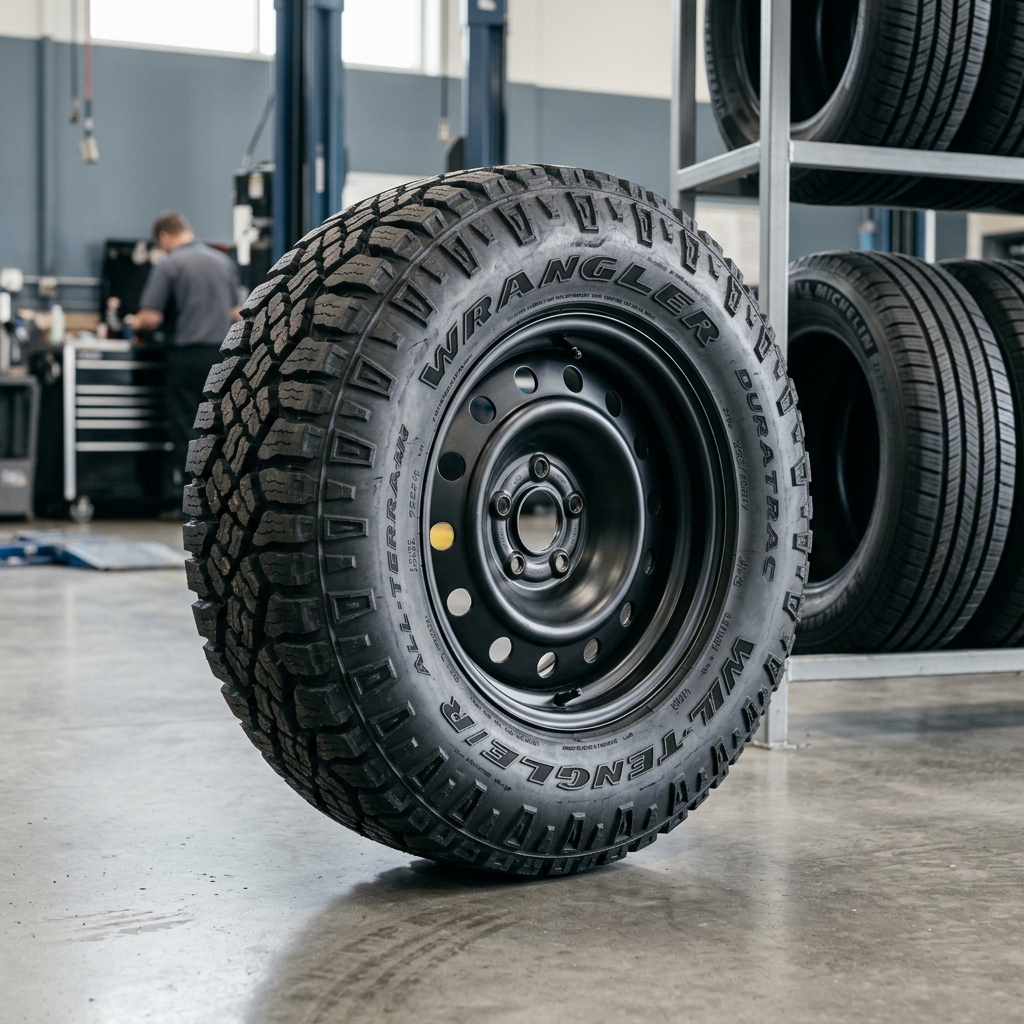
Selecting the correct replacement tires requires matching the exact size, load index, and speed rating listed on your driver-side door jamb placard to your driving conditions and load requirements. Standard highway all-season tires deliver maximum fuel efficiency and low road noise for daily pavement driving, whereas all-terrain and mud-terrain tires feature reinforced sidewalls and aggressive tread voids necessary for towing heavy trailers or navigating unpaved trails.
Determining the ideal tire for your vehicle starts with inspecting the federal tire placard located inside the driver-side door frame. This sticker defines the original equipment baseline engineered specifically for your vehicle's gross axle weight ratings and suspension geometry. While aftermarket tire charts offer various choices, altering tire dimensions or load capacities without accounting for wheel offset and mechanical clearances can cause recalibration issues with electronic stability control, antilock braking, and tire pressure monitoring systems.
Your routine driving environment should guide your tread selection. Drivers hauling work trailers across the agricultural dirt roads around Onsted require the puncture resistance of light-truck tires, whereas highway commuters prioritizing cabin quietness and wet-weather traction benefit from refined all-season tread patterns. Matching tread design to your actual road surface prevents premature wear, preserves highway handling, and maintains predictable braking distances in all weather conditions.
Maintaining proper tire pressure is equally vital for longevity and safety. Operating a tire below its recommended cold inflation pressure causes excessive sidewall flex, internal heat buildup, and accelerated wear along the outer shoulder treads. Conversely, over-inflating reduces the contact patch, leading to a harsh ride and premature center-tread wear. Checking cold tire inflation monthly with a calibrated gauge ensures your vehicle performs according to factory engineering standards.
When you need guidance selecting or mounting the ideal tire set for your truck or SUV, you can visit our service department on West Michigan Avenue or give our certified technicians a quick call. You can also explore factory-approved fitments when you browse genuine Mopar tire options online for your specific model year.
Table of Contents
- What Tire Size and Load Index Rating Fit Your Ram 1500 for Towing and Daily Hauling?
- How Do All-Season, All-Terrain, and Mud-Terrain Tires Differ for Jeep Wrangler and Dodge Durango Highway Noise?
- How Much Mileage Can You Expect from Mud-Terrain Versus All-Terrain Tires in Winters?
- How Often Should Tires Be Rotated and Aligned on 4WD Ram Trucks and Jeep SUVs?
- How Much Does a Full Set of Tires Cost and What Are the Benefits of OEM Care?
- Common Questions About Ram, Jeep, and Dodge Replacement Tires
- Maintain Your Tires with Certified Mopar Service in Clinton
What Tire Size and Load Index Rating Fit Your Ram 1500 for Towing and Daily Hauling?
Ram 1500 trucks require specific tire sizes and load ratings depending on trim level and capability, ranging from 275/65R18 fitments with a 116 load index on Tradesman models up to 285/45R22 tires with a 114 load index on Limited packages. To maintain full payload capacity and support maximum trailering limits up to 12,750 lbs safely, replacement tires must meet or exceed the original load index printed on your vehicle placard.
Understanding tire specification nomenclature is essential when preparing a truck for work duties. In a standard metric tire designation such as 275/65R18, the first number represents tread width in millimeters, the second is the sidewall aspect ratio percentage, and the final number indicates wheel diameter in inches. The trailing numbers represent the load index—a numerical code indicating the maximum load weight a tire can support when inflated to its recommended cold pressure. A tire rated with a 116 load index supports 2,756 pounds per tire, whereas a 114 load index rating carries 2,601 pounds per tire.
Truck owners who frequently haul heavy bed payloads or pull gooseneck and bumper-pull trailers should consider upgrading from standard P-metric passenger tires to commercial-grade Light Truck (LT) tires. Models like the Ram 1500 Rebel come factory-equipped with LT275/70R18/E tires featuring a Load Range E rating and a 125 load index. These heavy-duty tires utilize reinforced 10-ply rated internal construction and stiffer sidewalls that minimize trailer sway, resist tread squirm under heavy tongue weight, and protect against tire punctures from sharp gravel or road debris.
When mounting replacement tires on a Ram truck used for towing, running the recommended cold inflation pressure listed on the door jamb remains critical. Under-inflated tires carry less weight capacity and generate excessive internal casing heat under load, increasing the risk of structural tread separation. Always verify that any aftermarket or upsized tire meets the combined rear axle weight rating before hooking up a trailer.
How Do All-Season, All-Terrain, and Mud-Terrain Tires Differ for Jeep Wrangler and Dodge Durango Highway Noise?
Tread block geometry and void ratios directly control tire acoustic levels, as wide tread channels on mud-terrain tires trap air and generate high-frequency humming at highway speeds, while continuous tread ribs on all-season tires suppress road noise. All-terrain tires utilize staggered tread blocks and pitch-varied sound dampening to balance rugged off-road traction with quiet, comfortable highway performance.
All-season tires engineered for crossover and SUV platforms, such as the 295/45R20 performance fitments on high-output Dodge Durango models, focus on continuous rubber contact with the pavement. Small circumferential grooves and fine sipes channel water away from the contact patch without trapping air pockets. This smooth tread profile minimizes cabin drone, provides crisp steering response, and ensures maximum fuel efficiency during daily highway trips. Drivers cross-shopping SUV capabilities can compare tread behavior across the latest new Dodge Durango inventory to evaluate how highway tread designs complement high-performance all-wheel-drive systems.
All-terrain tires, such as the 255/75R17 fitment on the Jeep Wrangler Willys 4xe or the 285/70R17 tires on the Wrangler Rubicon X 4xe, feature deeper tread depth and wider shoulder voids. These interlocking tread blocks bite into dirt, mud, and loose rock, while angled tread sipes provide winter snow grip. Tire manufacturers engineer these blocks with randomized pitch patterns that alter the sound frequencies produced as the tire rotates, preventing harsh cabin resonant noise on paved roads.
Mud-terrain tires represent the most aggressive option, built with massive tread lugs, wide self-cleaning mud scoops, and reinforced upper sidewall cleats. While they deliver unmatched rock-crawling and deep-mud traction, those same wide tread gaps pump compressed air out of the tread blocks at speed, creating a noticeable acoustic hum. For drivers who evaluate different model trims, exploring options like the new Dodge Durango GT AWD or stepping up to the performance-tuned new Dodge Durango R/T Plus AWD illustrates how factory tire fitments are calibrated specifically for handling characteristics and interior quietness.
| Tire Type | Primary Application | Highway Noise Level | Tread Life Expectancy | Off-Road Traction |
|---|---|---|---|---|
| All-Season | Paved Highways & Daily Commuting | Low / Quiet | 60,000 – 80,000 miles | Minimal |
| All-Terrain | Mixed Highway & Trail Driving | Moderate / Muffled | 50,000 – 70,000 miles | Moderate to High |
| Mud-Terrain | Deep Mud, Rocks & Extreme Trails | High / Distinct Hum | 30,000 – 45,000 miles | Maximum |
How Much Mileage Can You Expect from Mud-Terrain Versus All-Terrain Tires in Winters?
All-terrain tires generally achieve between 50,000 and 70,000 miles of tread life due to durable silica rubber compounds, whereas mud-terrain tires typically last between 30,000 and 45,000 miles because of softer rubber formulations and aggressive lug wear. For sub-freezing winter driving, choosing tires marked with the 3-Peak Mountain Snowflake (3PMSF) emblem ensures the tread rubber remains pliable on icy, snow-covered roads.
Tread compound formulation plays a major role in how long off-road tires endure daily wear. All-terrain tires utilize dense tread block arrangements and tie-bars between lugs that reduce rubber squirm under acceleration and cornering. Mud-terrain tires feature taller, unsupported tread blocks that flex significantly under vehicle weight, causing accelerated squirm and uneven heel-toe wear when driven constantly on hot asphalt highways.
Sub-freezing temperatures dramatically impact tire performance across Michigan winters. Standard all-season and mud-terrain rubber compounds tend to harden when ambient temperatures drop below 45 degrees Fahrenheit, reducing rubber elasticity and traction on hard-packed snow or black ice. For commuters navigating frozen morning highway stretches around Michigan Center, selecting an all-terrain tire with 3PMSF certification provides severe snow performance thanks to specialized cold-weather polymers and high-density siping.
Jeep Wrangler enthusiasts upgrading to larger tire packages often compare 33-inch and 35-inch outer tire diameters. While 35-inch tires provide roughly one additional inch of ground clearance over 33-inch tires for trail obstacle clearance, the extra mass increases unsprung weight and rolling resistance. Running 35-inch tires without recalibrating axle gear ratios or recalibrating the transmission shift points can cause gear hunting on highway grades and alter speedometer readings, making proper suspension clearance and mechanical setup mandatory.
How Often Should Tires Be Rotated and Aligned on 4WD Ram Trucks and Jeep SUVs?
Tires on four-wheel-drive Ram trucks and Jeep vehicles must be rotated every 5,000 to 7,500 miles to distribute tread wear evenly across front and rear axles. A professional wheel alignment should be performed annually or every 12,000 miles—and immediately after severe off-road trail driving—to protect steering joints and prevent uneven edge wear.
Four-wheel-drive drivetrain configurations put unique mechanical stress on tires. Front tires handle cornering forces, braking loads, and steering angles, which scrubs tread from the outer shoulders. Rear tires absorb straight-line acceleration torque and heavy payload forces, wearing down center tread channels. Rotating tires systematically matches tread depth across all four corners, protecting 4WD transfer cases and center differentials from mechanical strain caused by mismatched tire circumferences.
For 4WD and AWD trucks and SUVs with non-directional tires, certified technicians perform a rearward cross rotation pattern. This service procedure follows specific steps:
- Move both front axle tires directly to the corresponding rear axle positions on the same side.
- Cross both rear axle tires to the opposite front axle positions (left rear to right front, right rear to left front).
- Check and adjust cold inflation pressure on all four tires to match the vehicle placard specs.
- Reset the Tire Pressure Monitoring System (TPMS) through the instrument cluster setup menu or diagnostic tool.
Recalibrating TPMS sensors after rotation ensures your vehicle maintains accurate position tracking for each tire pressure reading. Modern Chrysler, Dodge, Jeep, and Ram vehicles utilize auto-learn TPMS modules that detect sensor locations after driving a short distance at speeds above 15 mph, though manual tool triggers are occasionally required on select heavy-duty truck platforms. Combining tire rotations with regular engine oil service appointments keeps your maintenance schedule organized and maximizes tire tread life.
How Much Does a Full Set of Tires Cost and What Are the Benefits of OEM Care?
A complete set of four replacement tires for a Ram truck, Jeep SUV, or Dodge vehicle ranges from $600 to $1,400 for standard highway all-season models, and from $900 to over $2,000 for specialized heavy-duty or all-terrain fitments. Purchasing factory-recommended tires through an authorized dealership ensures precise fitment, correct speed and load ratings, and professional mounting by factory-trained technicians.
Tire replacement costs vary depending on wheel diameter, load range, and tread technology. Standard 18-inch all-season passenger tires for daily commuting represent the most economical option, while 20-inch and 22-inch low-profile tires or 10-ply Load Range E light-truck tires require higher manufacturing material costs. Investing in quality tires certified for your specific gross vehicle weight rating preserves vehicle handling characteristics and long-term suspension component life.
Servicing your vehicle at an authorized dealership offers advantages beyond basic tire mounting. Certified Mopar service centers utilize high-precision wheel balancers, touchless tire changers designed to protect aluminum rims, and alignment racks programmed with factory geometry specs. Furthermore, OEM replacement tires installed at a dealership come backed by road hazard protection and manufacturer warranties that protect your investment against unexpected road debris damage.
When your vehicle requires new tires, routine rotation, or a comprehensive multi-point inspection, you can easily schedule Mopar service online with our team. You can also visit our Clinton service center location or contact our service desk directly by calling (517) 456-6555 for personalized tire recommendations.
Common Questions About Ram, Jeep, and Dodge Replacement Tires
Q: Do TPMS sensors need to be recalibrated after rotating 4WD tires?
Most modern Ram, Jeep, and Dodge vehicles feature automatic TPMS re-learning systems that register sensor position changes after driving for 10 to 20 minutes above 15 mph. However, if your dashboard display continues to show incorrect tire locations or a flashing warning light after a tire rotation, a quick manual reset using a diagnostic tool at our service department will re-pair the sensors to their correct wheel positions.
Q: What is the mechanical difference between 33-inch and 35-inch tires on a Jeep Wrangler?
Upgrading from 33-inch to 35-inch tires increases ground clearance under the differential housing by roughly one inch, improving trail obstacle clearance. However, 35-inch tires add extra unsprung weight and require aftermarket clearance lifts or modified fender flares to prevent tire rubbing during full suspension articulation. Mounting 35-inch tires may also require re-gearing axle ratios to maintain factory acceleration punch and highway transmission shift points.
Q: Should I switch to dedicated winter tires or stay with all-season tires in Michigan?
Standard all-season tires provide adequate grip in mild rain and light slush, but their rubber compound stiffens in sub-freezing winter weather. Dedicated winter tires or 3PMSF-rated all-terrain tires utilize specialized cold-weather silica compounds and deep siping that stay pliable below 45 degrees Fahrenheit, drastically reducing braking distances on black ice and hard-packed snow.
Q: How do I know if my Ram 1500 requires Light Truck (LT) tires instead of P-metric tires?
If your Ram 1500 is used primarily for daily unladen passenger commuting, standard P-metric tires offer a smoother ride and better fuel economy. If you frequently tow heavy trailers, carry bed loads near maximum payload limits, or drive over sharp gravel trails, upgrading to 10-ply Load Range E Light Truck tires provides reinforced sidewalls that reduce trailer sway and resist punctures.
Q: Are factory OEM replacement tires better than generic aftermarket options?
Factory OEM replacement tires are engineered specifically for your vehicle's weight distribution, suspension tuning, and electronic safety systems. While generic aftermarket tires may offer a different upfront pricing, OEM-spec tires guarantee original noise levels, predictable wet-braking performance, and exact speed and load index matching required by manufacturer warranties.
Maintain Your Tires with Certified Mopar Service in Clinton
Keeping the correct tires on your vehicle is essential for preserving braking safety, fuel economy, and towing performance on every drive. Whether you need a set of highway all-season tires for your Dodge Durango, heavy-duty light-truck tires for your Ram 1500, or aggressive 3PMSF all-terrain tires for your Jeep Wrangler, choosing fitments that match factory load index and speed specifications ensures your vehicle performs as engineered. Routine care, including 5,000-mile rotations and annual alignment checks, protects your tire investment and extends tread life over thousands of miles.
Our team at NewGen Chrysler Dodge Jeep Ram of Clinton provides complete tire maintenance and replacement solutions tailored to your vehicle's engineering specs. Our factory-trained Mopar technicians perform digital wheel alignments, precision dynamic balancing, and tire pressure monitoring recalibrations using genuine OEM parts. To keep your truck or SUV performing at its best, book your next maintenance visit today and experience professional vehicle care dedicated to keeping you safe on the road.
© 2026 NewGen Chrysler Dodge Jeep Ram of Clinton. All rights reserved.