
Following the Jeep recommended maintenance schedule is essential to prevent premature mechanical wear, maintain factory warranty protection, and avoid costly unexpected repairs. Factory engineering dictates specific service intervals for fluid changes, filter replacements, and component inspections based on vehicle usage. Staying on schedule ensures critical systems like 4x4 transfer cases, braking components, and high-compression engines perform dependably across Michigan roads.
Every modern Jeep vehicle comes equipped with an Automatic Oil Change Indicator System. This onboard system monitors engine revolutions, operating temperatures, and driving conditions to alert drivers when service is required. While the system automatically calculates duty cycles, manufacturer guidelines specify that engine oil and filter service should occur no later than 10,000 miles or 12 months, whichever comes first. Routine tire rotations and brake pad inspections are standardly paired with these oil services to ensure even tire wear and consistent stopping power.
Driving habits significantly influence maintenance frequency. Operating in severe conditions—such as frequent short trips in sub-freezing temperatures, heavy towing, or driving on dusty off-road trails—requires shorter service intervals. Drivers navigating rural gravel roads around Onsted frequently encounter airborne dust and moisture that accelerate filter clogging and fluid breakdown. Adhering to manufacturer-recommended service windows protects vital engine internals from particulate contamination and thermal degradation.
Skipping or delaying routine care often leads to compounded mechanical issues. Minor wear in steering linkages, suspension bushings, or fluid quality can go unnoticed until major component damage occurs. Staying current with routine visits to our Clinton service center keeps your vehicle operating smoothly. For specific maintenance questions, local drivers can reach our service team directly at (517) 456-6555 to confirm their vehicle's recommended timeline.
Table of Contents
- What Services Are Included in the Jeep Factory Maintenance Schedule?
- Do Factory-Trained Technicians Make a Difference for Jeep Service?
- Are Dealer-Recommended Services More Expensive, and How Do They Protect Long-Term Value?
- How Does Documented Maintenance Impact Resale Value for Jeep and Ram Vehicles?
- Common Questions About Jeep Recommended Maintenance Schedules
What Services Are Included in the Jeep Factory Maintenance Schedule?
The factory Jeep maintenance schedule combines routine fluid and filter replacements with systematic multi-point inspections designed around specific mileage milestones. Standard care involves synthetic engine oil changes, tire rotations, cabin and engine air filter updates, and comprehensive underbody checks.
Service requirements expand as mileage accumulates to protect key mechanical systems:
- Up to 10,000 Miles: Engine oil and filter replacement, tire rotation, visual inspection of brake pads, rotors, battery terminals, and cooling system hoses.
- 20,000 to 30,000 Miles: Replacement of the cabin air filter and engine air filter, inspection of front and rear suspension components, CV joints, and transfer case fluid levels.
- 60,000 to 100,000 Miles: Comprehensive replacement of spark plugs, transmission fluid and filter, transfer case fluid, front and rear differential gear oils, and engine coolant flush.
Different models and powertrains carry distinct maintenance needs. For instance, a 2026 Jeep Grand Cherokee powered by a 2L engine and mated to a TorqueFlite® transmission relies on clean synthetic fluids to maintain its rated towing capacity of 6,200 lbs. Proper fluid maintenance keeps the transmission operating at optimal temperatures during heavy hauling or extended highway driving.
Factory maintenance coverage structures have evolved as well. While earlier model years included factory-sponsored oil changes through historical coverage programs, 2026 Jeep models transition protection coverage to Stellantis-backed FlexCare maintenance programs. Using genuine components helps protect powertrain integrity across all mileage tiers. Owners ready for routine upkeep can easily schedule routine maintenance online. Those exploring options in our inventory, such as a new Jeep Compass Limited 4x4 inventory model, can also order genuine Mopar parts directly for home care.
Do Factory-Trained Technicians Make a Difference for Jeep Service?
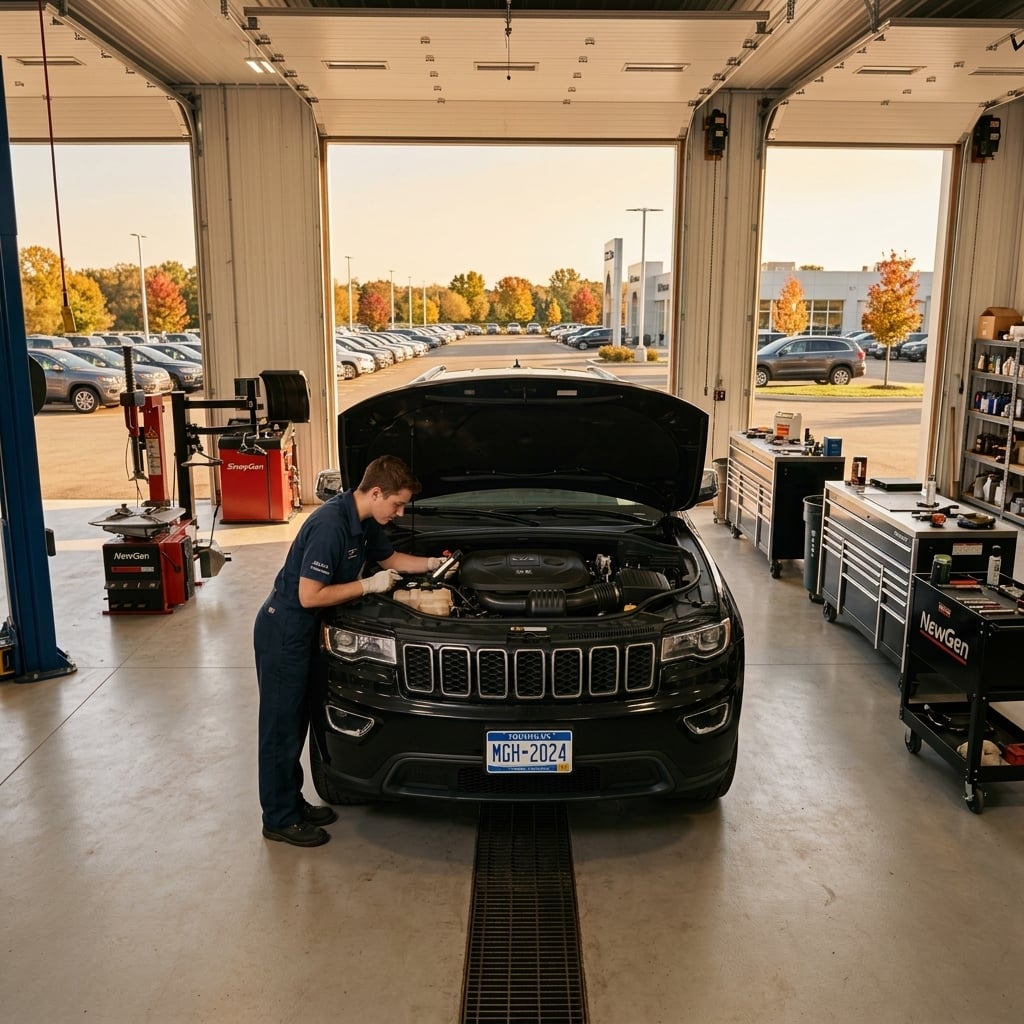
Factory-trained technicians complete specialized manufacturer instruction on complex 4x4 transfer cases, Uconnect software architecture, and modern electronic systems unique to Jeep, Dodge, Chrysler, and Ram vehicles. Their expertise ensures accurate diagnostic coding, precise torque adjustments, and proper installation of factory components that general repair shops often misdiagnose.
Jeep vehicles feature intricate driveline technologies, including active transfer cases, electronic sway-bar disconnects, and specialized Selec-Terrain management systems. Factory-certified technicians undergo continuous training directly from Stellantis engineers. This training covers advanced vehicle architecture, high-voltage systems on plug-in hybrid powertrains, and precise mechanical tolerances. General repair shops frequently rely on multi-brand diagnostic scanners that cannot clear manufacturer-specific diagnostic trouble codes or flash updated control module software.
Certified service facilities utilize proprietary wiTECH diagnostic tools connected directly to factory databases. This direct link allows technicians to verify technical service bulletins, perform module updates, and re-calibrate electronic safety systems after suspension or alignment work. Using genuine Mopar parts ensures every replacement component matches original equipment specifications for fitment, structural strength, and crash safety.
First-time service visitors often ask about differential fluid condition after seasonal trail driving. Certified technicians check fluid purity for microscopic metal shear before recommending replacement, preventing unnecessary expense while protecting axle gears. Drivers considering models like new Jeep Compass models benefit from knowing certified technicians maintain their vehicle to exact factory standards throughout ownership.
Are Dealer-Recommended Services More Expensive, and How Do They Protect Long-Term Value?
While individual dealer maintenance visits may carry higher upfront costs than independent quick-lube outlets, dealer-recommended care prevents major component failures and delivers a higher total return on investment over the vehicle's lifespan. Complete dealer service records eliminate claim denials during warranty evaluations and maximize trade-in appraisal values.
The difference in upfront cost stems from specialized equipment, factory-certified labor, and high-grade Mopar fluids designed specifically for Stellantis powertrains. Generic service centers often use universal fluids that lack proper friction modifiers required for Jeep 4x4 differentials or automatic transmissions. Using incorrect fluids can lead to premature clutch chatter, gear scuffing, and costly internal component failure. Spending slightly more on precise factory fluids avoids major repairs down the road.
Comprehensive multi-point inspections included during dealership visits catch wear items before they cause secondary damage. A worn ball joint or degrading water pump seal identified early prevents unexpected road breakdowns and protects adjacent components from excessive wear.
Commuters traveling daily from Michigan Center into nearby Jackson put continuous wear on brake hardware and suspension assemblies during stop-and-go driving. Routine multi-point inspections identify pad wear and rotor lip formation early, allowing drivers to replace pads before damaging expensive rotors. Investing in structured preventative maintenance preserves mechanical reliability and reduces long-term ownership expenses.
How Does Documented Maintenance Impact Resale Value for Jeep and Ram Vehicles?
A fully documented service history from an authorized dealership can increase vehicle resale value by 5% to 10% compared to vehicles with missing or spotty maintenance records. Appraisers and pre-owned buyers consistently pay a premium for verified dealer care because it provides tangible proof of mechanical upkeep.
Digital service records generated by authorized dealerships automatically link to the vehicle identification number (VIN). This central database logs exact dates, mileages, part numbers, and completed maintenance tasks. When trading in a vehicle or selling to a private party, a clean Mopar vehicle health history report eliminates uncertainty surrounding how the vehicle was maintained.
Documented maintenance is especially vital for heavy-duty trucks and off-road vehicles. Buyers evaluating a pre-owned 2026 Ram 1500 or a trail-ready 2026 Jeep Wrangler look for proof that differential fluids, transfer case oils, and engine air filters were replaced on schedule. Verified service records confirm the powertrain was protected against severe-duty wear.
Vehicles with verified dealer care sell faster and command higher trade-in offers at appraisal. Drivers considering an upgrade to a new Jeep Compass Latitude 4x4 options model can leverage a complete dealer maintenance record to secure maximum trade-in value for their current vehicle.
Common Questions About Jeep Recommended Maintenance Schedules
Q: What components are checked during a Jeep dealership multi-point inspection?
A multi-point inspection evaluates essential safety and performance systems across the vehicle. Technicians examine brake pad thickness, rotor condition, tire tread depth, battery health, suspension linkages, steering components, drive shafts, fluid levels, and exhaust shields. Each item receives a color-coded rating indicating whether condition is satisfying, requires future attention, or demands immediate service.
Q: How often does a Jeep Wrangler require an oil change?
Modern Jeep Wrangler models require an oil change when alerted by the onboard monitoring system, or at least every 7,500 to 10,000 miles or 12 months. Vehicles subjected to frequent off-road driving, low-speed idling, or heavy trailering should follow severe-duty guidelines, which often call for oil service closer to 5,000-mile intervals.
Q: What happens if I miss a scheduled maintenance milestone?
Delaying scheduled maintenance allows fluid thermal breakdown and mechanical wear to accelerate, increasing the risk of premature component failure. If a milestone passes, scheduling an immediate multi-point inspection allows technicians to refresh critical fluids, inspect wear items, and restore the vehicle to its recommended maintenance track before minor issues turn into major repairs.
Q: Does servicing my Jeep at an independent shop void the factory warranty?
Servicing your vehicle at an independent facility does not automatically void your factory warranty, but failure to maintain detailed records or using non-compliant fluids can lead to claim denials if a failure occurs. Dealer service records automatically log into central Stellantis databases, providing undisputed proof of proper maintenance for warranty validation.
Q: Which fluids need replacement during major mileage services?
Major maintenance milestones include replacing transmission fluid, transfer case fluid, front and rear differential gear lubricants, brake fluid, and engine coolant. Replacing these fluids removes suspended metallic wear particles and moisture, protecting gears, seals, and internal pumps across 4x4 drivetrains.
To keep your Jeep, Dodge, Chrysler, or Ram vehicle operating at peak performance, trust certified care backed by genuine parts. Drivers looking to maintain their vehicle's long-term value can visit our Clinton dealership or give our service advisors a quick call to schedule your next maintenance visit today.