

What I See Most Often with Radiator Problems in Clinton
## Identifying the Root Causes of Car Radiator Failure
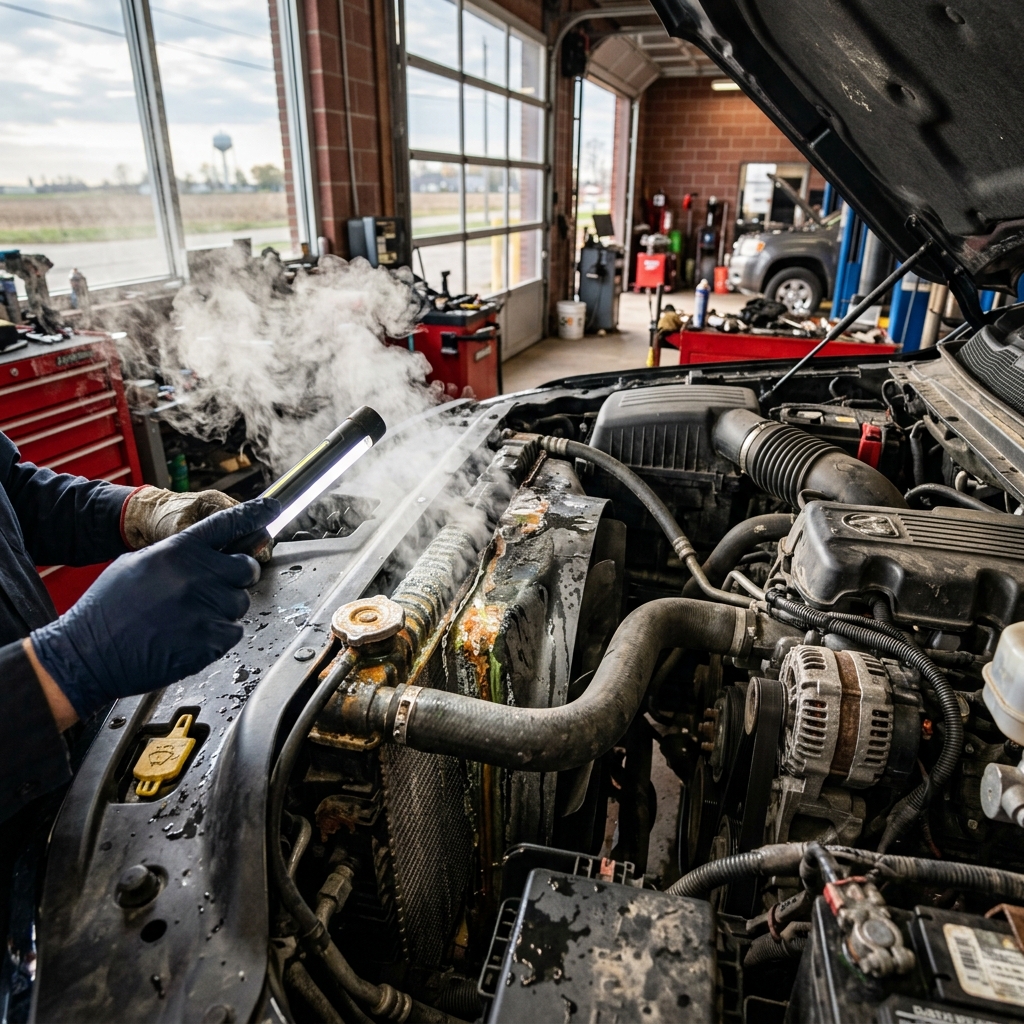
I have spent plenty of time under hoods at our service center, and I can tell you that most engine overheating issues usually trace back to a few specific failures within the cooling system. The most frequent culprit is a low coolant level, often caused by a slow leak that a driver might not notice until the temperature gauge starts climbing. I also see many cases where a thermostat gets stuck in the closed position, which physically prevents the coolant from reaching the radiator to shed its heat. When that happens, the engine temperature rises almost immediately because the fluid has nowhere to go to cool down.
Another common issue involves the radiator fan. If that fan fails to engage, your vehicle cannot pull enough air through the radiator fins while you are idling or driving at low speeds. I see this quite a bit with trucks coming in from the agricultural lands around Onsted, where slow-speed hauling through fields doesn't provide enough natural airflow, forcing the fan to do all the heavy lifting. If the fan motor burns out or a fuse blows, the radiator becomes a heat soak rather than a heat exchanger. We also look closely at the water pump, as a worn impeller or a leaking weep hole will stop the circulation entirely, leading to rapid overheating.
Internal corrosion is the silent killer of radiators. When owners go past the recommended 100,000 miles or 150,000 miles without a flush, the protective additives in the coolant break down. This leads to rust and scale buildup that physically clogs the narrow passages inside the radiator core. If you are noticing your gauge creeping up during a commute, you can reach our team at (517) 456-6555 to discuss a diagnostic appointment. For those driving in for an inspection, our service department entrance is easy to find right on Michigan Avenue.
Table of Contents
- Distinguishing Between Radiator Cracks and Hose Leaks
- The Impact of OEM vs Aftermarket Parts on Your Vehicle Value
- Maintenance Milestones: When to Flush Your Cooling System
- Essential At-Home Radiator Checks for Michigan Owners
- Understanding the Critical Role of a Failing Radiator Cap
- Other Cooling Components That Mimic Radiator Problems
Distinguishing Between Radiator Cracks and Hose Leaks
When a customer tells me they found a puddle of bright green or orange fluid on their driveway, the first thing I do is determine exactly where it originated. A radiator crack often happens along the plastic side tanks or the seams where the metal core meets the plastic. These cracks frequently show up as a fine spray or a crusty, discolored residue near the top of the unit. In contrast, a hose leak usually occurs at the connection points where the rubber meets the radiator inlet or outlet. If you see fluid dripping from a clamped area, it is likely a hose that has softened or a clamp that has lost its tension over time.
I often remind drivers that the smell is a huge giveaway. Coolant has a distinct, sugary-sweet aroma that is hard to miss once the engine is warm. If you are making the daily commute from Chelsea into Ann Arbor, you might smell it through the vents before you ever see a puddle. Rubber hoses can also fail internally; they might look fine on the outside but can collapse or swell, restricting the flow of coolant. A cracked radiator tank is almost always a mandatory replacement because the high pressure of the system will eventually blow out any temporary patch.
For owners of high-end trims like the Jeep Grand Cherokee Summit Reserve, maintaining the integrity of the cooling system is vital for protecting the advanced engine components. We offer several ways to manage these repairs, including exclusive service programs for eligible participants. If your current vehicle is reaching the point where repairs are becoming frequent, you can explore our latest Jeep models or specifically look at the features of the new Grand Cherokee Summit Reserve to see how modern cooling technology has improved.
The Impact of OEM vs Aftermarket Parts on Your Vehicle Value
I am often asked if an aftermarket radiator is "just as good" as an original part. From what I see in the shop, the answer usually comes down to fitment and longevity. A Mopar radiator is engineered specifically for the mounting points and pressure requirements of your Chrysler, Dodge, Jeep, or Ram. Aftermarket units are often built to fit a wide range of vehicles, which can lead to slightly misaligned brackets or thinner cores that do not dissipate heat as efficiently. This matters because a cooling system that runs even a few degrees hotter than intended can put extra stress on your engine seals over time.
Using Genuine Parts also protects your vehicle's resale value. When we perform a professional appraisal, seeing a high-quality repair with factory-spec components tells us the vehicle was maintained without cutting corners. If you are planning to value your trade-in soon, having a documented service history from a Mopar Parts Center can be a significant advantage. It provides the next owner with confidence that the cooling system won't fail prematurely.
Our team can help you order the correct parts for your specific VIN to ensure a perfect first-time fit. We also provide specials on parts and parts coupons to help make these essential repairs more affordable. If you are considering a different vehicle entirely, you can check out our new vehicle offers or new car specials. We also have pre-owned vehicle specials for those looking to find a specific model that fits their needs and budget.
Maintenance Milestones: When to Flush Your Cooling System
Many people assume they only need to worry about their radiator when the light on the dash comes on, but I recommend a more proactive approach. Most modern vehicles use long-life coolant that is rated for 10 years or 150,000 miles, but Michigan winters and heavy towing can shorten that lifespan. Over time, the fluid becomes acidic, which starts to eat away at the aluminum and rubber components from the inside out. A professional flush removes the old, degraded fluid along with any sediment or rust that has settled in the bottom of the radiator.
I tell my customers that a flush is much cheaper than a radiator replacement. By refreshing the corrosion inhibitors, you are essentially extending the life of your water pump and heater core as well. If you haven't had your fluid tested for its boiling point and acidity recently, it is a good idea to book a service visit. Our technicians can perform a pressure test at the same time to ensure there are no hidden leaks.
It is easy to schedule your maintenance online to fit your busy schedule. Keeping up with these milestones ensures your vehicle stays reliable for years to come. For those looking at a newer model with the latest cooling technology, you can browse our current manufacturer incentives to see what is available for your next upgrade.
Essential At-Home Radiator Checks for Michigan Owners
I believe every driver should know how to perform a basic visual inspection of their cooling system. The most important rule is to never open a radiator cap when the engine is hot. The system is under high pressure, and the coolant can be well over 200 degrees. Once the engine is completely cold, you can safely check the overflow reservoir to ensure the fluid is between the "min" and "max" lines. If the fluid looks dark, cloudy, or has oily bubbles in it, that is a sign of internal contamination that needs professional attention.
Take a look at the front of your radiator through the grille. In rural areas, it is common for the cooling fins to get clogged with dried mud, leaves, or even insects, which blocks the airflow. You should also squeeze the upper and lower radiator hoses; they should feel firm but pliable. If they feel crunchy or excessively soft, they are likely deteriorating and could burst under pressure. If you are driving a Jeep Grand Cherokee or a Jeep Compass Latitude, these checks are simple ways to ensure your vehicle is ready for a weekend trip to the lake.
If your inspections reveal that it might be time for a change, you can look into ordering a custom vehicle built to your exact specs. We also have the new Grand Cherokee and the Compass Latitude available for those who want a fresh start with a factory-backed warranty.
Understanding the Critical Role of a Failing Radiator Cap
The radiator cap is one of the smallest parts in the system, but it has a huge job. It is designed to maintain a specific pressure, usually between 12 to 16 psi, which raises the boiling point of the coolant. If the seal on the cap fails or the internal spring weakens, the system cannot hold pressure. This causes the coolant to boil at a lower temperature, leading to localized "hot spots" in the engine and eventual overheating.
I have seen cases where a bad cap actually caused a radiator hose to collapse. This happens because the cap's vacuum valve fails to let coolant flow back from the reservoir as the engine cools down, creating a vacuum that sucks the hose flat. If you see your reservoir overflowing frequently or notice dried white residue around the cap itself, the cap is likely the problem. It is a cheap part to replace, but ignoring it can lead to a blown head gasket.
For those shopping for a reliable second vehicle, we have a great selection of vehicles priced under $20,000 that our team has thoroughly inspected. You can also check out our new Jeep Compass inventory or look through our pre-owned specials for a deal on a well-maintained trade-in.
Other Cooling Components That Mimic Radiator Problems
Sometimes, what looks like a bad radiator is actually a failure in a different part of the system. A failing water pump can cause a leak that drips down the front of the engine, making it look like the radiator is the source. Similarly, a cracked overflow tank or a leaking heater core can lead to low coolant levels and overheating, even if the radiator itself is in perfect condition. We use pressure testers and dye kits to pinpoint the exact source of a leak so we aren't replacing parts that are still perfectly good.
A stuck-open thermostat is another tricky one. It won't cause overheating, but it will prevent the engine from reaching its proper operating temperature. This leads to poor fuel economy and a heater that never quite gets warm in the winter. If you want to learn more about how these parts work together, you can read more on our automotive service blog.
If you are experiencing any of these symptoms, don't wait for a breakdown. You can stop by our Clinton location for a cooling system health check. You can also give us a quick call to speak with a service advisor about your vehicle's specific needs.
© 2026 NewGen Chrysler Dodge Jeep Ram of Clinton. All rights reserved.