

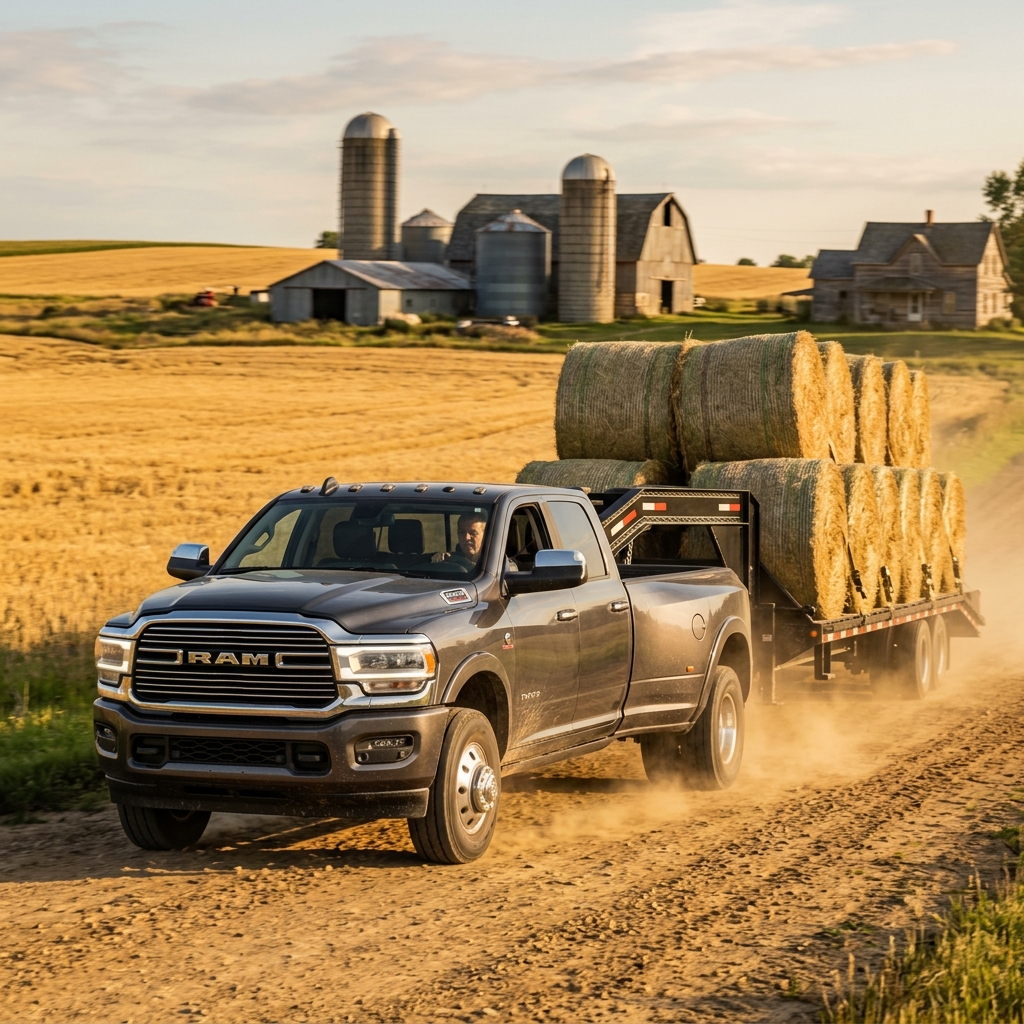
The 2027 Ram 3500 Heavy Duty equipped with the available 6.7L Cummins High-Output Turbo Diesel I6 and dual rear wheels handles heavy agricultural towing best, providing an anticipated maximum gooseneck tow rating up to 36,610 lbs based on established specifications. For medium-duty farm operations pulling livestock trailers or grain wagons under 20,000 lbs, the 2027 Ram 2500 Heavy Duty delivers exceptional stability and pulling power. Light-duty field work and utility hauling up to 11,600 lbs are well-served by a properly configured 2027 Ram 1500 with the 3.0L Hurricane Twin-Turbo I6.
Late-summer harvest brings intense demands to farm operations across Michigan. Transporting round bales, heavy grain wagons, livestock, and field machinery requires a vehicle engineered to handle high gross combined weight ratings under high ambient temperatures. Matching your farm trailer setup to the correct chassis prevents premature drivetrain wear and maintains highway safety during peak harvest hours.
Selecting the right pickup depends heavily on trailer hitch style and tongue weight. Bumper-pull farm implements generate dynamic load transfer at the rear bumper, while gooseneck and fifth-wheel setups transfer pin weight directly over the rear axle. Heavy-duty chassis incorporate hydroformed frame rails, commercial-grade solid axles, and high-capacity cooling packages designed to maintain operating temperatures when moving heavy loads through soft fields.
Our team at NewGen Chrysler Dodge Jeep Ram of Clinton assists local farm owners in matching exact trailer requirements with the ideal truck rating. You can drop by our Clinton showroom location at 1111 W Michigan Ave, Clinton, MI 49236 to review factory door-jamb weight tags, or give our sales staff a quick call to verify available configurations at your convenience.
Table of Contents
- How Does the Ram 1500 Towing Capacity Compare Directly to the Ram 2500 and 3500 Heavy Duty Models?
- Which Ram Heavy Duty Truck Offers the Highest Payload Capacity and Ideal Axle Ratios for Bed-Loaded Harvest Materials?
- Do Ram 2500 and 3500 Heavy Duty Trucks Feature Specific Tow or Haul Modes for Heavy Harvest Loads?
- What Critical Brake Maintenance Is Required for Ram Trucks Towing Heavy Agricultural Trailers?
- What Seasonal Maintenance Keeps Your Ram Truck Reliable During Late-Summer Agricultural Towing?
- Should Farm Owners Install Agricultural Towing Equipment Themselves or Trust Professional Technicians?
- Common Questions About Ram Agricultural Towing
- Prepare Your Ram Truck for the Harvest Season in Clinton
How Does the Ram 1500 Towing Capacity Compare Directly to the Ram 2500 and 3500 Heavy Duty Models?
A properly equipped 2027 Ram 1500 offers an expected maximum towing capacity of up to 11,600 lbs when powered by the 3.0L Hurricane Twin-Turbo I6 (Standard Output) with a 3.92 rear axle ratio and the factory Trailer-Tow Group, whereas the 2027 Ram 2500 Heavy Duty pulls up to 20,000 lbs with the 6.7L Cummins Turbo Diesel I6, and the dual-rear-wheel 2027 Ram 3500 Heavy Duty tops the lineup with a gooseneck rating reaching 36,610 lbs.
Step-change differences between light-duty and heavy-duty models stem from structural architecture rather than horsepower alone. While the half-ton platform excels at daily commuting, light property maintenance, and bumper-pull utility trailers, heavy agricultural loads require the massive frame strength and higher gross vehicle weight ratings of one-ton and three-quarter-ton chassis.
| Specification Feature | 2027 Ram 1500 (Expected) | 2027 Ram 2500 HD (Expected) | 2027 Ram 3500 HD (Expected) |
|---|---|---|---|
| Maximum Tow Rating | 11,600 lbs | 20,000 lbs | 36,610 lbs |
| Maximum Payload | 2,300 lbs | 4,580 lbs | 7,590 lbs |
| Standard Engine | 3.6L Pentastar V6 eTorque | 6.4L HEMI V8 | 6.4L HEMI V8 |
| Available High-Torque Engine | 3.0L Hurricane I6 | 6.7L Cummins Turbo Diesel | 6.7L Cummins High-Output Diesel |
| Rear Suspension Setup | Five-Link Coil or Air | Five-Link Coil or Air | Multi-Leaf Spring or Air |
| Rear Axle Option | Single Rear Wheel | Single Rear Wheel | Single or Dual Rear Wheel |
Frame design illustrates this gap clearly. Heavy-duty models feature fully boxed steel frames with high yield strength, larger ring gears, and massive brake rotors built to dissipate heat generated during continuous deceleration. In rural areas like Onsted, where farm routes alternate between paved county roads and unpaved farm lanes, a heavy-duty frame minimizes chassis flex under high pin weights.
Shoppers interested in versatile half-ton configurations can explore the new Ram 1500 showroom model details to review specs, or examine our selection of new Ram 1500 trucks directly. For everyday agricultural tasks paired with spacious interior comfort, many local operators choose a new Ram 1500 Big Horn Crew Cab 4x4 with the 5'7" box for its ideal combination of seating and utility.
Which Ram Heavy Duty Truck Offers the Highest Payload Capacity and Ideal Axle Ratios for Bed-Loaded Harvest Materials?
The dual-rear-wheel 2027 Ram 3500 Heavy Duty equipped with the standard 6.4L HEMI V8 gas engine offers the highest payload capacity in the lineup at up to 7,590 lbs, outperforming diesel variants in raw bed carrying capacity due to the lighter overall weight of the gas engine block.
Selecting the right rear axle ratio is critical when setting up a truck for bed-loaded grain, seed totes, or fertilizer bags. Ram Heavy Duty models offer 3.73 axle ratios and 4.10 axle ratios. A 4.10 rear axle ratio maximizes mechanical leverage at the wheels, providing easier off-the-line acceleration when launching a fully loaded truck out of soft field conditions and raising the maximum gross combined weight rating.
Payload capacity calculations must account for all weight added to the truck, including cab passengers, aftermarket accessories, toolbox contents, and trailer tongue or pin weight. While the 6.7L Cummins Turbo Diesel I6 produces a massive 1,075 lb-ft of torque for heavy pulling, its heavier cast-iron engine block reduces available payload headroom compared to the 6.4L HEMI V8.
Farm operators needing maximum payload for seed delivery or harvest support can review new Ram Heavy Duty inventory to find the correct chassis and axle specs. For lighter support duties around the property, exploring pre-owned Ram 1500 inventory offers practical alternatives for light-duty chores.
Do Ram 2500 and 3500 Heavy Duty Trucks Feature Specific Tow or Haul Modes for Heavy Harvest Loads?
Yes, Ram 2500 and 3500 Heavy Duty trucks feature dedicated software calibrations within their drive mode systems that adjust transmission shift patterns, throttle response, torque converter behavior, and engine braking to manage heavy loads.
When Tow mode is engaged, the automatic transmission holds gears higher into the engine torque band before upshifting, preventing gear hunting on rural inclines. The torque converter locks up earlier and remains locked longer, significantly reducing fluid shear and heat buildup—the primary cause of transmission wear during late-summer towing. Additionally, downshifts occur sooner during deceleration, allowing compression braking to slow the vehicle before friction brakes experience thermal stress.
On models with separate drive mode logic, Tow mode optimizes dynamic momentum control for trailing loads, while Haul settings adjust shift logic specifically for static bed weight. Integrating these drive modes with the factory integrated trailer brake controller automatically fine-tunes brake gain sensitivity based on deceleration force.
Local agricultural operators looking for well-maintained pre-owned work trucks equipped with integrated towing electronics can browse our certified pre-owned inventory for thoroughly inspected choices.
What Critical Brake Maintenance Is Required for Ram Trucks Towing Heavy Agricultural Trailers?
Critical brake maintenance for heavy agricultural towing includes measuring brake pad friction material thickness, inspecting rotors for thermal scoring or heat checking, replacing contaminated brake fluid, and calibrating the integrated trailer brake controller output before taking heavy loads onto public roads.
Agricultural towing imposes extreme demands on friction components. Decelerating combined weights exceeding 25,000 lbs generates severe heat that can boil aged brake fluid containing absorbed moisture, leading to a soft pedal and reduced hydraulic pressure. Flushing brake fluid every two years prevents vapor lock during steep descents.
Agricultural Trailer Brake Inspection Checklist:
1. Measure truck brake pad thickness (minimum 4/32-inch remaining friction material).
2. Check brake rotors for micro-cracking, heat discoloration, or uneven wear grooves.
3. Test trailer electric/hydraulic breakaway battery and switch functionality to ensure proper operation.
4. Verify 7-pin connector terminals are clean and free of corrosion or oxidation.
5. Calibrate trailer brake gain output on flat pavement with a full harvest load.
Trailer electric brake shoes and magnets require equal attention. Corrosion on 7-pin electrical connectors creates voltage drop, reducing trailer brake responsiveness. Testing the manual override slider on the integrated brake controller ensures trailer brakes engage smoothly without locking up or pulling to one side.
Farm owners around Napoleon can trust our service department for complete brake inspections and hydraulic maintenance. You can easily schedule Mopar service online to prepare your truck at your convenience. If you are considering upgrading your towing rig this season, you can also value your trade-in online to evaluate your current truck's value.
What Seasonal Maintenance Keeps Your Ram Truck Reliable During Late-Summer Agricultural Towing?
Seasonal maintenance critical for late-summer harvest towing involves inspecting engine cooling systems, servicing transmission and differential fluids, checking tire inflation pressures and tread condition, and replacing air filters coated in harvest dust.
High ambient temperatures combined with heavy engine loads subject drivetrain fluids to elevated thermal stress. Transmission fluid breakdown accelerates rapidly when sustained operating temperatures exceed normal thresholds, compromising clutch pack engagement and valve body operation. Fresh synthetic gear lubricant in front and rear differentials ensures proper hypoid gear protection under heavy torque loads.
Dust generated during grain harvest and field transit quickly clogs engine air intake filters. A restricted air filter starves the engine of airflow, reducing fuel efficiency and increasing exhaust gas temperatures on turbocharged diesel models. Inspecting the air filter box daily during active field operations preserves engine performance.
Late-Summer Harvest Maintenance Protocol:
- Coolant System: Inspect radiator fins, check coolant concentration and hose integrity.
- Drivetrain Fluids: Change transmission fluid, transfer case fluid, and axle lubricants.
- Engine Air Filter: Replace dusty air filters to maintain proper airflow and EGTs.
- Tires: Set cold tire inflation pressures to door-placard specs for heavy loads.
Financing routine maintenance or vehicle upgrades is straightforward with our dedicated finance department. You can apply for credit online to review flexible payment structures tailored to seasonal farm cash flows.
Should Farm Owners Install Agricultural Towing Equipment Themselves or Trust Professional Technicians?
Farm owners should trust professional Mopar-certified technicians to install heavy agricultural towing equipment, such as gooseneck hitches and fifth-wheel prep packages, to ensure precise frame attachment torque, proper electrical harness integration, and compliance with gross vehicle weight ratings.
Modern heavy-duty truck frames utilize high-strength steel that requires specific mounting procedures. Drilling holes in unauthorized frame locations can compromise structural integrity and void factory warranty coverage. Factory Fifth-Wheel/Gooseneck Prep Packages feature under-bed crossmembers engineered specifically for chassis stress distribution, complete with integrated 7-pin bed wiring sockets.
Proper electrical wiring is equally vital. Splicing into factory wiring harnesses without correct relays or factory-style connectors can disrupt body control modules and driver-assist safety sensors. Certified technicians install factory-engineered harnesses that communicate seamlessly with blind-spot monitoring systems calibrated for trailer length.
Our dealership provides complete equipment installation using factory-approved Mopar components. Get turn-by-turn directions to our dealership or give our service counter a call at (517) 456-6555 to discuss equipment options. You can also order genuine Mopar parts directly for your farm maintenance shop.
Common Questions About Ram Agricultural Towing
Q: How often should trailer brake controllers be tested during harvest season?
Trailer brake controllers should be tested before every loaded trip during harvest season. Perform a low-speed test on a flat surface by engaging the manual override slider on the integrated controller without applying the truck's foot brake. The trailer brakes should slow the combined load smoothly without locking wheels or causing the trailer to push or sway.
Q: What tire pressure adjustments are needed when switching between empty driving and heavy trailer hauling?
Tire pressures must be adjusted to match the vehicle manufacturer's cold inflation specs listed on the driver-side door placard for maximum payload and towing. Running empty tire pressures while towing heavy loads causes excessive sidewall flexing, heat buildup, and premature tread wear. Always measure and inflate tires when cold before hooking up heavy agricultural trailers.
Q: Does engaging Tow/Haul mode increase a Ram truck's certified towing capacity?
No, engaging Tow/Haul mode does not increase a truck's certified towing capacity or gross vehicle weight rating. Tow/Haul mode is a software calibration that alters transmission shift points, torque converter lockup timing, and engine braking behavior to manage heavy loads safely. Physical weight limits are determined strictly by axles, frame structure, suspension, and braking systems.
Q: What is the benefit of a factory Fifth-Wheel/Gooseneck Prep Group for farm work?
A factory Fifth-Wheel/Gooseneck Prep Group provides reinforced under-bed structural crossmembers bolted directly to the frame, along with a flush-mounted bed socket and integrated 7-pin electrical connector. This setup eliminates above-bed rails, leaving a completely flat bed floor when the ball is removed, making it easier to haul square bales or loose farm equipment when not towing.
Q: How does a dual-rear-wheel configuration improve stability on rural roads?
A dual-rear-wheel (dually) configuration places four tires across the rear axle, significantly widening the track width and spreading heavy pin weights over a larger contact patch. This layout minimizes lateral trailer sway, improves roll stability, and provides extra load safety headroom when hauling high-center-of-gravity agricultural trailers or heavy grain carts over unpaved rural routes.
Prepare Your Ram Truck for the Harvest Season in Clinton
Preparing your Ram truck for late-summer agricultural towing ensures smooth operation through the busiest weeks of the season. From checking brake fluid conditions to verifying axle ratio ratings and installing factory gooseneck hitches, proper maintenance protects your equipment investment and keeps your farm operation moving forward safely.
Our team at NewGen Chrysler Dodge Jeep Ram of Clinton is proud to support the local agricultural community with expert service, genuine Mopar parts, and a comprehensive inventory of heavy-duty trucks. Whether you need a pre-harvest multi-point safety inspection or are looking to upgrade to a dual-rear-wheel powerhouse, we are here to help.
Visit our showroom on W Michigan Ave in Clinton, MI or contact our team today to schedule your service appointment or schedule a test drive at your convenience.
© 2026 NewGen Chrysler Dodge Jeep Ram of Clinton. All rights reserved.