

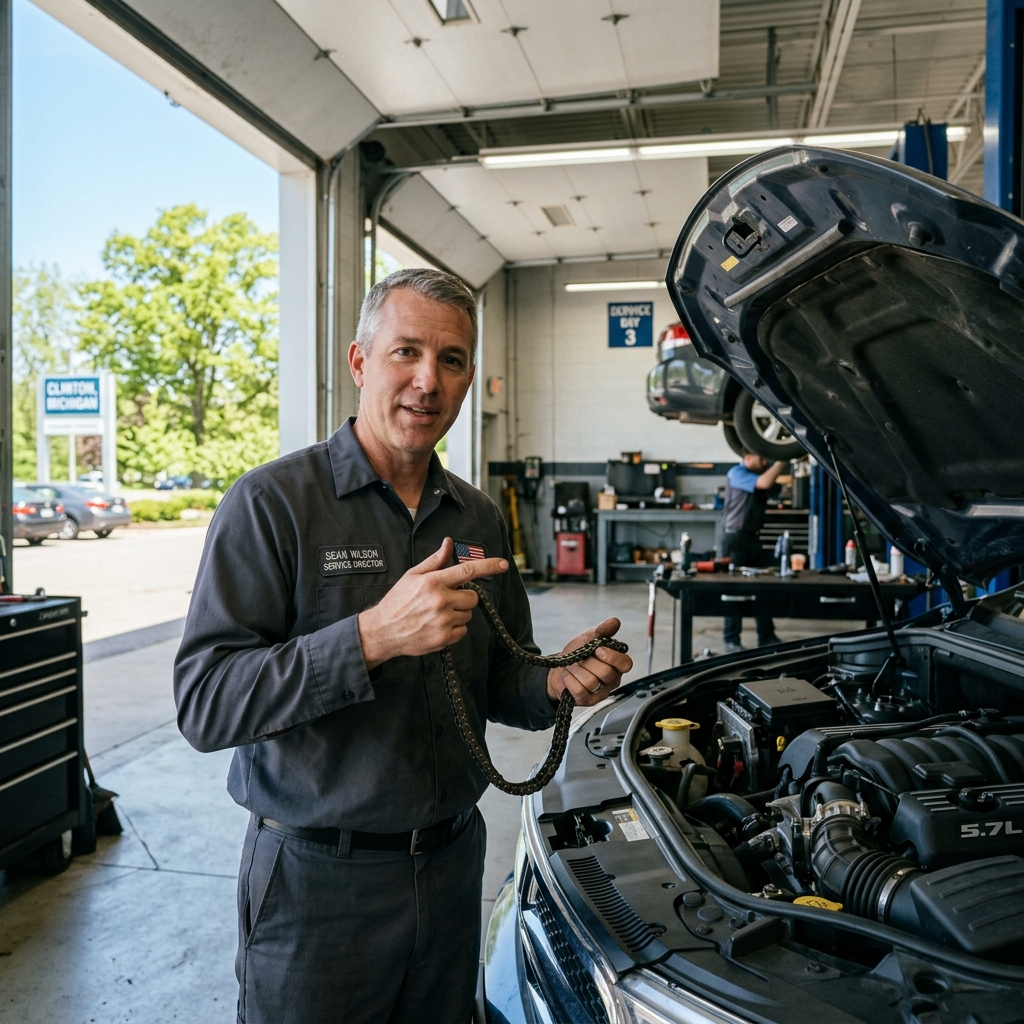
Understanding the internal mechanics of your vehicle is the best way to ensure it remains reliable for years of Michigan driving. Today, we are joined by Sean Wilson, the Service Director at NewGen Chrysler Dodge Jeep Ram of Clinton, who brings 2 years of specialized expertise to our service department. In this interview, Sean explains the critical role of the timing chain, how it differs from other engine components, and why proactive maintenance is the key to avoiding catastrophic engine failure. Readers will gain actionable advice on identifying warning signs and protecting their vehicle's longevity through professional care.
Q: Sean, could you start by explaining exactly what a timing chain is and why it is so vital for a vehicle's engine?
A: That is a great place to start because the timing chain is essentially the heartbeat of your engine's internal synchronization. It is a heavy-duty metal chain, much like what you would see on a bicycle but far stronger, located deep inside the engine block. Its primary job is to connect the crankshaft and the camshaft so they rotate in perfect harmony. This synchronization ensures that the engine's valves open and close at the precise micro-second required during the intake and exhaust strokes of each cylinder. If that timing is off by even a fraction, the engine cannot breathe or fire correctly, which leads to immediate performance issues.
A: For drivers who rely on their vehicles for daily commutes or rural tasks, the durability of this component is a major engineering advantage. Unlike some parts that are designed to be swapped out frequently, a well-maintained timing chain is often intended to last the entire lifespan of the vehicle. However, because it is a mechanical part subject to constant friction and heat, it isn't completely invincible. If you are ever unsure about the health of your engine, you can always reach out to our team at (517) 456-6555 to discuss any unusual performance changes you might be noticing.
A: We often see high-mileage vehicles where the chain has performed flawlessly for over 150,000 miles, but that only happens when the owner stays on top of their preventative maintenance. If you are currently driving an older model or one of the vehicles from our pre-owned inventory priced competitively, understanding this part is even more critical. If you need a professional eyes-on inspection, our service center location is easy to find, and we can pull the timing cover to check for any slack or wear that might be developing over time.
Q: Sean, how does a metal timing chain differ from the rubber timing belts we often hear about in other cars?
A: The biggest distinction really comes down to the materials used and the service intervals required by the manufacturer. A timing belt is made of a reinforced rubber compound, which is quieter and cheaper to produce, but it has a definitive expiration date. Most rubber belts must be replaced every 60,000 to 100,000 miles because the rubber eventually cracks and perishes. In contrast, the timing chain is made of high-strength metal links. This makes the chain significantly more durable and capable of handling the high-torque demands of a rugged HEMI V8 or a hard-working Pentastar V6 engine.
A: Another technical difference is how they are housed. A belt usually sits outside the main engine seals, while a timing chain is fully enclosed and constantly bathed in engine oil. This lubrication is what allows the metal links to glide over the gears for hundreds of thousands of miles without snapping. It is one of the reasons why models like the new Jeep Compass are built with such a focus on long-term reliability; the engineering is meant to reduce the number of major "teardown" repairs a customer has to face.
A: While many vehicles in our current new Jeep inventory utilize these long-life chains, it is important to remember that "long-life" doesn't mean "no-maintenance." Even with the advantages of special employee pricing programs that make these advanced vehicles more accessible, the responsibility of oil care remains with the owner. A metal chain won't rot like rubber, but it can stretch or "elongate" if it isn't properly lubricated, which eventually throws the engine's valve timing out of sync just as surely as a snapped belt would.
Q: What are the specific symptoms or warning signs that would tell a driver their timing chain is starting to fail?
A: One of the most common red flags is a distinct rattling noise coming from the front of the engine, particularly during a cold start. Because the chain relies on hydraulic tensioners that use oil pressure to stay tight, a worn chain or a failing tensioner will slap against the inside of the timing cover until the oil pressure builds up. If you hear a metallic clattering that disappears after the engine warms up, that is your early warning. We actually have a detailed breakdown of these acoustic signs on our automotive service blog for those who want to hear what to listen for.
"The most expensive repair is the one that could have been prevented with a simple oil change and a keen ear for engine noise."
A: Beyond the noises, you might notice the Check Engine Light illuminating. Modern engine computers are incredibly sensitive; they monitor the position of the crankshaft and camshaft constantly. If the chain has stretched even a few millimeters, the sensors will detect a correlation error and trigger a warning code. This is often accompanied by a rough idle, poor fuel economy, or a noticeable loss of power when you're accelerating. If you're driving something like a new Jeep Grand Cherokee and it feels like it's stumbling or hesitating, it is vital to get a diagnostic scan immediately.
A: I always tell folks that ignoring these signs is a massive gamble. A failing chain can also leave metal shavings in your oil pan as the links wear down the guides. When our technicians perform an oil change, they look for these microscopic fragments in the filter. We often have new service incentives available to help cover the cost of these essential diagnostic inspections, because catching a stretched chain early can save you from having to replace the entire engine block later on.
Q: You mentioned lubrication earlier—how much of an impact does oil quality really have on the life of a timing chain?
A: It is the single most important factor. Because the timing chain is a series of moving metal joints, it generates a tremendous amount of heat and friction. High-quality synthetic oil provides the film strength necessary to keep those joints from wearing down. When you skip oil changes, the oil breaks down and begins to form sludge. This sludge can clog the tiny passages in the timing chain tensioner, which is the component that keeps the chain tight. If the tensioner loses pressure, the chain starts to whip and stretch, leading to premature failure.
A: We see this often with vehicles that are used for heavy towing or frequent short trips in cold weather, which is common for families in Onsted. The oil doesn't always get up to the proper temperature to burn off moisture, making regular intervals even more critical. If you are behind on your maintenance, you should book a service visit as soon as possible. Using OEM-spec oil and filters is the best insurance policy you can buy for your engine's internal hardware.
A: For those who are planning for the long haul with a factory-ordered custom vehicle, establishing a strict maintenance habit from day one is key. Our technicians use specialized tools to verify that your oil pressure is within the correct range to support the timing system. You can easily schedule your next Mopar service online to ensure your vehicle is getting the exact grade of lubricant required to keep that chain spinning smoothly for the next decade.
Q: Why is replacing a timing chain considered such a complex professional service compared to other engine repairs?
A: Unlike a battery or an alternator that sits right on top of the engine, the timing chain is buried behind several layers of components. To reach it, a technician often has to remove the cooling fans, the serpentine belt, the water pump, and a heavy metal timing cover that is sealed with high-temp gasket maker. In some modern front-wheel-drive layouts, the clearance is so tight that we actually have to support the engine and remove an engine mount just to get the cover off. It is a labor-intensive process that requires precision and patience.
A: The most technical part is the timing alignment itself. If the new chain is installed even one "tooth" off on the gears, the engine will not run, or worse, it could sustain internal damage the moment you turn the key. Our certified Mopar parts center provides the exact alignment kits and heavy-duty chains designed for your specific engine's tolerances. We never recommend using "universal" or off-brand kits for this job because the specifications are just too tight to risk a misfit.
A: Because of the complexity, we always suggest checking our latest service specials or our current maintenance offers to help manage the cost of these larger repairs. When we do a timing chain, we also inspect the water pump and the oil pump drive while the engine is open, which is the most cost-effective way to handle those "while you're in there" parts. You can order genuine components directly through us to ensure that every seal and bolt used in the reassembly meets factory standards for a leak-free finish.
Q: Sean, what happens if a chain actually breaks, and what tips do you have for long-term owners to avoid that scenario?
A: If a timing chain breaks while the engine is running, the results are usually catastrophic, especially in an interference engine. In these designs, the valves and the pistons occupy the same space at different times. If the chain snaps, the camshaft stops turning, leaving some valves stuck in the open position while the crankshaft continues to drive the pistons upward. The pistons then slam into the open valves, bending them, cracking the cylinder head, and often destroying the engine block. It's an "instant engine replacement" scenario that every driver wants to avoid.
A: To prevent this, my best tip is to never ignore a Check Engine Light or a new sound. If you're driving through Chelsea and notice a new vibration or a tapping sound, pull over and give us a quick call. We can often tell a lot just by hearing the engine run. For those who feel their current vehicle is becoming a maintenance burden, it might be the right time to get an updated trade-in value and consider a newer model with a full warranty and a fresh timing system.
A: Ultimately, the longevity of your car is in your hands. Consistent oil changes and professional inspections are the only ways to verify the health of these internal parts. If you want a comprehensive health check for your vehicle, visiting our Clinton service department is the best next step. We have the diagnostic tools to check your engine's timing electronically, giving you total peace of mind before you head out on your next long-distance trip or daily commute.
© 2026 NewGen Chrysler Dodge Jeep Ram of Clinton. All rights reserved.