

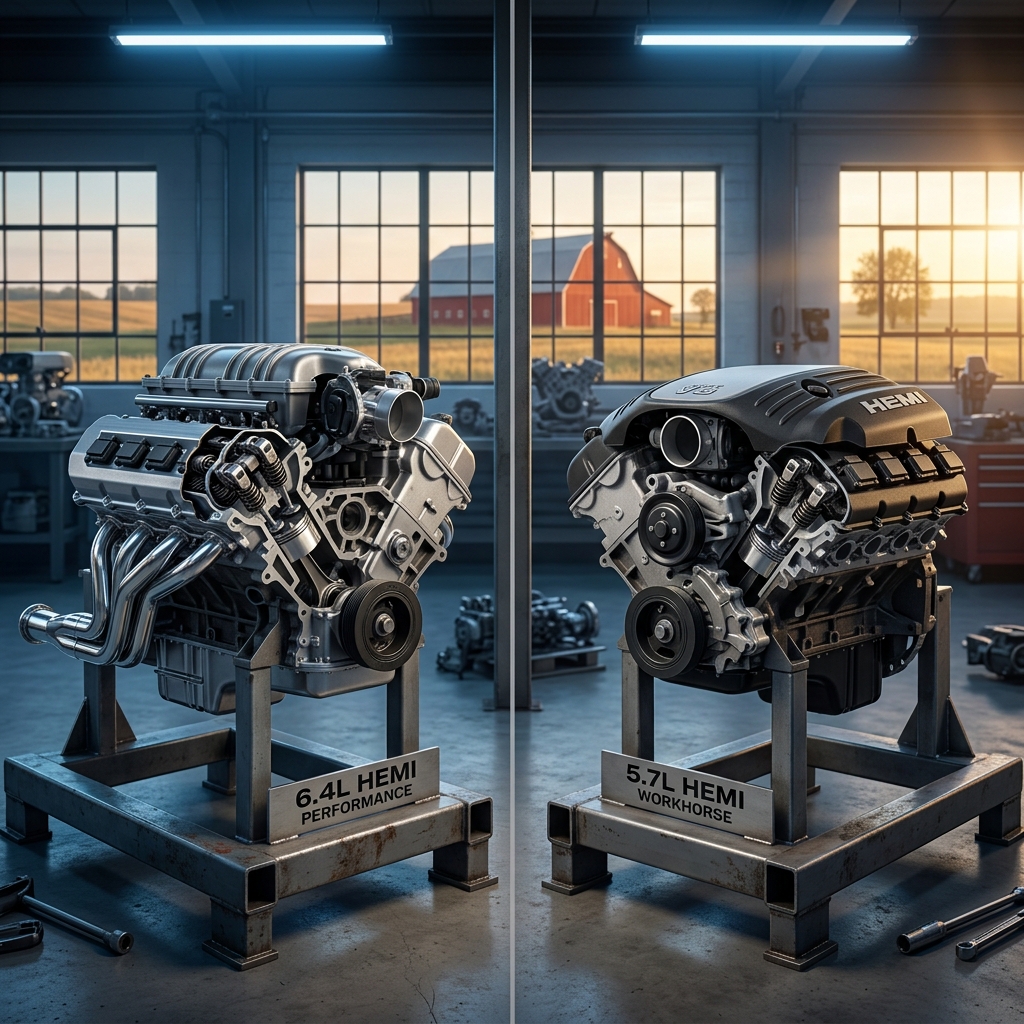
The Core Engineering Differences Between the 5.7L and 6.4L Hemi
The 6.4L HEMI provides 392 cubic inches of displacement, creating a significant physical size difference compared to the 345 cubic inches found in the 5.7L HEMI. While both engines belong to the third generation of the modern Hemi architecture, the 6.4L HEMI is engineered with performance-oriented internal components designed to handle higher stress. These include forged-aluminum pistons with an anodized top ring and a two-chain-driven oil pump that supports sustained high-output operation. Residents in Onsted often require the rugged dependability of a V8 for agricultural tasks and navigating rural routes between local farms, making the choice between these two engines a matter of daily utility.
The 5.7L HEMI has been in consistent production for over two decades, earning a reputation for being a versatile workhorse in everything from the Ram 1500 to the Dodge Durango. It utilizes a simpler internal design with cast-aluminum pistons and is typically specified for 5W-20 oil in most applications. In contrast, the larger 6.4L HEMI requires 0W-40 full synthetic engine oil to protect its more aggressive valvetrain. If you have questions about which engine is currently available in our showroom, you can find our Clinton showroom on West Michigan Avenue or give our team a quick call to discuss the current lineup.
Both powerplants feature the Multi-Displacement System (MDS) when paired with an 8-speed automatic transmission. This technology allows the engine to deactivate four of the eight cylinders during light-load cruising, such as steady highway driving. However, the tuning in the 6.4L HEMI is much more aggressive, prioritizing immediate throttle response over maximum efficiency. This engineering focus is evident in the reinforced cross-bolted steel main bearing caps that hold the forged steel crankshaft in the 392, a level of reinforcement not typically found in the standard 5.7L variant.
Table of Contents
- Horsepower and Torque: Breaking Down the Performance Gap
- Towing Capability and Practical Strength for Michigan Roads
- Real-World Drivability and Fuel Requirements for Hemi Owners
- Long-Term Reliability and Maintenance for V8 Performance
- Choosing the Right Engine: Comparing Costs and Resale Value
- Common Questions About Hemi V8 Engine Differences
- Test Drive a Hemi V8 at NewGen Chrysler Dodge Jeep Ram of Clinton
Horsepower and Torque: Breaking Down the Performance Gap
Choosing between these two V8 powerplants often comes down to the gap between 360 and 485 horsepower. In a standard application like the Dodge Durango, the 5.7L HEMI produces 360 horsepower and 390 lb-ft of torque. This provides a traditional muscle car feel with plenty of power for merging and passing. Stepping up to the 6.4L HEMI in the Durango R/T 392 increases those figures to 475 horsepower and 470 lb-ft of torque. For drivers looking for this level of performance in a pre-owned model, you can view our complete used-vehicle inventory to see what is currently in stock.
The performance difference is even more pronounced in the Dodge Scat Pack models. In these applications, the 6.4L HEMI is factory rated at 485 horsepower and 475 lb-ft of torque. When compared to the 375 horsepower typical of a 5.7L-equipped R/T car, the 392 delivers a much harder pull through the mid-range of the tachometer. This extra output translates to a roughly one-second difference in 0-60 mph times; a Scat Pack will usually hit the mark in about 4.2 to 4.5 seconds, while the 5.7L version takes closer to 5.1 to 5.4 seconds. To see how these performance tiers affect your financing options, you can explore our current financing options online.
Torque delivery is another area where the two engines diverge. The 6.4L HEMI reaches the majority of its peak torque much earlier in the rev range, which provides a more immediate sense of urgency when you press the accelerator. This makes the larger engine feel noticeably more aggressive during spirited driving on open backroads. Maintaining this high level of performance requires the right components, and you can browse our current parts specials for deals on filters and fluids. The 5.7L HEMI offers a more linear and relaxed power delivery that many owners find preferable for a smooth daily commute.
Towing Capability and Practical Strength for Michigan Roads
For families in Chelsea who spend weekends hauling bikes to the Border-to-Border Trail, the extra grunt of the larger engine changes how the vehicle handles a full load. In the Dodge Durango, the 5.7L HEMI enables a maximum towing capacity of 7,400 pounds when properly equipped. This is more than sufficient for most mid-sized boats or travel trailers. However, the 6.4L HEMI raises that maximum towing capacity to 8,700 pounds. This extra 1,300 pounds of capability provides a significant safety margin when pulling heavy loads through the rolling terrain of southern Michigan.
The increased torque of the 6.4L HEMI is particularly beneficial when pulling a trailer up an incline or maintaining speed against a headwind. Because the engine doesn't have to work as hard to move the same amount of weight, the driving experience feels more composed. If you are searching for a vehicle with these specific capabilities, you can browse our used inventory for heavy-duty options. We also offer employee pricing on select models to help you get into a high-output V8 for less.
The 5.7L HEMI remains a favorite for everyday towing because it balances capability with lower operating costs. It is a frequent choice for those who need a reliable truck for home improvement projects or light landscaping work. Our team regularly updates our latest pre-owned specials to include V8-powered trucks and SUVs that are ready for work. While the 6.4L HEMI is the undisputed king of towing in this comparison, the 5.7L variant still outperforms many V6 competitors by offering the consistent torque that only a naturally aspirated V8 can provide.
Real-World Drivability and Fuel Requirements for Hemi Owners
Does every Hemi require premium fuel? This is a common point of confusion for buyers. The 5.7L HEMI is designed to operate on regular unleaded gasoline, though 89-octane mid-grade is recommended for the best performance and efficiency. This makes it a more budget-friendly option for long-distance travel. On the other hand, the 6.4L HEMI has a higher compression ratio of 9.5:1 and requires 91-octane premium gasoline as a minimum. Using lower-grade fuel in the 392 can lead to engine knock and reduced power as the computer pulls timing to protect the internals.
Fuel economy also varies between the two displacements. The 5.7L HEMI typically achieves between 17 and 22 combined mpg depending on the vehicle and driving habits. The 6.4L HEMI is generally less efficient, often averaging 15 to 18 combined mpg. Over the course of 75,000 miles, the difference in fuel costs and the requirement for premium gas can add up to several thousand dollars. Shoppers can get approved for financing to help manage the total cost of ownership for these performance vehicles. If you have a specific configuration in mind, placing a custom factory order ensures you get the exact engine and fuel-saving features you want.
In terms of daily drivability, the 5.7L HEMI is often cited for its smoother, quieter operation. It is an excellent choice for a family SUV or a daily driver that needs to be refined in stop-and-go traffic. The 6.4L HEMI features a much louder, more aggressive exhaust note that is designed to be heard. It provides a raw, mechanical experience that enthusiasts crave but might be too intense for some passengers. For those looking for V8 power on a budget, we often have used inventory priced under $20,000 that includes these legendary engines.
Long-Term Reliability and Maintenance for V8 Performance
High-mileage fleet data shows the 5.7L HEMI often reaches impressive odometer readings due to its relatively simpler engineering and two decades of production refinements. It has a long track record in police vehicles and work trucks, where durability is the primary metric of success. The most critical maintenance task for any Hemi owner is staying on top of oil changes with the correct viscosity. You can schedule your next service appointment at our dealership to ensure your engine is maintained by certified technicians.
The 6.4L HEMI is also a highly reliable engine, but it is more sensitive to maintenance lapses. Because it is a high-performance engine with forged internals and more aggressive cam profiles, using the wrong oil or skipping an interval can lead to premature wear on the lifters. We recommend that 392 owners strictly adhere to the synthetic oil requirements and use only high-quality filters. You can book a service visit online to have our team perform a multi-point inspection and fluid flush.
Using genuine parts is essential for preserving the warranty and performance of these V8s. Our official Mopar Parts Center stocks the exact spark plugs, gaskets, and sensors required for both the 5.7L and 6.4L versions. While both engines are built to last, the 5.7L is generally considered easier to work on and has a more abundant supply of replacement parts due to its higher production volume. Consistent care is the key to ensuring either engine stays running strong for years to come.
Choosing the Right Engine: Comparing Costs and Resale Value
If you are looking at the bottom line, the initial price gap for a 6.4L HEMI is roughly $5,000 in many Charger and Durango configurations. This premium covers the larger displacement, the forged internal components, and the upgraded Brembo brakes that often come standard with the 392. To see how your current vehicle can help cover this cost, you can get your trade-in value online before visiting us.
Resale value is a strong point for both engines, but the 6.4L HEMI often holds a slight edge. Because it is the flagship engine for many trims, it is highly sought after on the used market. Historically, Scat Pack and 392 models retain about 5 to 10 percent more of their original MSRP after five years compared to the 5.7L R/T models. For those who enjoy working on their own vehicles, you can order genuine parts through our website to keep your Hemi in top condition for future resale.
The 5.7L HEMI remains the value leader for buyers who want V8 power without the high-performance price tag. It offers a lower entry point and lower insurance premiums, which typically run 10 to 15 percent less than the 6.4L models. For more tips on choosing the right powertrain for your lifestyle, feel free to check out our automotive blog . Ultimately, the 5.7L is the practical choice for many, while the 6.4L is an investment in pure performance.
Common Questions About Hemi V8 Engine Differences
Understanding the specific nuances of these engines helps Clinton drivers prepare for long-term ownership.
Q: Do the 5.7L and 6.4L Hemi engines use the same transmission? Both engines are typically paired with the 8-speed automatic transmission, specifically the 8HP series. However, the version used with the 6.4L HEMI is often reinforced with different clutch packs to handle the significantly higher torque output.
Q: Can I use regular gas in the 6.4L Hemi? It is not recommended. The 6.4L HEMI requires 91-octane premium fuel to prevent engine knock. Using regular gas will cause the engine to reduce power and could potentially lead to long-term internal damage.
Q: Which engine is better for a daily commute? The 5.7L HEMI is generally better for daily commuting because it is quieter, more fuel-efficient, and runs on less expensive mid-grade or regular fuel. You can learn more about our dealership and our commitment to finding the right fit for your drive.
Q: Is the 5.7L Hemi powerful enough for towing a boat? Yes, with a capacity of 7,400 pounds in the Durango, it can easily handle most recreational boats. To get started on your purchase, you can get pre-approved for financing today.
Q: How often should I change the oil in these engines? We recommend following the oil life indicator, but most owners prefer a 5,000 to 7,500-mile interval using full synthetic oil. You can view our service specials for discounts on your next oil change.
Test Drive a Hemi V8 at NewGen Chrysler Dodge Jeep Ram of Clinton
When our team walks a buyer through a side-by-side comparison, we usually suggest paying close attention to low-speed throttle response during the first mile of the test loop. Feeling the difference in torque between the 5.7L HEMI and the 6.4L HEMI in person is the only way to know which engine fits your driving style. We invite you to visit our Clinton showroom or call us at (517) 456-6555 to set up an appointment. You can also explore our new inventory and new vehicle incentives online.
We carry a wide selection of vehicles, including the new Jeep Compass and the new Jeep inventory . If you need more space, check out the new Jeep Grand Cherokee or the new Jeep Grand Cherokee Summit Reserve . We also have new vehicle specials and various trims like the new Jeep Compass Latitude , new Jeep Compass Limited , and new Jeep Compass Trailhawk . For off-road fans, we have the new Jeep Wrangler .
Truck buyers can browse the new Ram 1500 , new Ram 2500 , or the new Promaster . We also stock the new Ram 1500 Big Horn Crew Cab 4x4 5'7 box . Performance enthusiasts will love the new Dodge Durango GT AWD and new Dodge Durango RT Plus AWD . Don't forget to look at the new Jeep Grand Cherokee Limited , new Ram inventory , new Dodge Durango , new Jeep inventory , and new Dodge inventory . Be sure to shop new vehicle specials and check our new Chrysler inventory or new Ram Heavy Duty inventory . View our Ram incentives , Chrysler incentives , Jeep incentives , and Dodge incentives today.
© 2026 NewGen Chrysler Dodge Jeep Ram of Clinton. All rights reserved.