

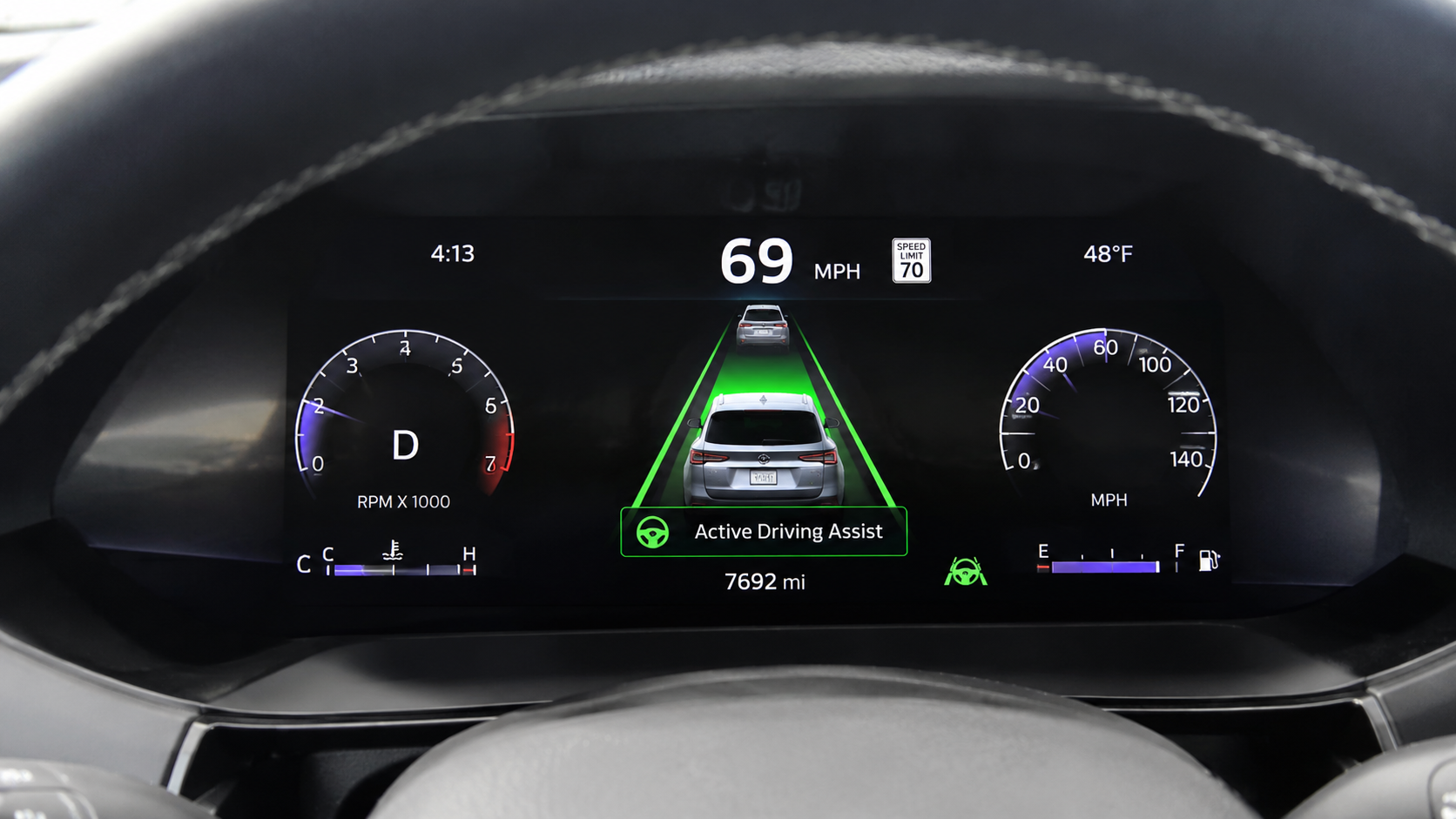
Jeep Active Driving Assist in the Cherokee is a Level 2 driver-assist system that combines Adaptive Cruise Control with Stop and Go and Active Lane Management. Using radar sensors and forward-facing cameras, it automatically regulates vehicle speed, maintains safe following distances, and applies subtle steering adjustments to keep the crossover centered in its lane on marked roads at speeds up to 90 mph while the driver actively monitors the road.
The underlying technology relies on integrated software processing that continuously evaluates road conditions and surrounding traffic. When engaged on open highways or during daily commutes along route corridors from Onsted toward nearby regional hubs, the system reduces driver fatigue by handling routine acceleration, braking, and lane-centering micro-corrections. Adaptive Cruise Control with Stop and Go can bring the crossover to a complete stop when trailing congested traffic, resuming momentum automatically once the path ahead clears.
Standard Active Driving Assist operates as a hands-on system. Built-in capacitive sensors inside the steering wheel rim monitor driver contact. If the system detects that steering torque or physical touch has ceased, visual and audible alerts prompt the driver to resume active steering input immediately. Drivers interested in experiencing this technology firsthand can visit our Clinton showroom, give our team a quick call, or explore new Grand Cherokee Summit Reserve models equipped with top-tier convenience packages.
Table of Contents
- What Is the Difference Between Hands-On and Hands-Free Active Driving Assist?
- What Sensors and Hardware Power Active Driving Assist in the Cherokee?
- How Does Active Driving Assist Respond to Tight Curves and Severe Weather?
- How Does Jeep Active Driving Assist Compare to Ford BlueCruise and GM Super Cruise?
- Common Questions About Jeep Active Driving Assist in the Cherokee
- Test Drive a Jeep Cherokee at NewGen Chrysler Dodge Jeep Ram
What Is the Difference Between Hands-On and Hands-Free Active Driving Assist?
The primary difference between base Active Driving Assist and Hands-Free Active Driving Assist is the level of physical steering wheel contact required while driving on approved roadways. Standard Active Driving Assist mandates continuous hands-on contact with the steering wheel across all roadways, whereas Hands-Free Active Driving Assist enables true hands-off driving on over 125,000 miles of designated pre-mapped divided highways at speeds up to 85 mph.
Hands-Free Active Driving Assist incorporates an infrared driver-monitoring camera mounted on top of the steering column. This camera tracks driver eye movement, head orientation, and facial positioning to confirm attentiveness. Because the infrared sensor monitors attention directly, drivers may remove their hands from the steering wheel while traveling along mapped multi-lane corridors. If the camera detects eyes wandering or distraction lasting more than a few seconds, the vehicle initiates a multi-stage alert sequence:
- Visual cluster icons transition from green to yellow and red on the display screen.
- Haptic seat vibrations and audible warning chimes sound inside the cabin.
- The system prompts the driver to place hands back on the steering wheel immediately.
- If the driver remains unresponsive, the crossover executes a controlled controlled stop maneuver, activates hazard lights, applies the parking brake, and connects to emergency dispatch via the integrated SOS assistance system.
Selecting Hands-Free Active Driving Assist requires compatible trim levels and packages, along with an active Uconnect Connected Services subscription following an initial trial period to maintain updated HD GPS mapping data. Drivers evaluating earlier model years or exploring pre-owned crossover values can browse our pre-owned vehicle inventory to compare feature packages across different model generations.
What Sensors and Hardware Power Active Driving Assist in the Cherokee?
A sophisticated hardware network consisting of front-facing radar, optical camera vision, interior infrared tracking, and high-definition positioning hardware powers Active Driving Assist in the Cherokee. A long-range radar sensor mounted behind the front bumper measures relative speed and distance to preceding vehicles, while optical cameras positioned behind the windshield monitor lane markings, roadside infrastructure, and surrounding traffic.
An HD GPS module provides lane-level location accuracy within 6.6 feet, allowing the vehicle to confirm its exact highway lane placement on mapped routes. Inside the cabin, driver-vehicle interactions display across a 10.25-inch digital instrument cluster and a 12.3-inch Uconnect touchscreen display, presenting real-time vehicle positioning, lane boundaries, and active system notifications.
Maintaining sensor calibration and clean camera lenses is essential for system precision. For residents navigating rural gravel roads or damp conditions near the Michigan Center Reservoir, road dust and debris can occasionally coat front sensor housing. If driver-assist warning lights indicate sensor obstruction, vehicle owners can easily schedule certified Mopar service with factory-trained technicians to clear fault codes and restore proper system alignment.
2026 Jeep Cherokee Engine & Performance
Powertrain specs by trim
| Feature | 85th Anniversary Edition HEV 4X4 | Cherokee HEV 4X4 | Laredo HEV 4X4 | Limited Altitude HEV 4X4 | Limited HEV 4X4 | Overland HEV 4X4 |
|---|---|---|---|---|---|---|
| Engine | 1.6L | 1.6L | 1.6L | 1.6L | 1.6L | 1.6L |
| Horsepower | 207 hp | 207 hp | 207 hp | 207 hp | 207 hp | 207 hp |
| Torque | 230 lb-ft | 230 lb-ft | 230 lb-ft | 230 lb-ft | 230 lb-ft | 230 lb-ft |
| Transmission | CVT | CVT | CVT | CVT | CVT | CVT |
| Drivetrain | Four-wheel drive | Four-wheel drive | Four-wheel drive | Four-wheel drive | Four-wheel drive | Four-wheel drive |
How Does Active Driving Assist Respond to Tight Curves and Severe Weather?
Active Driving Assist utilizes driver-assist speed adjustments to evaluate roadway geometry and automatically adjust vehicle velocity when approaching tight highway curves. Upon detecting an upcoming curve via camera vision and navigation data, the system smoothly decelerates the crossover to a comfortable cornering speed, returning to the pre-set cruising speed once the road straightens out.
In addition to cornering management, the system includes lane-centering assistance, which detects large commercial vehicles in adjacent lanes and subtly adjusts the crossover's position within its lane to maintain a safer lateral distance. However, environmental conditions play a significant role in operational availability:
- Heavy Snow and Ice: Snow buildup or slush clinging to the front radar dome blocks radar signal transmission, forcing the system to disengage until cleared.
- Torrential Rain and Fog: Extreme rain or dense fog obscuring lane markings prevents optical windshield cameras from tracking lane edges accurately.
- Direct Sun Glare: Blinding sunrise or sunset glare hitting the camera lens directly can temporarily limit vision-based lane centering.
When severe weather impacts sensor visibility, a driver cluster notification prompts manual steering and speed control. Vehicle owners looking to transition into a newer crossover featuring winter-ready Four-wheel drive systems and advanced driver-assist tech can value your current vehicle trade-in online before visiting our dealership.
How Does Jeep Active Driving Assist Compare to Ford BlueCruise and GM Super Cruise?
Jeep Hands-Free Active Driving Assist holds a competitive position against rival domestic systems like Ford BlueCruise and GM Super Cruise by pairing HD GPS positioning precision with intuitive driver-monitoring controls. Like GM Super Cruise, the Jeep system uses high-definition GPS receivers capable of pinpointing lane position within 6.6 feet, offering more precise lane identification than standard GPS systems used in earlier iterations of Ford BlueCruise.
GM Super Cruise currently leads the segment in total mapped highway mileage with over 400,000 miles of approved roads, while Ford BlueCruise offers approximately 130,000 miles and Jeep Hands-Free Active Driving Assist covers over 125,000 miles of pre-mapped divided highways. All three systems feature automated lane changes initiated by tapping the turn signal stalk, where onboard radar checks blind spots before executing the merge.
For shoppers evaluating daily driving convenience, payment structures, and feature availability, our finance specialists can help structure custom purchasing plans when you submit an online credit application.
Common Questions About Jeep Active Driving Assist in the Cherokee
Q: Does Jeep Active Driving Assist require the driver to keep hands on the steering wheel?
Standard Active Driving Assist requires continuous steering wheel contact, verified by built-in capacitive sensors inside the steering wheel rim. The available Hands-Free Active Driving Assist system allows hands-off driving on approved pre-mapped highways, provided the infrared interior camera detects that the driver's eyes remain focused on the road ahead. Browse our new Jeep SUV inventory to explore available driver-assist configurations.
Q: Is there an ongoing monthly subscription fee for Hands-Free Active Driving Assist?
Hands-Free Active Driving Assist includes an initial trial period upon new vehicle purchase. Following the trial period, maintaining hands-free functionality, high-definition map updates, and connected routing features requires an active Uconnect Connected Services subscription through the vehicle's cellular link.
Q: Can Hands-Free Active Driving Assist automatically perform lane changes?
Hands-Free Active Driving Assist includes Assisted Lane Change capability. When driving on an approved highway with the system active, tapping the turn signal stalk triggers the feature. The crossover scans surrounding lanes and blind spots, then automatically executes the lane change when safe. Buyers comparing trim options can view our new Grand Cherokee Limited models to see feature packaging.
Q: How does the driver monitoring system ensure driver attention?
An infrared camera mounted on top of the steering column constantly monitors driver eye movement and head position. If the system detects that eyes have turned away from the road for more than a few seconds, it triggers progressive visual warnings, audible chimes, and seat vibrations to prompt immediate re-engagement.
Q: What additional safety features come with the Advanced Tech Group package?
Depending on the trim level, the Advanced Tech Group package pairs driver-assistance hardware with premium safety options. These may include select driver-assistance and parking features depending on trim and package availability. Vehicle owners needing replacement wiper blades or sensor maintenance components can order authentic Mopar parts directly through our department.
Test Drive a Jeep Cherokee at NewGen Chrysler Dodge Jeep Ram
First-time buyers test-driving a crossover with driver-assist technology often ask whether the system handles highway lane centering and speed adjustments automatically. Experiencing Active Driving Assist on local highway stretches provides complete clarity on how seamless Level 2 semi-autonomous technology operates in real-world traffic.
The Jeep Cherokee lineup pairs standard Four-wheel drive with a 1.6L EP Turbo hybrid powertrain producing 207 hp and 230 lb-ft of torque through a CVT. Delivering an EPA-estimated 39 city / 35 hwy MPG and a towing capacity of up to 3,500 lbs, the Cherokee combines fuel efficiency with practical capability. Trim configurations are available at different MSRP levels; please contact the dealership for the latest pricing and availability.
Our team at NewGen Chrysler Dodge Jeep Ram of Clinton is ready to walk you through every feature, demonstrate active safety systems, and help you find the ideal crossover for your lifestyle. You can get directions to our Clinton dealership, call our team directly at (517) 456-6555, or explore our new Jeep Cherokee showroom online to schedule your test drive today.
2026 Jeep Cherokee Pricing
Pricing by trim
| Feature | 85th Anniversary Edition HEV 4X4 | Cherokee HEV 4X4 | Laredo HEV 4X4 | Limited Altitude HEV 4X4 | Limited HEV 4X4 | Overland HEV 4X4 |
|---|---|---|---|---|---|---|
| Base MSRP | $40,905 | $35,000 | $38,000 | $40,595 | $40,000 | $43,000 |
| Destination charge | $1,995 | $1,995 | $1,995 | $1,995 | $1,995 | $1,995 |
© 2026 NewGen Chrysler Dodge Jeep Ram of Clinton. All rights reserved.