

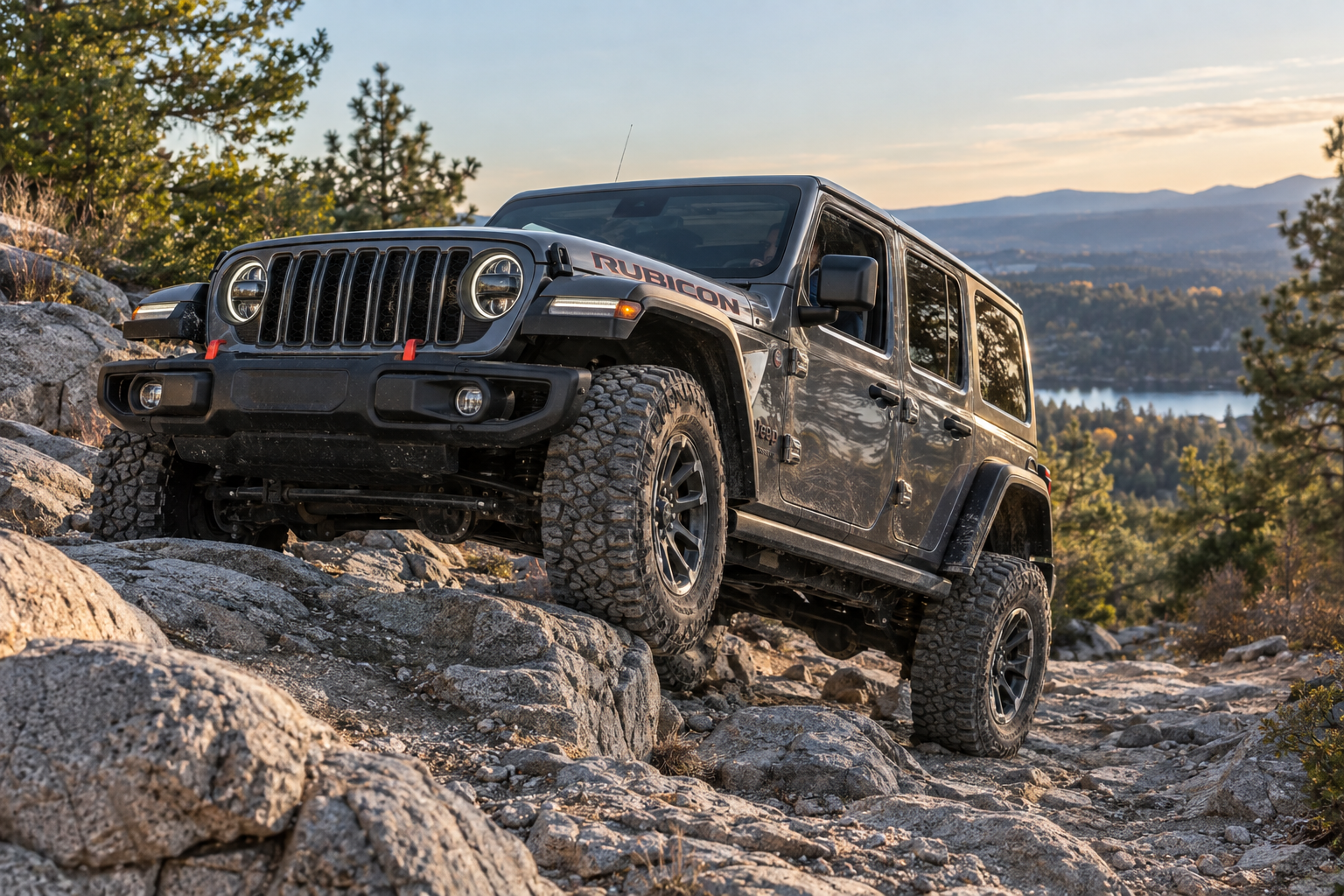
Master 2027 Jeep Wrangler Off-Road Features: Expert Q&A with Vincent Nowatzke
You should engage the rear axle locker first whenever facing steep climbs, loose mud, or deep sand to maintain steady traction without compromising steering control. Only engage the front axle locker when momentum stops completely on extreme rock crawls or severe washouts, using it strictly for short straight-line maneuvers because locking the front axle significantly restricts turning ability.
To dive deeper into trail mechanics, we sat down with Vincent Nowatzke, Sales Consultant at NewGen Chrysler Dodge Jeep Ram of Clinton. With 3 years of hands-on experience helping local drivers choose and equip their trail rigs, Vincent shares expert guidance on getting the most out of the latest 2027 Jeep Wrangler hardware.
Q: When should you engage front vs rear axle lockers in a 2027 Jeep Wrangler?
A: Lockers are all about controlling wheel spin before you get stuck, but knowing which switch to flip first makes all the difference on the trail. In a 2027 Jeep Wrangler equipped with electronic locking differentials, your baseline strategy should always start with the rear axle. When you are approaching an incline with loose gravel, wet clay, or uneven rock ledges, engaging the rear locker sends equal torque to both rear tires simultaneously. This pushes the vehicle forward through tricky spots while keeping your front wheels free to steer cleanly through line adjustments.
The front locker comes into play only when the rear locker alone is not enough to keep you moving forward. If you find yourself hung up on a massive boulder or a deep rut where a front tire loses contact with the ground, flipping on the front locker forces both front wheels to turn at identical speeds regardless of resistance. However, because both front wheels are bound together, turning the steering wheel becomes significantly harder, and the vehicle will resist changing direction. Once you clear that specific obstacle, disengaging the front locker immediately restores your turn radius and reduces mechanical stress on your steering linkage. If you ever want to check out these controls in person, you can stop by our showroom address at 1111 W Michigan Ave in Clinton or get quick trail tips by calling our sales team at (517) 456-6555.
Q: What is the function of Tru-Lok front and rear locking differentials?
A: Standard open differentials allow wheels on the same axle to rotate at different speeds, which is essential for smooth turns on dry pavement but a major liability in slippery off-road situations. If one tire loses traction on a patch of ice or lifted off a rock, a standard differential sends all the engine torque to that spinning wheel, leaving the tire with actual traction completely motionless.
The Tru-Lok electronic locking differential system solves that issue by mechanically locking the left and right axle shafts together at the push of a dash-mounted switch. When locked, equal torque is delivered to both tires on that axle, forcing them to spin together regardless of individual traction levels. Whether one tire is suspended in mid-air or sunk in thick mud, the opposite wheel continues to push the vehicle forward. Drivers exploring our pre-owned Jeep Wrangler selection often ask how to preserve these heavy-duty components over years of heavy trail use, and keeping up with fluid changes using genuine Mopar replacement parts ensures the locking solenoids and internal gears operate smoothly for the long haul.
Q: What off-road equipment comes standard across the 2027 Jeep Wrangler trim lineup?
A: Capability starts right at the foundation across the whole family, which includes Sport, Sport S, Willys, Sahara, Rubicon, Rubicon X, Willys 392, and Moab 392 trims. Every standard 2027 Wrangler comes equipped with proven Command-Trac part-time four-wheel drive, heavy-duty Dana solid front and rear axles, protective underbody skid plates for the transfer case and fuel tank, and frame-mounted steel tow hooks. Engine choices remain exceptionally versatile, ranging from the efficient 2.0L turbocharged inline-four pushing 270 hp and 295 lb-ft of torque to the classic 3.6L Pentastar V6 generating 285 hp and 260 lb-ft of torque.
"True trail capability is not just about raw horsepower; it comes down to how efficiently your transfer case and locking differentials apply that torque directly to the ground."
Stepping up through the trim ladder adds increasingly aggressive trail hardware. The Willys trim adds a standard electronic rear locker, 33-inch all-terrain tires, and protective rock rails. For extreme terrain, the Rubicon introduces the Rock-Trac 4x4 system, electronic front and rear lockers, and an electronic front sway-bar disconnect. Upgrading to the available Xtreme 35 Package brings factory 35-inch tires, beadlock-capable wheels, and a 1.5-inch suspension lift, delivering up to a 47-degree approach angle on four-door models and a 32-degree breakover angle on two-door variants. You can explore the full range of options in our new Jeep Wrangler model lineup, browse our certified pre-owned inventory, or even compare full-frame capability against compact crossover options like our new Jeep Compass Latitude 4x4 options.
Q: How does the Wrangler Rubicon crawl ratio compare to the Ford Bronco Badlands?
A: Crawl ratio measures a vehicle's mechanical advantage at low speeds by multiplying the transmission's first-gear ratio, the transfer case low-range ratio, and the axle differential ratio. A higher crawl ratio allows an off-roader to creep over massive boulders and steep drops at slow speeds using engine braking alone, giving the driver precise control without needing to ride the foot brake.
When you compare top-tier factory rock crawlers, the Jeep Wrangler Rubicon equipped with a six-speed manual transmission delivers a leading 100:1 crawl ratio thanks to its 4:1 low-range transfer case and low axle gearing. By comparison, a manual Ford Bronco Badlands achieves a 95:1 crawl ratio. Even when equipped with an eight-speed automatic transmission, the Rubicon maintains a strong 77:1 crawl ratio that offers exceptional low-speed crawl control. Proper gear maintenance is critical after hard crawling sessions, and scheduling a service appointment online with certified technicians keeps differential fluids fresh and transfer cases fully aligned.
Q: How do you safely drive a 2027 Jeep Wrangler through deep water around Onsted trails?
A: Water crossing requires patience, technique, and proper vehicle preparation to protect low-hanging breathers and intake systems. The 2027 Wrangler is engineered for water fording in up to 34 inches of water, featuring sealed electrical connections and high-mounted air intakes. When approaching water trails near Onsted, start by stopping before entering to verify depth and check the bottom surface for hidden submerged logs or sudden drop-offs.
Enter the water smoothly at under 5 mph to create a gentle, steady bow wave ahead of your front bumper. Maintaining momentum is crucial because stopping mid-stream allows water to push up against the exhaust and underbody components. Avoid rushing through fast enough to spray water over the hood, which risks engine ingestion. Once you exit onto dry land, tap your brakes lightly several times to dry out the pads and rotors before accelerating back to trail speeds. Drivers looking to upgrade from an older SUV can evaluate their current vehicle's trade value using our online vehicle trade-in valuation tool before shopping for an off-road model, or cross-shop everyday commuter vehicles like the new Jeep Compass Limited 4x4 alongside our dedicated Jeep 4xe plug-in hybrid lineup.
Q: What range and performance specs should buyers expect from the 2027 Jeep Wrangler 4xe?
A: The Wrangler 4xe combines a 2.0L turbocharged engine with an electric motor integrated into the transmission to output a robust 375 hp and 470 lb-ft of instant electric torque. Drivers can expect up to 21 miles of all-electric driving range on a full charge, making quiet, zero-emission trail riding or short daily commutes entirely feasible. Combined with the gas engine, total driving range reaches approximately 370 miles, allowing for long-distance trail trips without range anxiety.
Local weather patterns also play a role in real-world battery performance for drivers in Michigan Center. During cold sub-freezing winter months, EV battery chemistry typically experiences a temporary range reduction between 15% and 30%. Preconditioning the battery while plugged into a home charger helps minimize this cold-weather range dip and ensures max cabin warmth before hitting the road. If you are ready to experience electrified trail power, consider submitting an online credit application to prequalify before visiting our Clinton dealership location or calling (517) 456-6555 to set up a personalized test drive.
© 2026 NewGen Chrysler Dodge Jeep Ram of Clinton. All rights reserved.